Blog
EV Charger Cooling Fan Selection Guide: Thermal Design for Level 2 and DC Fast Chargers

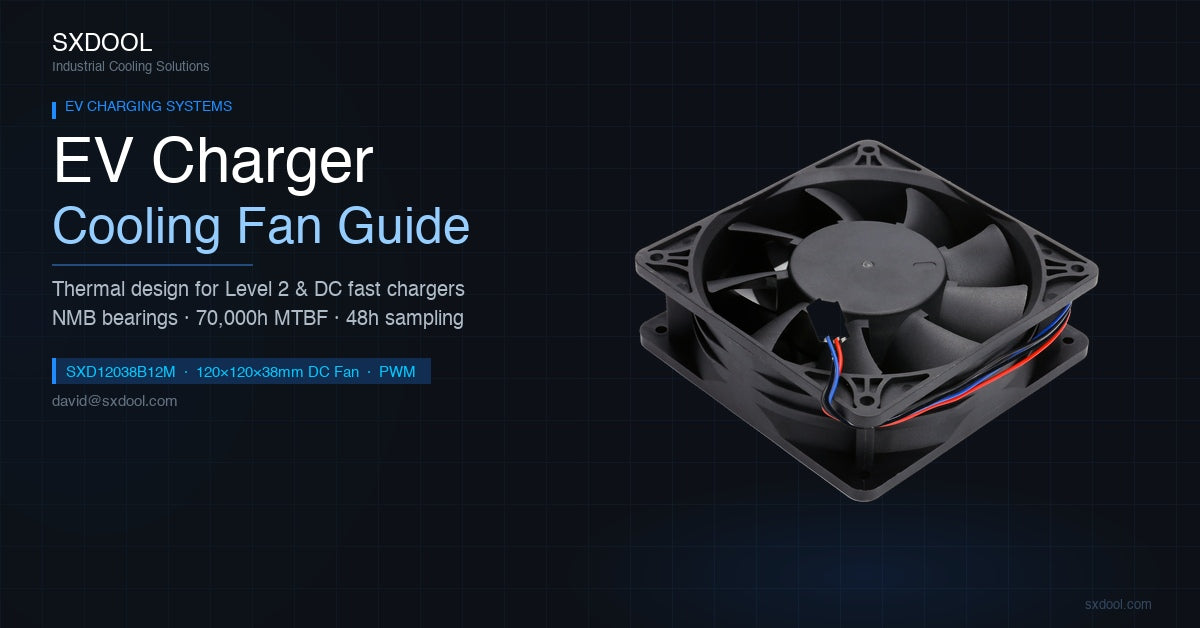
As EV charging infrastructure scales globally—with projections exceeding 40 million public charge points by 2030—the thermal management of EVSE hardware has become a first-order engineering problem. A Level 2 charger dissipating 3–7 kW of heat, or a DC fast charger (DCFC) pushing 50–350 kW of power through its power electronics, demands a cooling fan that can survive years of outdoor operation without a service visit.
This guide walks through the key selection criteria for EV charger cooling fans, covering thermal load calculations, IP rating requirements, bearing selection, and real-world performance tradeoffs.
—
1. Understanding the Thermal Load
Before selecting a fan, engineers must calculate the heat dissipated by the charger’s internal components:
- Power factor correction (PFC) stage: 1–3% of total power as heat
- DC/DC conversion stage: 2–5% losses at full load
- IGBTs and switching devices: Primary heat sources, often requiring dedicated heatsinks
- Control electronics and communication modules: Typically 20–50 W
For a 150 kW DCFC with a combined efficiency of 95%, the heat rejection requirement is approximately 7.5 kW. With typical heatsink-to-air thermal resistance, this translates to an airflow requirement of 8–15 m³/min depending on ambient temperature.
Key equation:
Q = P_input × (1 - η)
ΔT = Q / (ṁ × Cp)
Where ṁ is mass flow rate (kg/s) and Cp is specific heat of air (1,006 J/kg·K).
—
2. Why IP68 Is the Correct Rating for Outdoor EVSE
Outdoor charging stations face conditions that standard industrial fans are not designed for:
| Threat | Specification Requirement |
| Rain splash / power washing | IP65 minimum; IP68 recommended |
| Condensation cycles (indoor→outdoor) | Vacuum-sealed motor housing |
| Salt spray (coastal installations) | IP68 + corrosion-resistant coating |
| Dust accumulation in filter units | IP6X particulate protection |
| Humidity > 95% RH | Sealed winding insulation |
IP65 is insufficient for DCFC applications. Power washing during maintenance routinely directs pressurized water at enclosure vents. A fan rated only to IP65 (water jets at 12.5 L/min) can experience winding failures within 12 months in coastal or high-humidity regions.
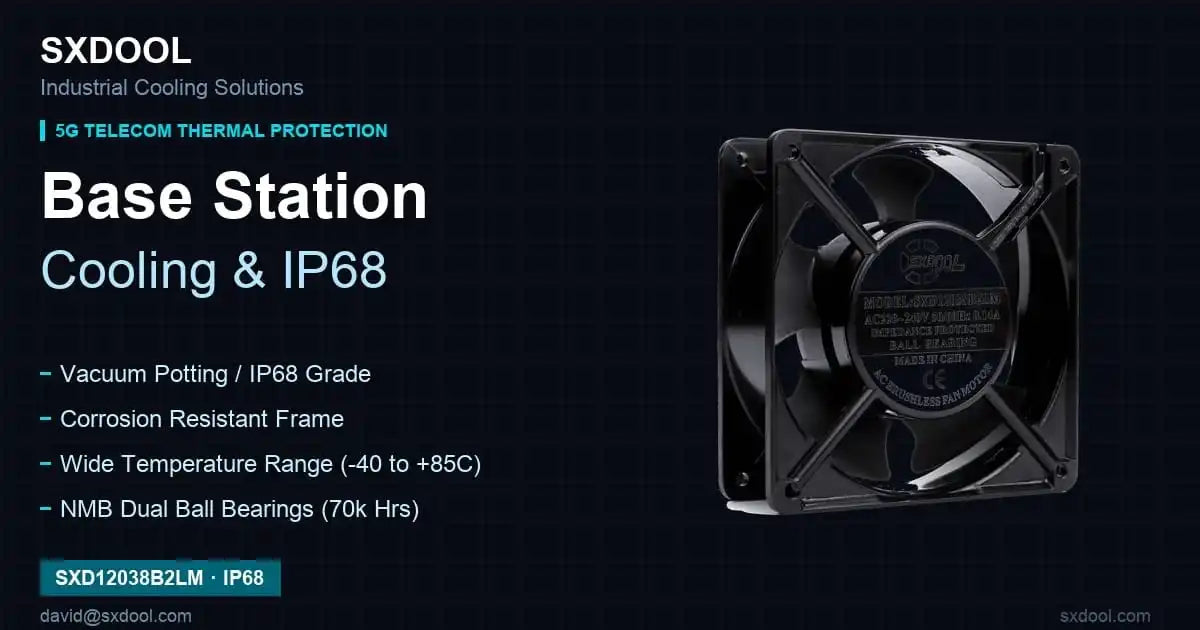
SXDOOL’s vacuum potting process creates a genuinely hermetic barrier around the motor windings. Unlike conformal coating, which degrades under thermal cycling, the potted motor maintains IP68 integrity (1 m submersion for 30 minutes per IEC 60529) through the fan’s entire 70,000-hour service life.
—
3. Bearing Selection: Ball vs. Sleeve vs. Fluid Dynamic
Bearing type is the single largest determinant of fan lifespan in high-temperature, continuous-duty applications:
| Bearing Type | L10 Life at 40°C | Max Operating Temp | Orientation |
| Sleeve bearing | 20,000–30,000 h | 60°C | Horizontal only |
| Single ball bearing | 40,000–50,000 h | 70°C | Any |
| Dual ball bearing (NMB) | 70,000 h | 85°C | Any |
| Fluid dynamic bearing | 50,000–60,000 h | 70°C | Primarily horizontal |
For EVSE applications, dual ball bearings are the engineering standard. SXDOOL specifies genuine Japanese NMB bearings (not generic Chinese production), which undergo 100% factory QC including noise and vibration screening. The difference in consistency is measurable: NMB bearings exhibit ±3% variance in L10 life versus ±15–25% for unbranded alternatives.
—
4. Voltage and Power Supply Considerations
EV chargers are increasingly deployed across multiple markets with different grid standards. A fan specified for a 120 kW charger in North America (120 V / 60 Hz) may fail when the same hardware platform is shipped to Europe (230 V / 50 Hz).
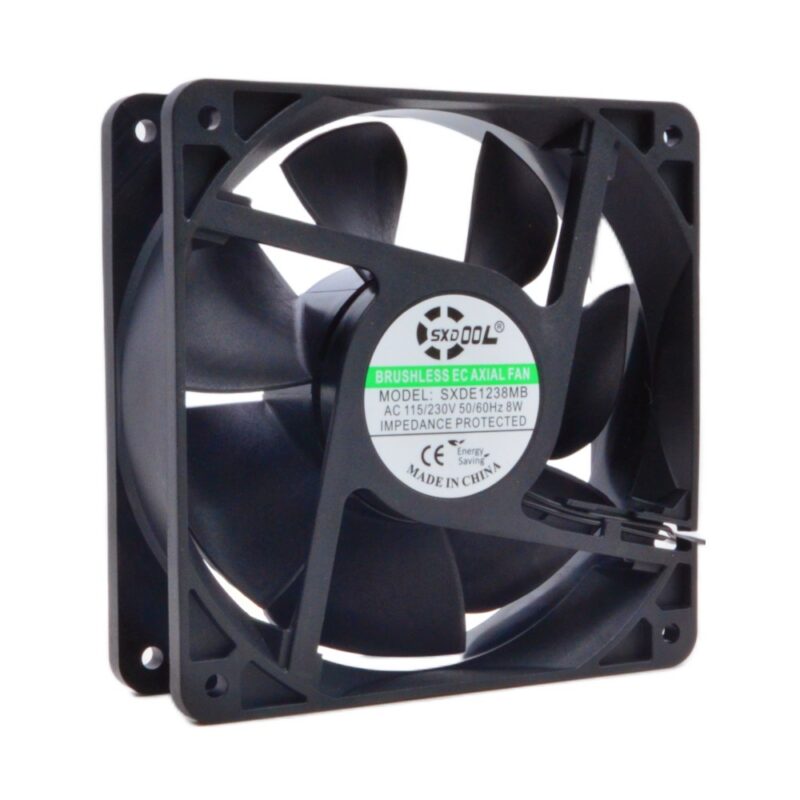
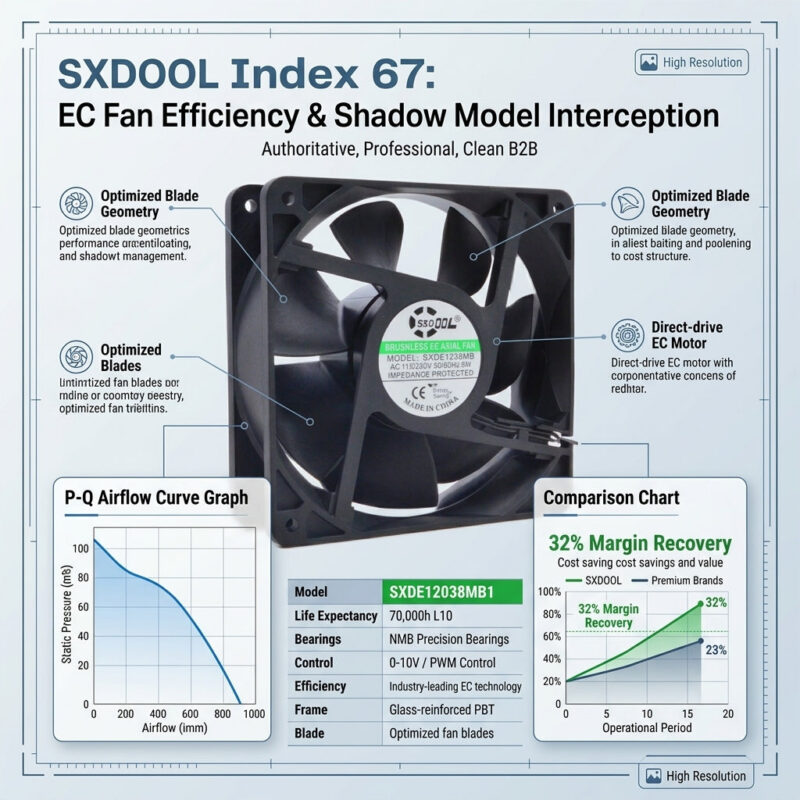
SXDOOL’s EC fan solution eliminates this problem. Our SXDE1238MB operates across a continuous input range of 100–264 VAC / 47–63 Hz—a single SKU that covers every grid standard worldwide. This has direct implications for EVSE OEM procurement:
- Reduced SKU count: One part number replaces two (115 V and 230 V variants)
- Simplified spares logistics: Single inventory pool for global service fleets
- Reduced qualification cost: One fan validation covers all market entries
—
5. Fan Curve Matching: Static Pressure vs. Airflow
The most common error in EVSE cooling design is selecting a fan based on free-air flow rate (CFM at zero static pressure) rather than operating point.
An EV charger with inlet filters, heatsink fin arrays, and internal baffling creates a system impedance curve. The fan’s operating point is where its P-Q curve intersects the system curve—typically at 30–60% of free-air flow.
Practical example:
A 120 kW charger requires 10 m³/min at 8 Pa system resistance. A fan with 14 m³/min free-air flow and a flat P-Q curve will deliver only 9 m³/min at 8 Pa—insufficient. A fan with 13 m³/min free-air flow and a steep P-Q curve may deliver 11 m³/min at the same system pressure.
SXDOOL provides P-Q curve data for all standard models. Contact our engineering team for matched fan selection based on your system impedance measurements.
—
6. Acoustic Requirements in Residential and Commercial Zones
Many Level 2 chargers are installed in residential settings or underground parking garages where acoustic limits apply (typically 40–55 dB(A) at 1 m). DCFC stations in commercial zones typically allow 60–70 dB(A).
EC motor fans with PWM control enable dynamic speed reduction during low-load periods (overnight, low ambient temperature), reducing acoustic output significantly while maintaining thermal headroom. At 70% speed, a fan’s acoustic output drops by approximately 9 dB(A)—a 3x reduction in perceived loudness.
—
Recommended Models for EV Charging Applications
| Application | SXDOOL Model | Airflow | Static Pressure | Voltage | IP Rating |
| Level 2 charger (7–22 kW) | SXDE1238MB | 285 CFM | 0.62 inH₂O | 100–264VAC | IP68 |
| DC fast charger (50–150 kW) | SXDE28080BTM | 850 CFM | 1.2 inH₂O | 100–264VAC | IP68 |
| DCFC redundant cooling | 2× SXDE1238MB | 520 CFM | 0.55 inH₂O | 100–264VAC | IP68 |
—
Conclusion
Selecting a cooling fan for an EV charger is not a commodity procurement decision. The combination of outdoor IP requirements, dual-voltage grid compatibility, continuous-duty bearing life, and acoustic constraints demands a purpose-engineered solution.
SXDOOL’s 48-hour engineering sample fast-track allows EV charger OEMs to receive and validate a physical sample before committing to production quantities. Our engineering team can provide P-Q curves, MTBF calculations, and form-fit candidate subject to mechanical and electrical validation specifications for your existing fan assembly.
Contact SXDOOL’s engineering team at david@sxdool.com for EV charger fan samples and bulk OEM pricing.
Visit www.sxdool.com | WhatsApp: +86 134 3209 3474