Blog
Anti-Fouling Solutions for Cooling Fans in Humid Marine Environments

Anti-Fouling Solutions for Cooling Fans in Humid Marine Environments
Introduction: The Hidden Threat in Marine Thermal Management
In the marine sector, the reliability of electronic components is not just a matter of performance—it is a matter of safety and operational continuity. Whether it is navigation systems, radar arrays, or engine room control panels, thermal management is a critical pillar of infrastructure. However, the very air that provides cooling is also the primary vector for system failure.
For industrial B2B buyers and engineers, the challenge of “Marine cooling” goes beyond simple heat dissipation. It involves battling a relentless cocktail of high humidity, salt spray, and biological agents. Traditional cooling fans, designed for dry terrestrial environments, fail rapidly at sea due to short circuits and mechanical seize-ups. This article explores the cutting-edge “Anti-fouling” and protective technologies that define SXDOOL’s IP68-rated marine fans, ensuring longevity in the most unforgiving environments on Earth.
The Biological Frontier: Combating Algae and Fungi Fouling
While salt-induced corrosion is well-documented, biological fouling (biofouling) is a frequently overlooked cause of cooling fan failure in humid marine climates. In tropical and subtropical maritime zones, the relative humidity often exceeds 90%, creating a perfect petri dish for algae, fungi, and bacterial biofilms.
The Mechanism of Biofouling in Fans
As fans pull in air to cool internal components, they also draw in microscopic spores. These spores settle on the fan blades and the stator assembly. In the presence of moisture and salt deposits, they proliferate. Biological growth on fan blades leads to:
1. Mass Imbalance: Even a few milligrams of fungal growth can disrupt the dynamic balance of a high-speed fan, causing vibration and premature bearing wear.
2. Increased Aerodynamic Drag: Biofilms increase the surface roughness of the blades, significantly reducing CFM (Cubic Feet per Minute) and increasing power consumption.
3. Chemical Degradation: Certain fungi excrete organic acids that can etch plastic housings and accelerate the corrosion of metal parts.
To counter this, SXDOOL implements specialized anti-microbial additives within the blade polymers and utilizes smooth-surface finishes that inhibit spore adhesion.
Vacuum Encapsulation: The IP68 Standard for Total Protection
For a fan to survive in a marine environment, the electrical components—specifically the motor’s PCB and stator windings—must be completely isolated from the atmosphere. This is where the distinction between “water-resistant” and “IP68-rated” becomes critical.
The Vacuum Encapsulation Process
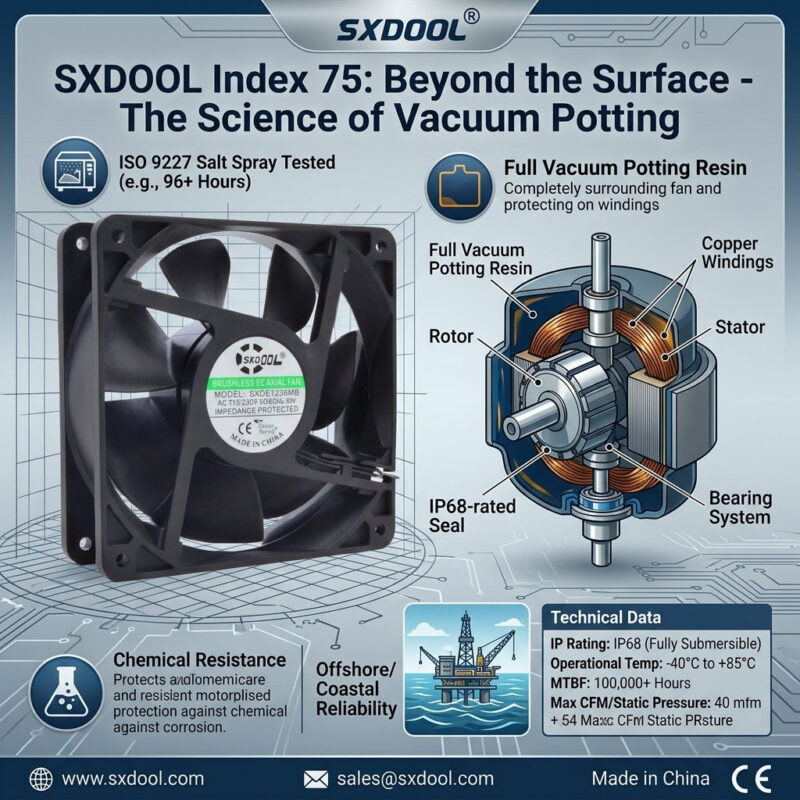
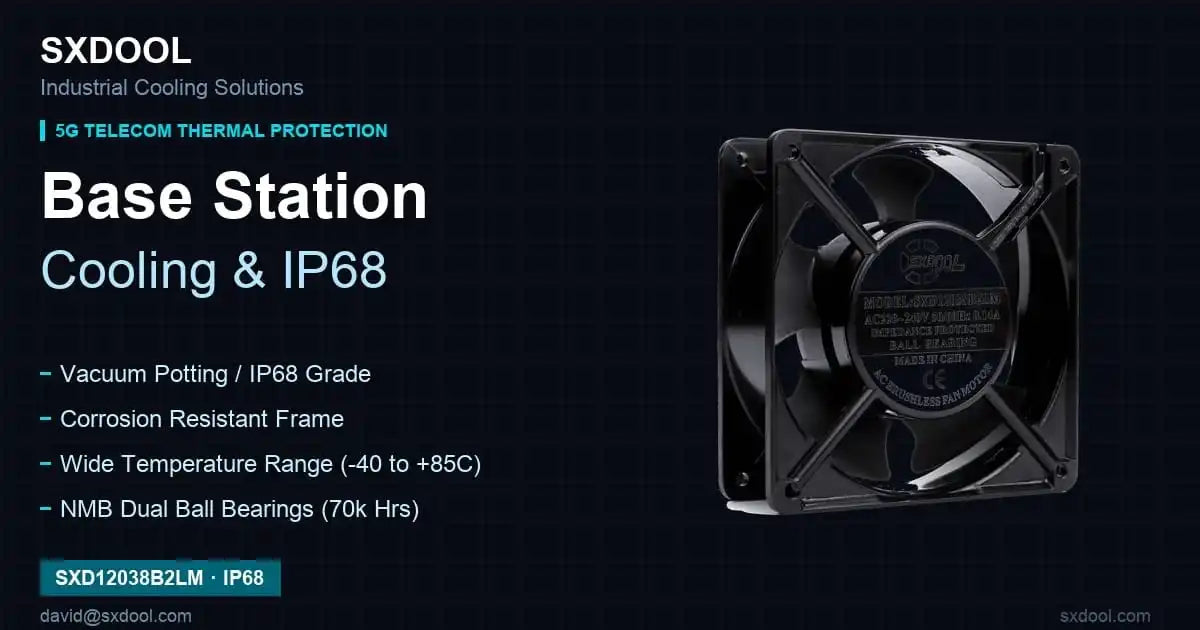
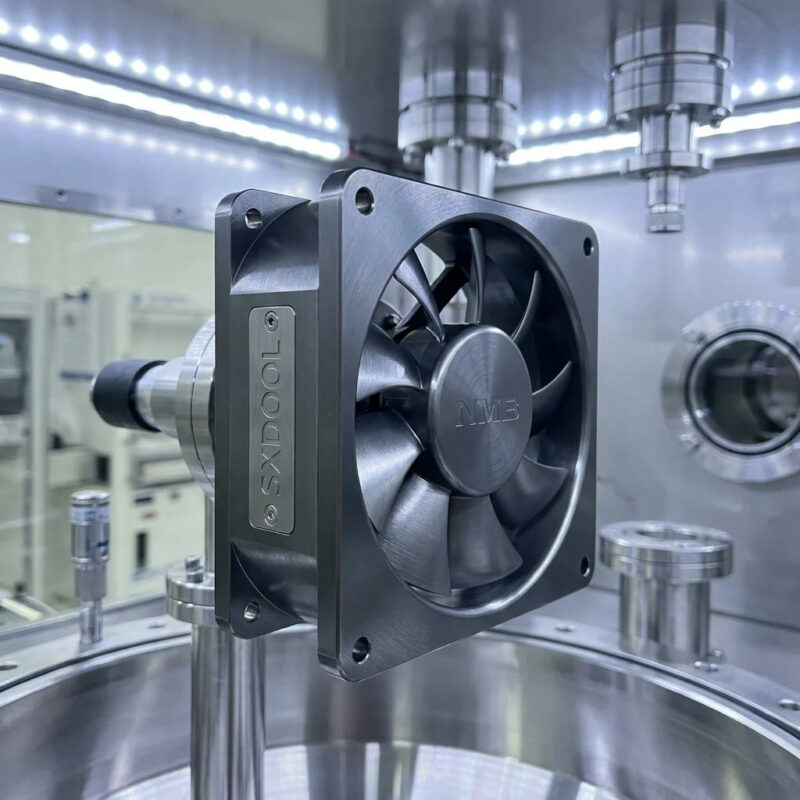
SXDOOL’s IP68 fans utilize a sophisticated vacuum encapsulation (also known as potting) technique. Unlike standard coatings that are sprayed on, vacuum encapsulation involves placing the entire motor assembly into a mold and injecting a specialized epoxy resin or silicone compound under a vacuum.
Why Vacuum Matters:
* Elimination of Voids: Under atmospheric pressure, bubbles can form in the potting compound. In a marine environment, these voids can trap moisture through “breathing” (expansion/contraction due to thermal cycles), leading to internal arcing. Vacuum processing ensures a 100% solid, void-free block.
* Thermal Conductivity: While providing electrical insulation, the potting compound must also be thermally conductive to dissipate heat from the motor windings to the external casing.
* Chemical Resistance: The encapsulation material is engineered to be resistant to salt spray, fuel vapors, and hydraulic oils commonly found in engine rooms.
An “IP68 fan” treated with vacuum encapsulation can operate even when fully submerged, providing the highest level of assurance for offshore and shipboard applications.
The Science of Repellency: Hydrophobic Nanocoatings
While the motor is protected by encapsulation, the external surfaces benefit from hydrophobic nanocoatings. These coatings work on the principle of the “Lotus Effect,” where water droplets maintain a spherical shape and roll off effortlessly.
Advancements in Nanotechnology
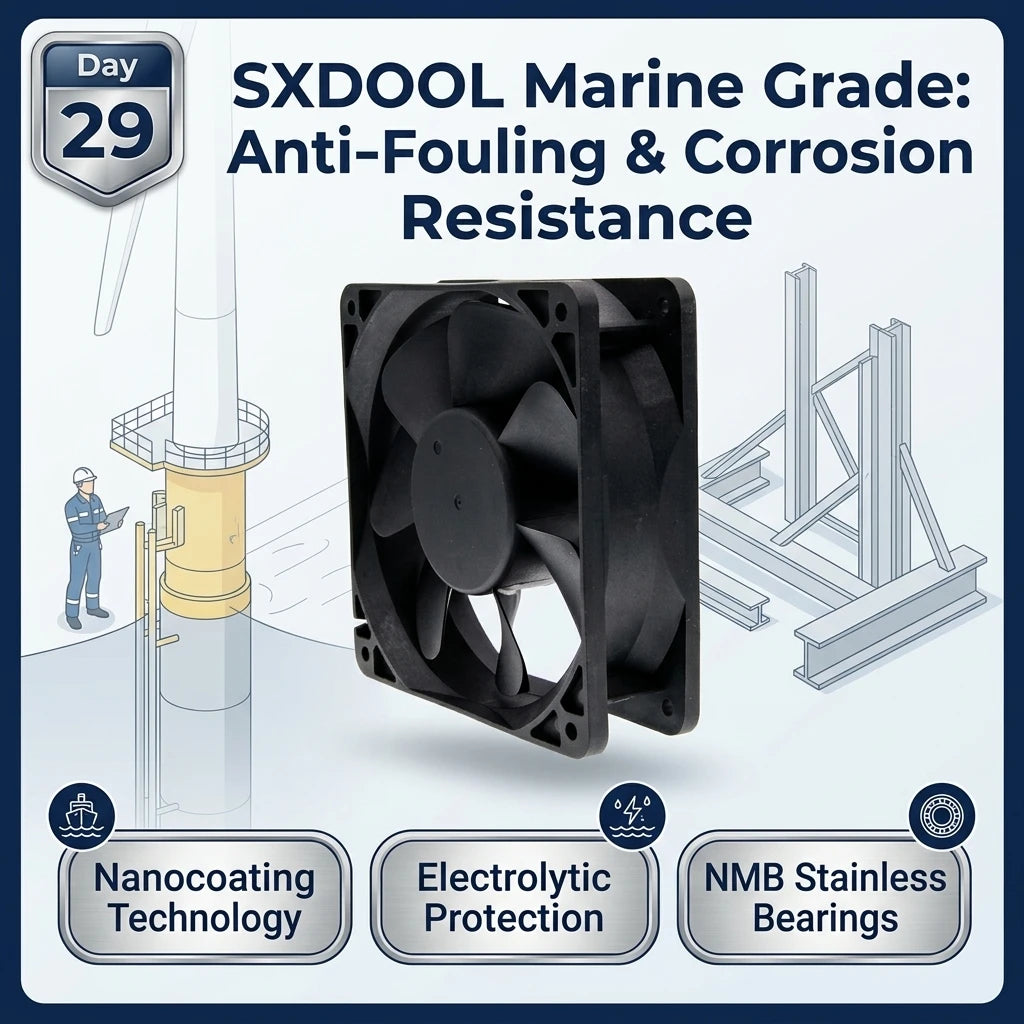
Modern hydrophobic coatings are applied at the molecular level, creating a durable barrier. The effectiveness is measured by the “Contact Angle.” A standard plastic fan blade might have a water contact angle of 70-80 degrees, while a SXDOOL nanocoated blade exceeds 150 degrees, entering the realm of super-hydrophobicity.
* Salt Repellency: By preventing wetting, nanocoatings prevent salt crusts. As moisture rolls off, it carries salt particles with it—a self-cleaning process.
* UV Stability: Marine environments expose fans to intense UV radiation. SXDOOL uses UV-stabilized nanocoatings to prevent the polymer blades from becoming brittle, ensuring structural integrity over years of exposure.
Standardizing Reliability: Salt Spray and Environmental Testing
To support marine cooling performance targets after application validation our B2B clients expect, SXDOOL employs a battery of standardized tests that simulate a lifetime of abuse in weeks.
ASTM B117: The Salt Spray Benchmark
The most critical test for any marine component is the Salt Spray Test. Our fans are placed in a controlled chamber where they are subjected to a continuous fog of 5% sodium chloride solution at a temperature of 35°C (95°F).
* Duration: While standard fans might be tested for 48 or 96 hours, SXDOOL’s marine-grade fans are often tested for 500, 700, or even 1,000 hours of continuous exposure.
* Success Criteria: A “pass” is not just a fan that still spins. We inspect for zero corrosion on internal components, no degradation of the vacuum encapsulation, and no “creeping” of salt under the nanocoating.
Thermal Cycling and Humidity
Marine fans must also survive “Thermal Shock.” We test our fans by rapidly cycling them between -40°C and +85°C. This tests the coefficient of thermal expansion (CTE) mismatch between the vacuum encapsulation resin and the metal motor parts. If the materials are not perfectly matched, cracks can form, allowing moisture ingress. SXDOOL’s proprietary resin formulations are engineered to expand and contract in harmony with the motor assembly.
Case Study: Thermal Management in Offshore Radar Arrays
Modern naval and commercial vessels rely on S-band and X-band radar arrays for navigation and threat detection. These systems generate massive amounts of heat within a confined, exposed housing.
In one application, a commercial shipping fleet was experiencing 15% annual failure rates in their radar cooling systems due to fungal growth on the fan blades and salt-induced motor shorts. By switching to SXDOOL’s IP68-rated fans with vacuum encapsulation and NMB stainless steel bearings, the failure rate dropped to near zero over a 24-month period. The anti-fouling properties of the nanocoated blades prevented the mass imbalance that was previously causing bearing failure, while the IP68 protection ensured that even in heavy storms, the electronics remained dry.
Frequently Asked Questions (FAQ) for Marine Engineers
1. Can IP68 fans be used in salt water permanently?
Yes, SXDOOL’s vacuum-encapsulated fans are designed for permanent exposure to salt spray and can even handle temporary immersion. However, for permanent submersion, we recommend our specialized underwater motor series.
2. What is the difference between IP67 and IP68 for cooling fans?
IP67 allows for immersion up to 1 meter for 30 minutes. IP68 is a manufacturer-defined standard that exceeds IP67, often allowing for continuous operation under deeper or more high-pressure conditions. For marine use, IP68 is the minimum requirement for mission-critical cooling.
3. Are NMB stainless steel bearings noisy?
On the contrary, the high precision of NMB bearings combined with the use of marine-grade synthetic lubricants ensures that these fans operate as quietly as standard ball-bearing fans while offering significantly higher corrosion resistance.
Mechanical Reliability: NMB Stainless Steel Bearings
The bearing is the heart of any cooling fan. In a marine environment, standard chrome steel bearings are the first point of failure. Salt air penetrates the seals, causes pitting on the raceways, and eventually leads to a seized motor.
The NMB Advantage
SXDOOL partners with industry leaders like NMB to integrate high-grade stainless steel bearings into our marine-line products.
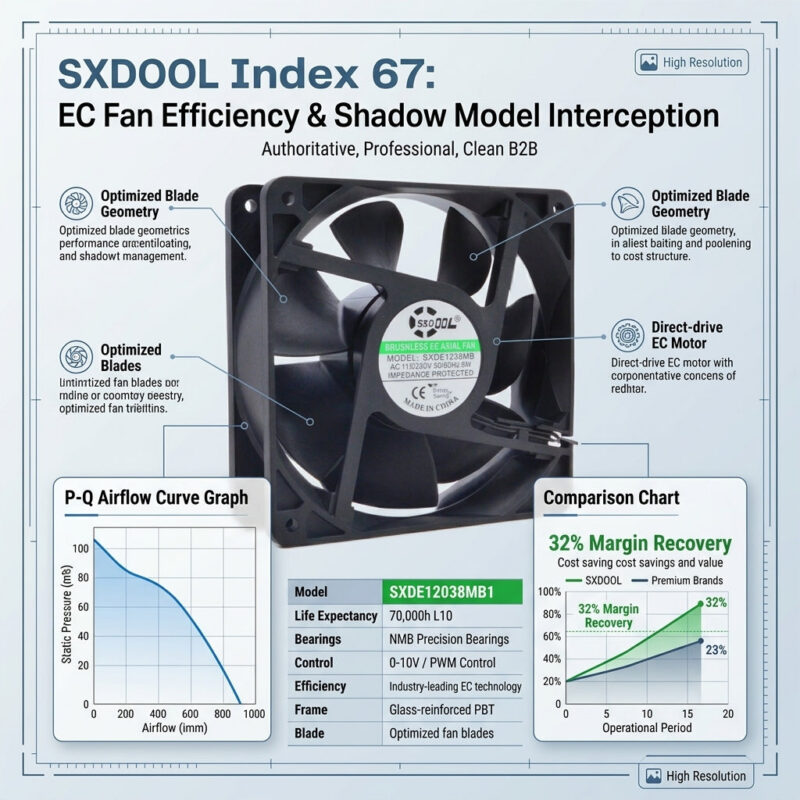
* AISI 440C Stainless Steel: This material provides a superior balance of hardness (for long life) and corrosion resistance.
* Advanced Sealing Technology: These bearings feature specialized rubber seals (DD format) or metal shields with labyrinth paths to prevent the ingress of fine salt crystals.
* Marine-Grade Lubricants: The grease used within NMB stainless steel bearings is formulated to maintain its viscosity and lubricity even when subjected to high humidity and temperature fluctuations.
The SXDOOL Approach to System-Wide Reliability
At SXDOOL, we understand that “Marine cooling” is a system-wide challenge. Our engineering philosophy for marine fans rests on three pillars:
1. Material Synergy: We don’t just use one protection method. We combine vacuum encapsulation for the electronics, stainless steel for the mechanics, and nanocoatings for the surfaces.
2. Rigorous Testing: Every SXDOOL marine fan undergoes accelerated life testing, including Salt Spray Testing (per ASTM B117) and Humidity Cycling, to ensure they meet the 50,000 to 70,000-hour L10 life expectancy our B2B clients demand.
3. Customization: We recognize that a fan on a coastal wind turbine faces different stresses than one in a deep-sea submersible. We offer customized lead wire lengths, connector types, and PWM control options to integrate seamlessly into existing marine systems.
Conclusion
The transition to offshore energy, autonomous shipping, and advanced naval electronics requires a new generation of thermal management. “Anti-fouling” is no longer just for hulls; it is a vital requirement for the fans that keep our digital infrastructure cool.
By investing in SXDOOL’s IP68-rated fans—equipped with vacuum encapsulation, hydrophobic nanocoatings, and NMB stainless steel bearings—marine operators can reduce maintenance overhead, prevent catastrophic failures, and ensure their systems perform reliably in the world’s most challenging conditions.
—
Keywords: Marine cooling, IP68 fan, Anti-fouling, SXDOOL, NMB stainless steel bearings, Vacuum encapsulation, Hydrophobic nanocoatings, Biofouling.