Blog
Selecting Fire-Resistant Fans for Grid-Scale Energy Storage Enclosures


As grid-scale Battery Energy Storage Systems (BESS) continue to expand in capacity and deployment density, the thermal management of these installations has evolved from a routine mechanical consideration into a critical safety discipline. Within the sealed or semi-sealed enclosures that house lithium-ion battery racks, airflow must be precisely engineered to dissipate heat without becoming a vector for fire propagation. This technical audit examines the engineering rationale behind selecting fire-resistant cooling fans for BESS enclosures, with specific focus on UL94V-0 rated materials, thermal propagation dynamics, and the manufacturing quality controls that ensure component reliability under fault conditions.
The fundamental challenge in BESS thermal design is paradoxical: cooling fans must move substantial volumes of air across high-density battery modules, yet their physical structure cannot contribute fuel to a potential fire event. A standard ABS or polycarbonate fan housing, when exposed to temperatures exceeding 350°C, will soften, deform, and eventually ignite. In a thermal runaway scenario where a single cell failure can cascade through an entire rack, a conventional plastic fan becomes not a safety device but an accelerant. This is precisely why the industry is shifting toward Polybutylene Terephthalate (PBT) formulations that achieve UL94V-0 flame retardancy ratings.
Understanding UL94V-0: The Material Distinction That Matters
The UL94 standard, maintained by Underwriters Laboratories, is the globally recognized benchmark for flammability classification of plastic materials. The V-0 rating represents the most stringent vertical burn test classification, requiring that a vertically mounted specimen self-extinguishes within 10 seconds after flame application, with no flaming drips that could ignite underlying materials. For BESS applications, this classification is particularly meaningful because the vertical orientation of a fan mounted in a rack or enclosure door mirrors the test configuration.
UL94V-0 PBT achieves this performance through a combination of intrinsic polymer properties and flame-retardant additives. Unlike halogenated flame retardants that can release corrosive and toxic gases during decomposition, modern phosphorus-based and nitrogen-based synergistic systems provide the required V-0 performance while maintaining compliance with RoHS and the evolving regulatory landscape around halogen content in electronic components. The glass-fiber reinforcement commonly incorporated into PBT compounds (typically 15-30% GF) further enhances dimensional stability at elevated temperatures, which is critical for maintaining blade-to-housing clearances as ambient temperatures rise within a BESS enclosure.
The comparative data is stark. Unrated ABS maintains structural integrity to approximately 85°C and ignites readily, self-propagating flame. V-2 rated materials self-extinguish but allow flaming drips. V-1 rated materials self-extinguish within 30 seconds. Only V-0 rated materials combine rapid self-extinguishing with zero flaming drip characteristics. In the confined geometry of a battery rack where melted, burning material would fall directly onto cells below, the absence of flaming drips is not a luxury—it is a necessity.
Heat Spread Dynamics in Battery Racks: Why Fan Placement and Material Selection Are Interlinked
A modern BESS enclosure typically arranges battery modules in vertical stacks with narrow air gaps—often 20-40mm—between adjacent modules. Cooling fans are positioned to draw ambient air through these gaps, removing heat generated during charge-discharge cycles. Under normal operating conditions, this airflow design works effectively, maintaining cell temperatures within the manufacturer’s specified range of 15-35°C for optimal cycle life.
However, when a cell experiences internal short circuit, overcharge, or mechanical damage, temperatures can spike to 200-400°C within seconds. The localized heat release creates a thermal plume that the cooling fan continues to move through the enclosure. At this critical moment, the fan transitions from a cooling device to a potential fire vector. If the fan housing softens, the impeller can seize against the frame, stopping airflow entirely and allowing heat to concentrate. If the material ignites, the fan becomes a secondary ignition source, spreading flame to adjacent modules through both direct contact and radiated heat.
The failure mode analysis reveals three distinct risk pathways that fire-resistant fan materials must address. First, structural collapse: when housing deformation exceeds approximately 2% of the original geometry, blade-to-frame interference occurs, resulting in motor stall and airflow termination. UL94V-0 PBT with glass fiber reinforcement maintains dimensional accuracy to approximately 200°C, providing a critical operational window during early-stage thermal events. Second, ignition propagation: V-0 rated materials self-extinguish, meaning that even if the fan housing is exposed to external flame from a battery cell fire, it will not sustain combustion independently. Third, dripping hazard: the zero-drip characteristic of V-0 PBT prevents molten polymer from falling onto undamaged cells and creating additional failure points.
The 12038 Form Factor: Optimized Airflow Geometry for Rack-Mount BESS
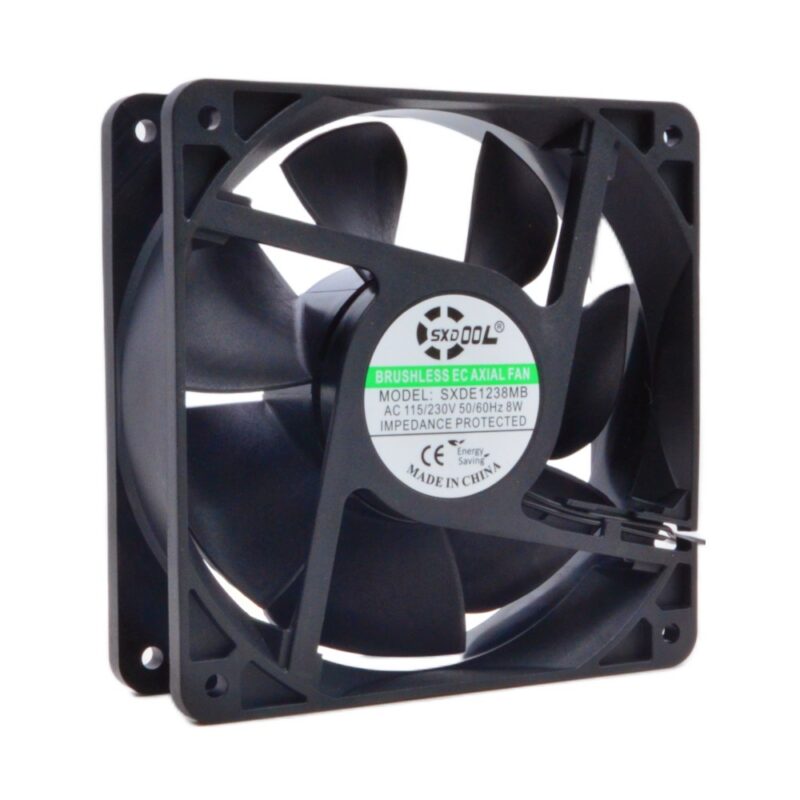
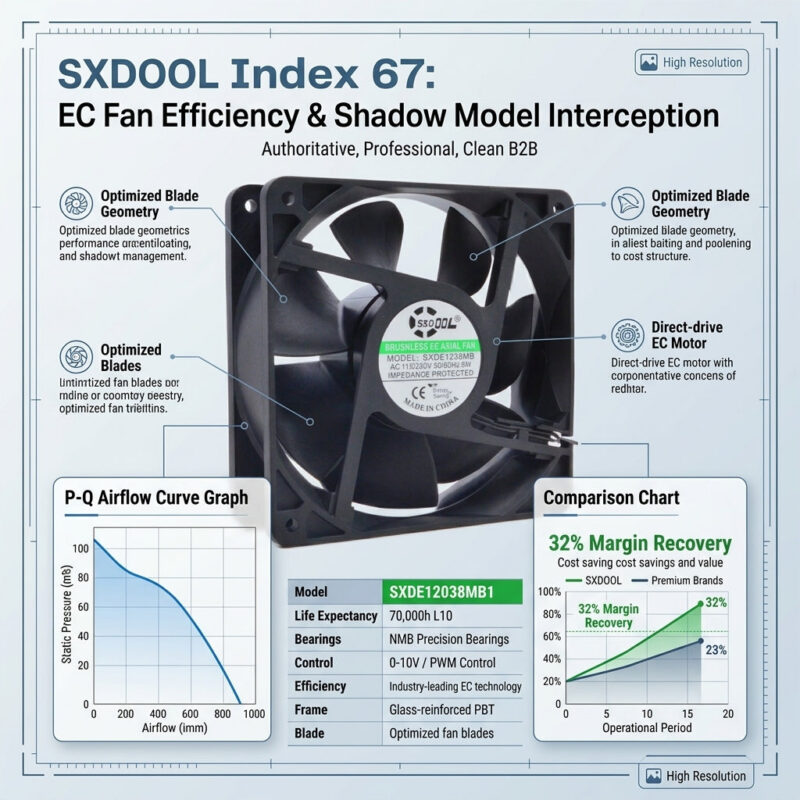
The 120mm × 120mm × 38mm (12038) fan form factor has emerged as a preferred configuration for BESS rack cooling due to its balance of airflow volume and pressure capability. A typical 12038 axial fan operating at 3000-4000 RPM can deliver 130-180 CFM at zero static pressure, with pressure capability of 8-12 mmH₂O. This pressure head is critical for overcoming the flow resistance created by densely packed battery modules and the associated cable management infrastructure within the enclosure.
When manufactured from UL94V-0 PBT, the 12038 frame and impeller assembly provides the structural rigidity needed for continuous operation at these performance levels. The 38mm thickness—compared to standard 25mm or 32mm profiles—allows for a deeper blade geometry that improves pressure development without increasing rotational speed. This has the secondary benefit of operating at lower RPM for a given airflow target, reducing bearing wear and acoustic signature. In BESS installations where multiple fans operate simultaneously, even a 3-5 dBA reduction per unit translates to meaningful community noise compliance advantages.
SXDOOL Quality Control Framework for BESS Fan Components
The performance of UL94V-0 PBT in BESS applications depends not only on the material selection but on the consistency with which that material is processed into finished components. SXDOOL maintains a comprehensive quality control program that spans incoming material verification through finished product testing, ensuring that every 12038 fan destined for energy storage applications meets the rigorous demands of the application.
Incoming Quality Control begins with raw material certification and verification. Each batch of UL94V-0 PBT compound is accompanied by a material certificate from the resin supplier, and SXDOOL conducts periodic third-party verification of flame retardancy to UL94 standards. PCB assemblies undergo automated optical inspection (AOI) and functional testing before integration. Bearing components are measured to micron tolerances using digital micrometers, with statistical process control tracking bearing consistency across production lots. Frame and blade assemblies receive 100% visual inspection for surface defects, gate vestige, and dimensional conformity.
Finished product performance testing represents the most comprehensive phase of SXDOOL’s BESS fan quality program. Each production lot undergoes airflow and air pressure verification using calibrated wind tunnel test chambers, ensuring that aerodynamic performance meets the published specifications that system integrators depend on for their thermal models. Noise level testing is conducted in an anechoic chamber that eliminates ambient reflections, providing accurate sound power and sound pressure measurements critical for installations near residential or commercial areas. Environmental stress screening includes high and low temperature cycling tests (-40°C to +85°C) with humidity exposure at 95% RH, validating fan performance across the full range of potential installation environments from desert solar farms to coastal storage facilities.
Accelerated life testing subjects fans to continuous operation at elevated temperatures for extended durations, typically 5,000 to 10,000 hours, with periodic performance checks to establish reliability metrics such as L10 bearing life. Vibration testing simulates transportation and seismic conditions to verify that fan assemblies maintain structural integrity and performance after exposure to mechanical stress. Packaged drop testing validates that the protective packaging design prevents damage during the logistics chain from factory to installation site. Electrical safety testing, including dielectric withstand and insulation resistance measurements, ensures compliance with IEC and UL safety standards applicable to components installed in high-voltage energy storage systems.
Regulatory Landscape and Certification Requirements
The regulatory framework governing BESS components continues to evolve rapidly, driven by both safety incidents and the accelerating deployment of utility-scale storage. UL 9540, the Standard for Energy Storage Systems and Equipment, and UL 9540A, the Test Method for Evaluating Thermal Runaway Fire Propagation in Battery Energy Storage Systems, provide the foundational safety framework for BESS installations in North America. In Europe, IEC 62933 series standards govern electrical energy storage systems, while IEC 62619 addresses safety requirements for secondary lithium cells and batteries.
For cooling fans specifically, CE marking requires compliance with the Low Voltage Directive (LVD) 2014/35/EU and Electromagnetic Compatibility (EMC) Directive 2014/30/EU. RoHS compliance (Directive 2011/65/EU) is particularly relevant for flame-retardant PBT formulations, as it restricts the use of certain halogenated flame retardants that were historically common but are now prohibited in electronic equipment sold in the EU market. SXDOOL maintains CE and RoHS certifications as baseline requirements, with additional certifications available upon request for region-specific or application-specific requirements.
Integration Considerations for System Designers
Beyond the material and performance specifications, system integrators should evaluate several integration factors when specifying 12038 fire-resistant fans for BESS enclosures. Fan redundancy architecture—typically N+1 or N+2 configurations—ensures that cooling capacity is maintained even if one unit fails. Speed control interfaces, whether PWM (Pulse Width Modulation) or voltage-controlled, enable the BESS Battery Management System (BMS) to adjust airflow in response to thermal conditions, optimizing energy consumption and acoustic performance during partial-load operation. Tachometer feedback signals provide real-time confirmation of fan rotation, enabling the BMS to detect fan failure and trigger protective responses.
The connector interface also merits careful consideration. In BESS environments where vibration, thermal cycling, and potential exposure to condensation are present, connectors with positive locking mechanisms and appropriate IP ratings are preferred over friction-fit connections. SXDOOL offers a range of connector options including standard 2-wire, 3-wire (with tachometer), and 4-wire (with PWM control and tachometer) configurations, with custom connector solutions available for volume applications.
Conclusion: Fire resistance in BESS cooling fans is not an optional specification—it is a fundamental safety requirement. The selection of UL94V-0 rated PBT materials, combined with rigorous incoming and finished product quality control, represents the minimum viable standard for components installed in proximity to lithium-ion battery racks. As energy storage deployments continue to scale toward utility-level capacities and populate increasingly diverse installation environments, the engineering discipline applied to auxiliary components like cooling fans will directly influence system safety, reliability, and ultimately, the public acceptance of energy storage as a cornerstone of the renewable energy transition.