Blog
Cooling Fan Compatibility With Medical Cleaning Agents

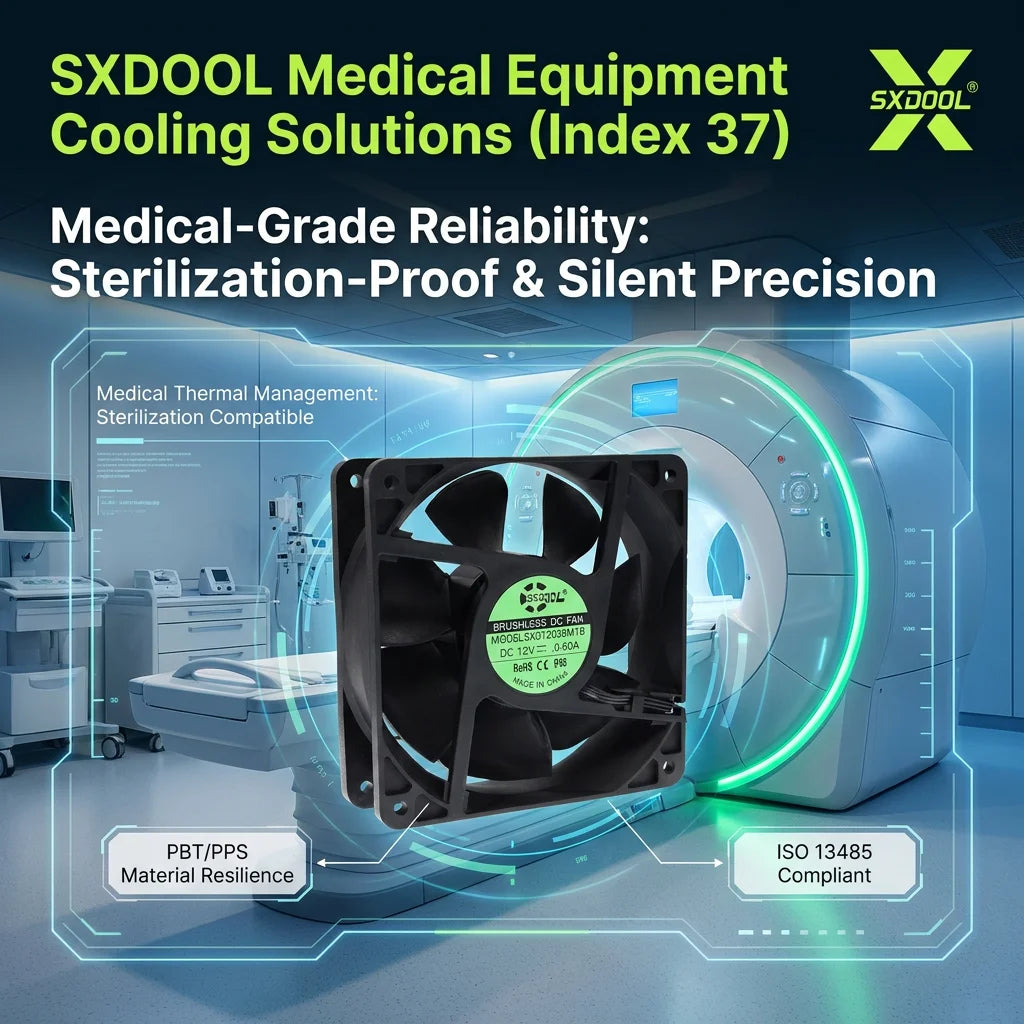
Cooling fans used in medical, laboratory and diagnostic equipment may be exposed to alcohol wipes, peroxide vapour, chlorine-based cleaners, quaternary ammonium compounds and repeated high-humidity cleaning cycles. Whether a fan is suitable cannot be answered by an IP rating alone. The correct decision depends on the cleaning method, concentration, exposure route, material system, sealing design and the acceptance tests defined by the equipment manufacturer.
This guide gives hardware engineers and B2B procurement teams a practical framework for evaluating cooling fan compatibility with cleaning agents. It is not a sterilization certification for any individual fan model. Final suitability must be confirmed against the selected SXDOOL model, the finished equipment design and the customer’s validation protocol.
Cleaning, disinfection and sterilization are different requirements
These terms are often used interchangeably, but they create very different loads on a cooling system:
- Surface cleaning normally involves wiping the enclosure with a diluted agent. The fan may only encounter vapour or incidental droplets.
- Disinfection uses a defined chemical concentration and contact time to reduce microorganisms. Repeated exposure can affect plastics, labels, cable jackets, adhesives and bearing seals.
- Sterilization is a validated process intended to eliminate viable microorganisms. Steam autoclaving at high temperature and pressure is outside the normal operating envelope of most installed cooling fans unless a specific assembly has been designed and validated for it.
For most powered medical consoles, analyzers and laboratory instruments, the practical question is therefore not “Can the fan be sterilized?” but “Can the selected fan and its installation tolerate the defined cleaning or disinfection process without losing electrical, mechanical or airflow performance?”
Typical cleaning-agent risks for cooling fans
| Exposure | Potential fan risk | Engineering review |
|---|---|---|
| Isopropyl alcohol wipes or mist | Stress cracking of unsuitable plastics, label damage, lubricant contamination | Confirm housing, impeller, label, cable and seal compatibility at the stated concentration and cycle count |
| Hydrogen peroxide vapour | Oxidation of exposed copper, solder joints and connector contacts | Review exposure path, PCB protection, motor encapsulation and connector placement |
| Chlorine-based disinfectant | Corrosion of metals and degradation of some elastomers, coatings and labels | Define concentration, dwell time, rinse process and accumulated cycles |
| Quaternary ammonium compound | Residue can attract dust and change impeller balance or airflow resistance | Evaluate residue control, cleaning direction and maintenance interval |
| Steam autoclave | Heat, pressure and moisture can damage polymers, electronics, lubricant and adhesives | Do not assume compatibility; use a separately validated architecture or remove the fan before the process |
Why an IP rating is not a chemical-resistance certificate
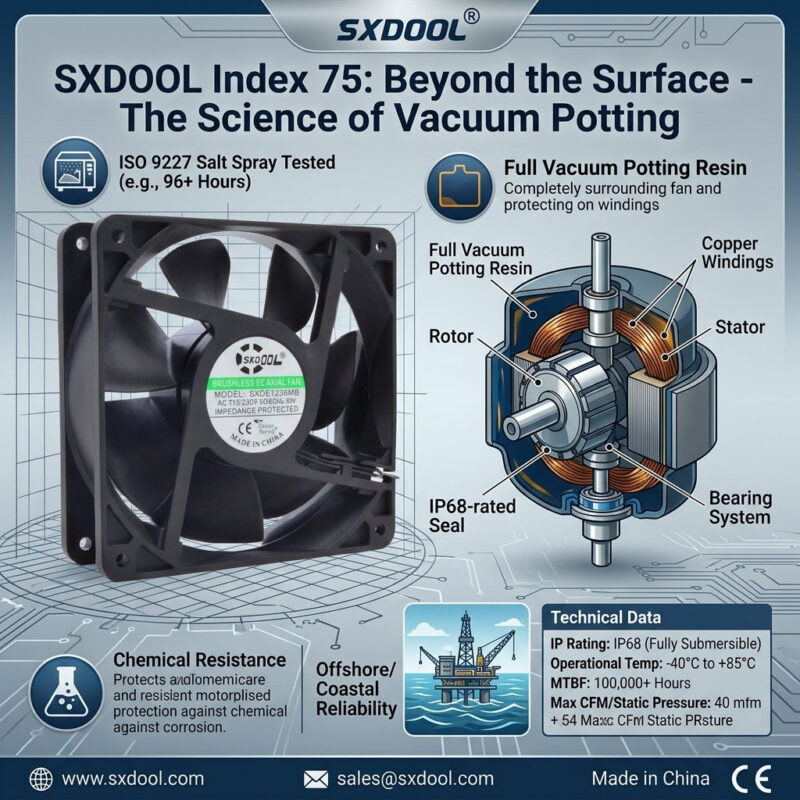
An IP rating describes protection against defined solid-particle and water-ingress tests. It does not establish resistance to alcohol, peroxide, chlorine or other cleaning chemistry. An IP68 option can be useful where the main risk is moisture reaching the motor windings or PCB, but it does not automatically qualify the impeller, frame, bearing system, cable jacket, connector, label or adhesive for a particular disinfectant.
Some SXDOOL fan platforms can be reviewed with enhanced moisture protection or motor potting. Availability and the applicable rating depend on the model and project specification. The quotation and approved datasheet should identify the exact construction rather than relying on a generic product-family claim.
Components that require separate compatibility review
Frame and impeller materials
PBT is commonly used for industrial fan frames and impellers because it offers dimensional stability and useful chemical resistance. However, resin grade, glass-fibre content, flame rating, moulding stress, temperature and exposure concentration all affect performance. A material name alone is not sufficient evidence. Where cleaning chemicals may contact the fan directly, the project team should verify the exact material grade and test representative moulded parts.
Motor, PCB and protective system
Humidity protection, conformal coating and full encapsulation are different protection strategies. Conformal coating may help with condensation and light contamination, while a project-specific potted construction can provide a more complete barrier around selected electronics. The design must still address thermal dissipation, rotor clearance, cable entry and repairability.
Bearing and lubricant
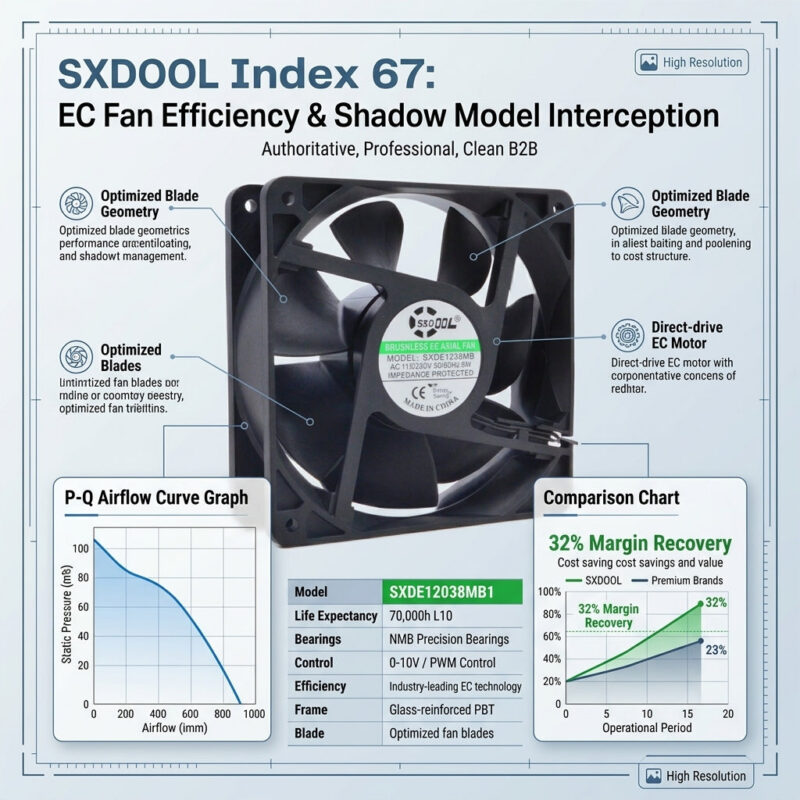
Sleeve and dual-ball bearing configurations react differently to temperature, orientation and contamination. Bearing life is model- and condition-specific; it should be evaluated using the approved datasheet, operating temperature, duty cycle and mounting orientation. If a branded bearing or a particular L10 life is required, state that requirement in the RFQ so it can be confirmed for the selected configuration.
Cable, connector and label
Many compatibility failures occur outside the fan motor. Cleaning agents can harden cable jackets, weaken adhesive labels or corrode exposed contacts. Connector location, strain relief, cable length, jacket material and label method should therefore be part of the engineering review.
A practical qualification workflow for medical-equipment projects
- Define the actual process. Record the chemical name, concentration, temperature, contact time, application method, drying or rinsing step and expected number of cycles.
- Map the exposure route. Determine whether the fan receives direct spray, wipe contact, vapour, condensation or only filtered ambient air.
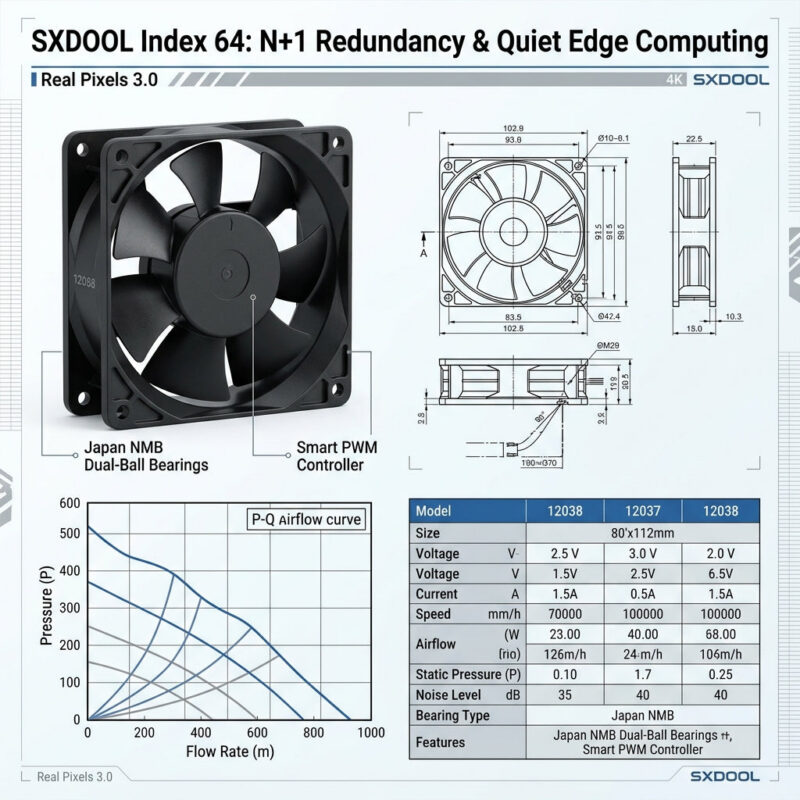
- Select a candidate configuration. Confirm dimensions, voltage, airflow, static pressure, speed signal, bearing, cable, connector, material and ingress-protection requirements.
- Test representative samples. Use the production-intent fan, cable, connector and label inside a representative enclosure. Avoid qualifying only a raw material coupon.
- Measure before and after exposure. Useful checks include insulation resistance, current, starting behaviour, RPM, airflow, vibration, noise, visual cracking, corrosion and label adhesion.
- Document acceptance criteria. The equipment manufacturer should define permitted drift and the required safety margin before approving the final bill of materials.
Information to include in an SXDOOL RFQ
For a cleaning-agent compatibility review, send the fan size, voltage, target airflow and static pressure together with the cleaning specification. Include the equipment environment, exposure route, chemical concentration, temperature, cycle count, required ingress protection, cable and connector details, expected annual quantity and any mandatory test or documentation format.
SXDOOL can then review a model-specific configuration for OEM/ODM customization, sample evaluation and batch quotation. Production requirements and optional features are confirmed through the approved drawing, datasheet or quotation; they should not be inferred from a general article.
FAQ: cooling fans and medical cleaning agents
Can an IP68 cooling fan be sprayed with hospital disinfectant?
Not automatically. IP68 addresses water ingress under defined test conditions, not chemical resistance. Confirm the disinfectant, concentration, temperature, exposure time and all wetted materials, then validate the complete fan installation.
Can a standard DC fan go through an autoclave?
Most installed DC fans are not designed for repeated steam-autoclave temperature, pressure and humidity. If autoclaving is mandatory, the equipment architecture should isolate or remove the fan, or use a separately engineered and validated solution.
What evidence should procurement request before approving a fan?
Request the model-specific datasheet or drawing, material and protection details relevant to the project, sample test results under the customer’s cleaning protocol, and clearly defined acceptance criteria. Avoid relying on a family-level IP or lifespan statement as a substitute for application validation.
Request a model-specific review
For OEM cooling fan selection, sample review or a bulk quotation, contact david@sxdool.com. Please include the cleaning-agent specification and operating conditions so the engineering review can focus on the exact risk.