Blog
Outdoor Kiosk Thermal Design Guide

Use this page for outdoor thermal architecture
This guide addresses public and outdoor kiosks where solar load, rain paths, dust filters, condensation and service intervals shape the airflow architecture. It is an engineering companion to the vending-machine RFQ checklist, not a model-level certification statement.

Vending Machine and Kiosk Cooling Fan Selection Guide

Self-service kiosks and vending machines have become indispensable in modern urban life, providing everything from snacks and beverages to ticketing and pharmaceutical services. These machines are essentially computers housed in enclosed cabinets, often operating 24/7 in high-traffic or outdoor locations. Managing the thermal load of the internal displays, processors, and power supplies is vital to preventing system crashes and component degradation. This guide explores how to select the right cooling fans for vending and kiosk applications, featuring SXDOOL’s professional-grade solutions.
Understanding the Kiosk Thermal Profile
Kiosks and vending machines face unique thermal challenges. Large touchscreens and high-brightness outdoor displays generate significant heat, while the internal electronics (SBCs, payment modules) are often packed into tight spaces with limited natural airflow. Furthermore, machines located outdoors must deal with solar loading—the heat absorbed from direct sunlight. Selecting a fan with sufficient static pressure to overcome the resistance of the cabinet’s air filters and internal components is the first step in a successful thermal design.
Key Criteria for Fan Selection
1. Reliability and Lifespan (70,000 Hours)
Vending machines are often located in remote areas where maintenance is expensive and logistically challenging. A “cost-effective” fan that fails in six months can lead to a truck roll that costs more than the machine’s daily revenue. SXDOOL fans are built for longevity. By utilizing model-specific dual ball bearing option, our fans are rated for an a model- and condition-dependent L10 life target that must be confirmed in the approved datasheet. This translates to roughly 8 years of continuous operation under the confirmed rating conditions.
2. Low Acoustic Noise for Public Spaces
For indoor kiosks located in malls, airports, or hospitals, acoustic comfort is a priority. A loud, buzzing fan can be a nuisance to customers and nearby staff. SXDOOL focuses on “low acoustic noise” by using precision-balanced impellers and high-quality BLDC motors. By minimizing vibration and turbulence, our fans provide effective cooling without the disruptive noise of lower-quality alternatives.
3. IP68 Protection for Outdoor Deployments
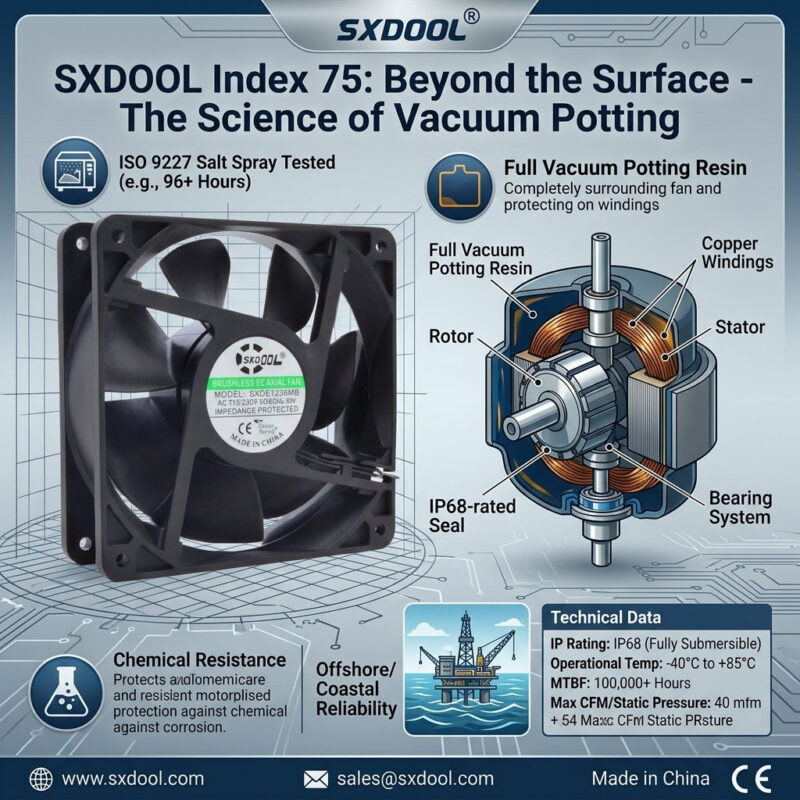
Outdoor kiosks must withstand rain, humidity, and dust. SXDOOL offers IP68-rated fans that are available with a model-specific ingress-protection option subject to confirmation. Our vacuum-sealing process ensures that the motor’s internal circuits remain isolated from the environment, preventing short circuits and corrosion that can plague machines in coastal or high-humidity regions.
4. Fire Safety and Material Quality
Safety is non-negotiable for public-facing equipment. Applicable SXDOOL configurations—including the frame and impeller—are manufactured from UL94V-0 rated PBT plastic. This flame-retardant material ensures that the cooling fan does not contribute to the spread of fire in the event of an electrical fault within the machine.
Advanced Features: PWM and Monitoring
Modern smart kiosks benefit from intelligent cooling. SXDOOL fans can be customized with PWM (Pulse Width Modulation) control, allowing the system’s motherboard to adjust fan speed based on internal temperature sensors. This reduces energy consumption and noise during idle periods. Additionally, we offer “Tachometer” (FG) signals for real-time speed monitoring and “RD Alarm” signals that alert the kiosk management software if a fan has stopped due to an obstruction, enabling proactive maintenance.
OEM/ODM Support and Fast Supply Chain
Procurement and engineering teams in the kiosk industry require a partner who can support both rapid prototyping and large-scale rollouts. SXDOOL provides:
- 7-15 Day Lead Times: Ensuring your production lines never stop.
- Low MOQ (100 Pieces): Supporting innovative startups and custom kiosk builds.
- Customization: Specific wire lengths, connectors (JST, Molex), and voltage options (12V, 24V DC or 110V/220V AC/EC).
- Global Compliance: CE, RoHS, FCC, and ISO9001 certifications.
Conclusion: Cooling the Interface of the Future
Reliable cooling is the silent partner of the self-service revolution. By integrating SXDOOL’s high-performance fans into your vending machine or kiosk design, you ensure that your hardware remains operational, your customers remain satisfied, and your maintenance costs remain low. Our commitment to model-specific long-life configuration and IP68 protection makes us the ideal choice for hardware engineers worldwide.
Contact SXDOOL’s engineering team at david@sxdool.com for bespoke thermal solutions and OEM bulk pricing. Visit www.sxdool.com
Related engineering resource
Continue with Vending Machine Cooling Fan RFQ Checklist for the adjacent decision stage. The two pages address different search intents and should be used together.
Project-specific FAQ
How should solar load be included in an outdoor kiosk fan calculation?
Treat solar gain as an additional enclosure heat input and use the worst credible surface exposure, ambient temperature and duty cycle. Validate the result in a representative cabinet rather than sizing from electronics power alone.
Does an IP-rated fan make the complete kiosk weatherproof?
No. The fan rating does not qualify the enclosure, vents, filters, connectors or drainage path. Water management must be designed and tested at complete-system level.
When is a thermostatic or PWM airflow strategy useful?
Variable control is useful when heat load changes substantially between idle and active operation. Confirm the selected model input type and control curve because signal requirements differ between DC and EC platforms.
Project review: Send the operating conditions, target airflow, static pressure, voltage, size, cable and connector requirements to david@sxdool.com for a model-specific review and factory quotation.