Blog
Noise Reduction Kits for Micro Data Centers in Office Environments

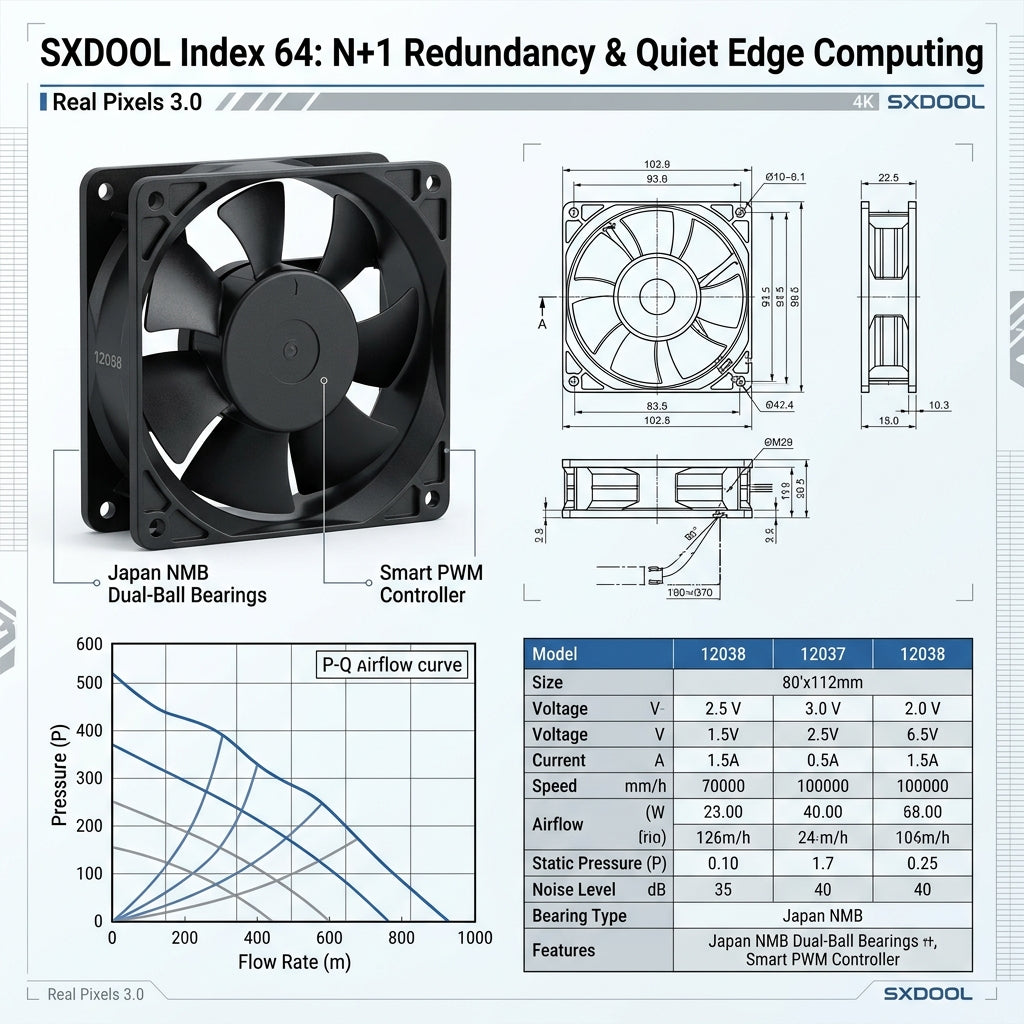
A micro data center placed in an office fails on acoustics long before it fails on cooling capacity. The rack itself is a noise source, but the reason retrofits disappoint is usually that someone replaced the fans without changing anything else. This page sets out where office noise actually comes from, which levers work, and in what order to apply them.
Use this page for RFQ preparation
If the goal is a quieter micro data center, the RFQ needs three numbers, not one: the current sound level measured where people sit, the target level, and the heat load the system must still reject. A request for “quieter fans” without those three cannot be answered properly — noise reduction and airflow move in opposite directions.
Where the noise actually comes from
In a typical edge or micro data center installation, the dominant source is the server and network equipment’s own fans, because those are small, high-speed and mounted close to the cabinet wall. Facility-level components — UPS, PSU fans, room air conditioning — add to the total but rarely dominate. Structure-borne noise matters too: a fan whose vibration couples into a lightweight partition radiates sound from a surface far larger than the fan itself.
Isolating the source from the listener matters as much as reducing it. A rack in a closed room with a hard floor, hard ceiling and no absorption will produce a higher measured level at the desk than the same rack in a carpeted, furnished office.
Why “swap in a quieter fan” usually fails
Fan noise rises steeply with rotational speed — a small decrease in RPM gives a disproportionate reduction in level. That is the good news. The bad news is that the same change reduces airflow roughly in proportion, so the equipment inlet temperature rises, the equipment’s own fans speed up to compensate, and the measured level at the desk barely moves. The noise has not been removed; it has been relocated to a different fan.
Acoustic treatment makes this worse in a specific way: any lining, baffle or tortuous air path adds resistance. The fan that was adequate at free delivery now operates further up its pressure curve and delivers less air. This is why acoustic retrofits that ignore system impedance end up both louder and hotter.
Four levers, in order of cost-effectiveness
1. Control the speed from temperature, not from a fixed setting
A fan running at full speed with a cold cabinet is producing noise for no thermal benefit. A temperature-driven PWM curve lets the system sit quietly at low load and only ramp when it must. The specification detail that matters is the curve’s shape: a steep knee produces audible surging as load crosses the threshold, and a slow ramp with hysteresis is usually preferred in occupied spaces.
2. Choose larger, slower, higher-pressure fans
For the same airflow, a larger fan turning more slowly is quieter than a small fan turning fast. When acoustic treatment is added, the fan also needs static pressure margin to push air through the restriction. Both requirements point the same way: fewer, larger, pressure-capable fans rather than more small ones.
3. Fix the mechanical path
Vibration isolators under the fan and under the rack, flexible connections where ducting meets the cabinet, and avoidance of large flat panels that resonate will often deliver more perceived improvement than a fan change, especially in the 100–500 Hz band where structure-borne noise lives.
4. Treat the acoustic path last
Lined enclosures, baffled intake and exhaust paths and sealed cable penetrations are effective, but they cost airflow and space. Apply them after the first three levers, and size the fans for the restriction they introduce — not before.
What a practical kit contains
- Fans sized for the post-treatment system impedance, with PWM control and FG tach feedback
- A temperature sensor and controller, or an interface to the existing monitoring system
- Vibration isolation mounts for fan and cabinet
- Acoustic lining and baffle plates for intake and exhaust paths, with a defined free area
- Sealing gaskets and cable-penetration seals to stop leakage paths
- Filter media appropriate to the room, with a pressure-drop specification at the design airflow
What SXDOOL supplies
Within a noise-reduction project we supply the air-moving and control layer: DC axial fans in 5 V, 12 V, 24 V and 48 V ranges, EC fans with a 110–220 V wide-range input, both with PWM and FG options, in frame sizes from 20 mm to 280 mm, with ball or sleeve bearings and configurable leads and connectors. Cabinet ventilator filter units are a catalogue line. Minimum order quantity is 50 pcs.
An acoustic enclosure, lining or baffle set is not a catalogue item for us. We can specify the fan for the restriction your acoustic design creates, but the enclosure itself is normally sourced locally or built to your drawing.
How to measure, so the claim is checkable
Ask for sound pressure level in dBA at a stated distance and position, and for sound power level if the result has to be compared across products. Report the measurement standard, the background level and whether the reading was taken with tonal components present — a broadband number can hide an audible tone that dominates subjective impression. For equipment rooms, an NC or RC curve is more useful than a single figure.
RFQ Checklist
- Current sound level and where it was measured, with the instrument and standard
- Target level and the time of day it applies to
- Heat load to be rejected, and the maximum acceptable inlet temperature
- Cabinet dimensions, free area available for intake and exhaust, and the treatment planned
- System impedance or pressure budget after treatment
- Whether speed control must be autonomous or driven by existing monitoring
- Bearing orientation, mounting position and service access
- Ambient conditions: dust, humidity, temperature range
- Quantity, sample requirement, and whether acoustic verification is part of acceptance
Related engineering resource
Because acoustic treatment changes the operating point, the pressure budget has to be recalculated before fans are selected: see calculating system impedance. For rack-level airflow behaviour once several fans share a plenum, see fan array recirculation and hot-spot bypass. Catalogue ranges are under DC cooling fans and cabinet ventilator filter units.
Project-specific FAQ
Will a quieter fan keep the same airflow?
Only if it is a different design, not a slower version of the same one. A fan selected for lower rotational speed at equal airflow must generally be larger in diameter. If the frame size cannot change, expect a trade-off between noise and airflow.
How much noise reduction is realistic in an office retrofit?
It depends far more on the mechanical and acoustic path than on the fans. Projects that combine speed control, larger fans, isolation and a treated path achieve clearly audible improvement; fan replacement alone often does not, because the equipment’s own fans take over the duty.
Does temperature-controlled speed risk overheating the equipment?
Not if the control curve has a defined maximum-temperature ceiling and a fail-safe that runs the fan at full speed on sensor loss. The ceiling should be set from the equipment’s inlet specification, not from a comfort target.
Can filters be added without raising noise?
Filters add resistance, so the fan must have pressure margin. If the margin is not there, filter loading will reduce airflow and the equipment will compensate by increasing its own fan speed — the room gets louder and hotter at the same time.