Blog
NVR and PoE Recorder Cooling Fans

Select cooling for a PoE network video recorder from its internal heat, recording workload and installed airflow path—not from channel count or the PoE power budget alone. A recorder may combine a continuously writing HDD, a processor handling live view or playback, and power circuitry supplying cameras. Each can need a different route to cooling air.
This guide is for OEM NVR and surveillance-recorder enclosure design. It is not a replacement-fan compatibility list for an existing branded recorder. For general storage appliances, see NAS and storage enclosure cooling; for compute appliances installed in warm closets, see compact edge-node cooling.
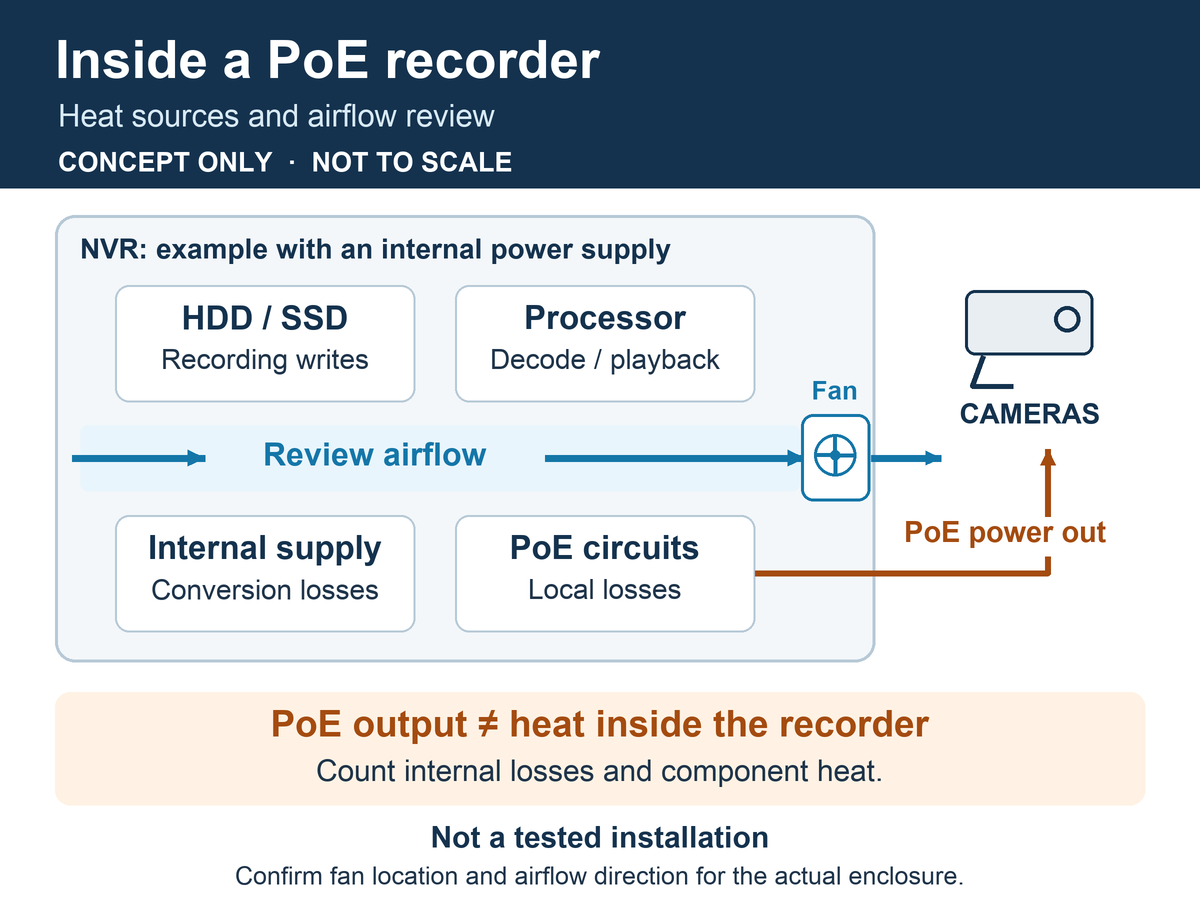 Open diagram at full size
Separate camera power from heat inside the recorder
Map the HDD or SSD, recorder processor and memory, Ethernet switch, PoE power stages and internal power supply. An external adapter puts some conversion losses outside the recorder; an internal supply puts those losses inside. Record the actual architecture before estimating the fan duty point.
A PoE budget is the power available to connected devices, not a measurement of heat released inside the NVR. Much of the delivered power leaves through the camera cables. Include the recorder’s own consumption and internal conversion losses, then verify temperatures under the intended load. A data-sheet figure that excludes HDDs also cannot represent a populated recorder by itself.
For a concrete documentation example, Panasonic’s Advidia M-NVR-4CH-4POE specifications separately list PoE output and recorder consumption excluding the HDD. Those are different quantities; the listing does not provide an SXDOOL fan selection or a full enclosure heat measurement.
Power reserved by the PoE controller can also differ from power consumed. AXIS S3016 documentation, July 2026, “Allocate power” explains reservation by device power class and the total power budget. For a thermal review, supply both the camera allocation and measured operating load. Include supported night illumination, heaters or other camera features that change demand.
Make the airflow reach the disk and power circuitry
Trace an inlet-to-outlet path with the cover fitted, the final HDD mounting bracket installed and all cables routed. Check whether the fan pulls mostly through an easy opening while the drive underside, processor heat sink or PoE circuitry sits in a stagnant pocket. Raising fan speed does not necessarily correct that bypass.
Keep the equipment manufacturer’s clearance requirements around the completed recorder. A fan inside the box cannot compensate indefinitely for a closed shelf or warm exhaust recirculating into its inlet. The AXIS S3008 installation guidance, July 2026 calls for ventilation and clear space around the recorder; the required arrangement must still follow the exact equipment manual.
Review grille resistance, inlet proximity, guards and wiring before choosing a fan. In a quiet monitoring room, also inspect vibration transfer through the HDD bracket, chassis panel and mounting feet. Compare sound with the recorder fully assembled and at a defined listener position, alongside component temperatures.
A slim SXDOOL candidate for a custom shallow compartment
The SXDOOL 12012 DC axial fan family lists a nominal 120 × 120 × 12 mm envelope and identifies the pictured SXD12012S12M as a 12 V sample. Its shallow listed depth is a reason to investigate it for a custom recorder compartment that has space for the full 120 mm frame and an appropriate axial airflow path.
This candidate is conditional on the mounting layout. A 120 mm square frame is not a direct replacement for a small fan on a conventional 1U rear panel. A shallow top or bottom mounting arrangement still needs inlet clearance, cable clearance and a path through the actual heat sources. If the available area or the enclosure resistance does not suit this fan, keep the fan selection open.
Request an exact-configuration drawing and pressure–airflow curve, supply and startup limits, connector pinout and any required control or feedback definition. The family voltage options are separate configurations. This guide does not assign a noise rating, delivered airflow, bearing, life, ingress protection, certification, PWM or tachometer capability to SXD12012S12M.
Fit must be demonstrated: the available sample identity and family dimensions do not establish approval for an AXIS, Dahua, Panasonic or other recorder. For an existing appliance, follow its manufacturer’s service instructions and approved parts. For a new design, qualify the chosen sample in the final enclosure.
Test the workload that the surveillance installation will use
Recording, decoding and playback are separate workload limits. For example, the official archived Dahua NVR2108HS-8P-I specifications distinguish recording bandwidth, playback and decoding capability with analytics enabled or disabled. That discontinued model is a documentation example, not a current product recommendation or an SXDOOL compatibility reference.
| Condition | Measurements and checks | Decision supported |
|---|---|---|
| All planned cameras recording at the supported resolution, codec and bit rate | Inlet, HDD and relevant component temperatures after stabilization; recording logs and available throughput | Whether the sustained recording configuration stays within its thermal and functional limits |
| Recording plus the permitted live view, playback or export workload | Processor temperatures, fan behavior, response and recording continuity, within the recorder’s stated capacity | Whether additional operator activity creates a different limiting condition |
| Supported maximum camera power demand | Actual PoE load, power-stage temperatures and camera power or link events | Whether the power section needs a separate cooling path |
| Quiet-room operation and speed transitions | Noise and vibration at the stated listener position, together with the hottest component | Whether an acoustic setting preserves thermal margin under load |
| Planned service interval and restart conditions | Intake condition, fan startup, fault detection and recovery using an approved test procedure | Whether maintenance and control requirements are met throughout the intended service cycle |
Use the limits and measurement points of the exact recorder, drives and electronic components. Record enclosure revision, fan sample, ambient conditions, camera configuration and firmware. If the design supports multiple disks or RAID, add its supported maintenance workload to the qualification plan; do not assume that every NVR has these features. A fan alone cannot guarantee uninterrupted recording.
NVR cooling questions
Does a larger PoE budget always require a larger cooling fan?
No. First separate power delivered to cameras from losses inside the recorder. The internal supply arrangement, conversion efficiency, disk population, component layout and airflow resistance determine the cooling task. Use actual loads and component temperatures to assess the candidate.
Can a quieter fan of the same connector shape replace the original?
Connector appearance does not establish pinout, voltage limits, startup behavior or feedback compatibility. A slower fan may also reduce flow through a restrictive grille or drive bracket. Use the equipment manufacturer’s approved service route, or qualify the exact replacement assembly where an OEM design permits it.
Why test playback while the recorder is recording?
Operator activity can change decoding and storage work even when the number of connected cameras stays constant. Test only combinations supported by the recorder, and monitor both temperature and recording continuity. A no-load desktop check does not represent that condition.
Is SXD12012S12M already validated for PoE recorders?
No recorder-specific validation is established here. It is a candidate for a custom layout with enough frame area and limited mounting depth. The exact drawing, curve, electrical interface and assembled thermal and acoustic tests are required before approving it.
Send the recorder configuration for a fan review
Include a chassis drawing and airflow sketch; HDD models and quantity; recorder processor and analytics workload; recording, display, playback and export requirements; camera count and actual PoE demand; internal or external supply arrangement; maximum inlet temperature; and the acoustic target. Add fan space, supply limits, pinout, control and alarm requirements. State whether the request is for a new OEM design or a manufacturer’s approved replacement project.
Related: industrial cooling applications · NAS and storage enclosure cooling.