Blog
Reading Fan Curves: Airflow vs. Static Pressure


Understanding Fan Curves: How to Read Airflow vs. Static Pressure Charts
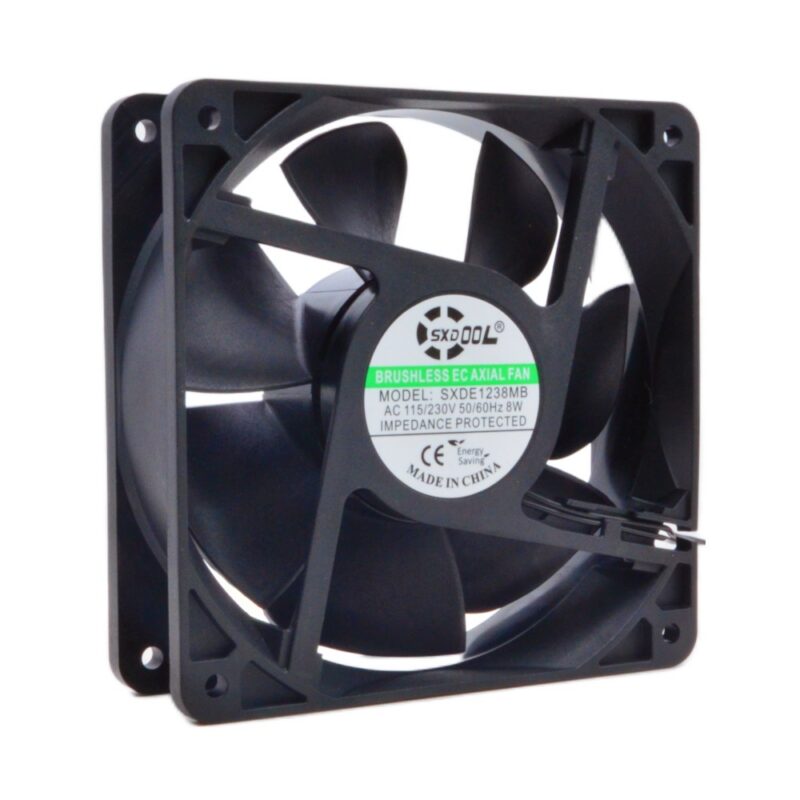
Read a fan curve by checking the airflow and pressure units, locating the measured curve for the stated test conditions, and finding its intersection with the system resistance curve. That operating point predicts installed airflow; free-air flow and shutoff pressure describe different endpoints, not one usable duty point. Understanding how to read these charts is essential for choosing a fan that actually performs as expected within a real-world enclosure. For an SXDOOL candidate, request the P-Q data available for the complete model and revision, with voltage, speed and test conditions.
For a worked airflow and system-resistance calculation, see Fan Curves: System Resistance and Heat Balance.
The Anatomy of a Fan Curve
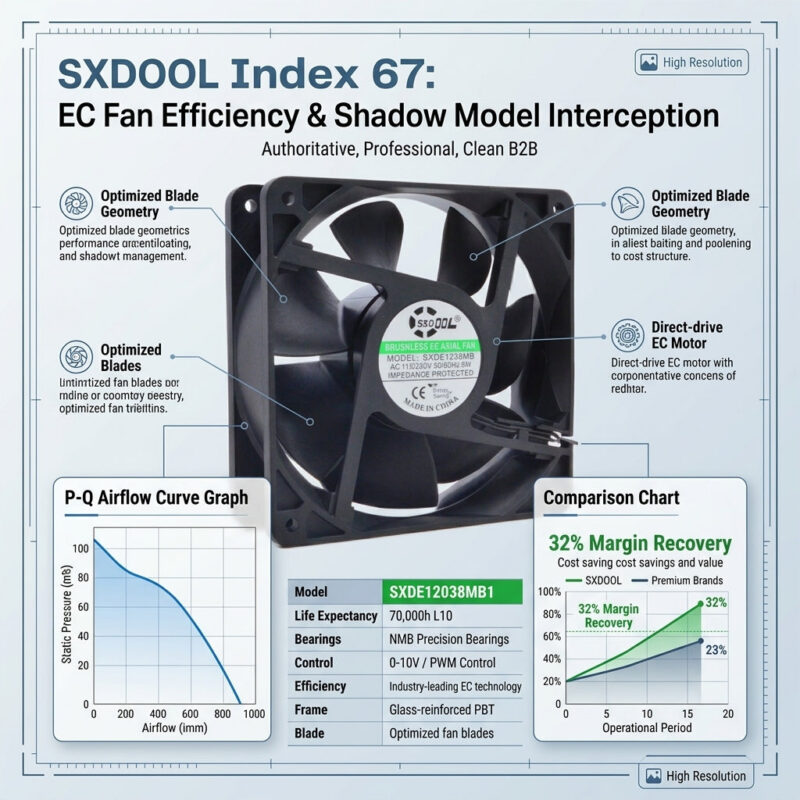
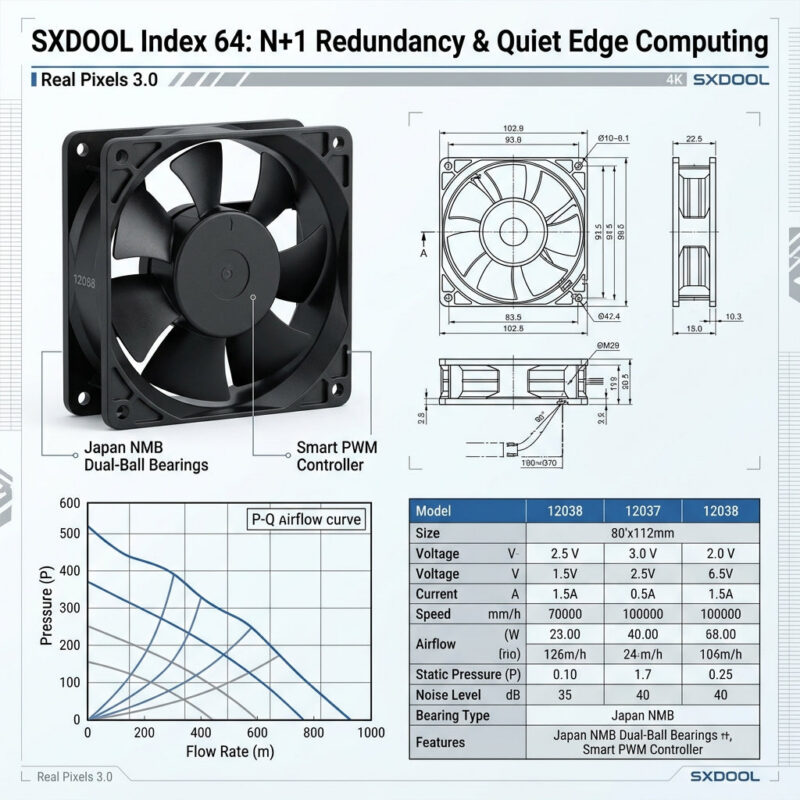
A standard fan curve chart has two axes: the horizontal axis (X-axis) representing Airflow (measured in CFM or m³/min), and the vertical axis (Y-axis) representing Static Pressure (measured in mmH₂O, Pa, or inH₂O).
- Max Airflow (Free Air): This is the point on the X-axis where static pressure is zero. It represents the maximum volume of air the fan can move when there are no obstructions.
- Shutoff Static Pressure: Read the pressure at zero airflow. Check the complete curve: its maximum pressure may occur elsewhere, depending on the fan design.
- The Performance Curve: Read the measured pressure at each airflow. The curve need not be a straight or uniformly descending line; two endpoint ratings are insufficient to reconstruct it.
Finding the System Operating Point
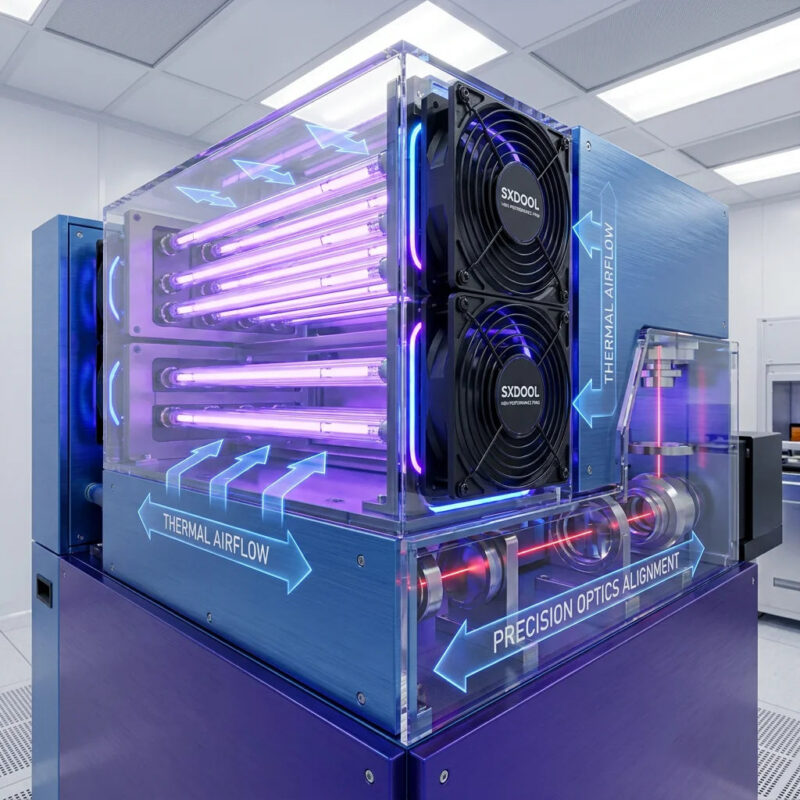
Choosing a fan based solely on its “Free Air” CFM is a common mistake. In any real application—like a server chassis or an industrial cabinet—there is internal resistance from the PCB, heatsinks, cables, and filters. This resistance is called the System Impedance Curve.
The System Operating Point is where the measured fan curve meets the system impedance curve. It predicts installed airflow under the stated test and installation conditions; verify the assembled equipment. Keep the duty point within the exact fan’s recommended stable range. See NMB’s explanation of system impedance and operating points.
Advanced Parameters for High-Performance Fans
Compare curves for the same voltage, speed, air density and test setup. For the selected SXDOOL build, request the documented bearing specification, impeller material and operating limits. Do not infer these from a brand-wide description or use a material rating as proof of airflow performance.
Key Tips for Better Fan Selection
- Check the Duty Point: Compare the pressure available at your required airflow, rather than ranking fans by free-air CFM or shutoff pressure alone.
- Set a Tested Margin: Allow for the specified dirty-filter condition, ambient temperature and installation tolerances, then verify component temperatures. A fixed percentage does not suit every enclosure.
- Control with PWM: For a PWM-capable model, speed changes produce a different fan curve and a new system operating point. Verify signal levels, duty-cycle response and minimum speed for the exact build; do not equate duty cycle with a fixed airflow percentage. See SANYO DENKI’s general PWM guidance.
Contact SXDOOL about a DC, AC or EC fan for your operating conditions. Ask for the exact model’s lifetime estimate and its temperature, speed and failure criteria, plus applicable compliance documents with their covered models and scope. Confirm minimum order quantity and lead time in the quotation for your selected build and quantity.
Compare Candidates for Your Operating Point
Use the SXDOOL fan selector to identify a relevant fan family, then request the measured curve for the exact model and build. For cable, connector or control requirements, use the custom cooling fan enquiry page. Include the required airflow and pressure, electrical supply, installation space and operating environment.
Contact SXDOOL at david@sxdool.com if you need help specifying the curve and test conditions to request. Model suitability remains subject to the available evidence and equipment testing.