Blog
Tool-Free Latch EC Fan Modules for Industrial Enclosures

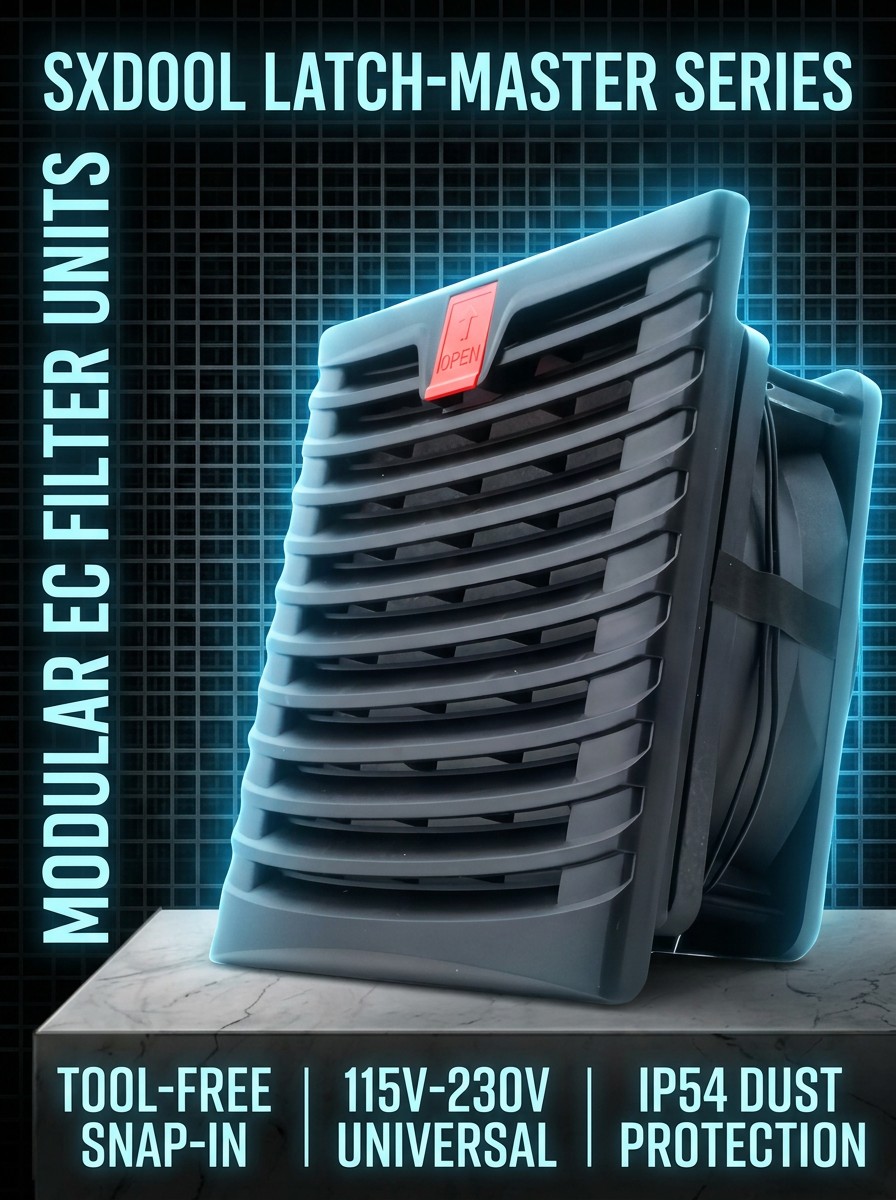
Tool-free latch fan modules can reduce assembly steps and make filter service easier in industrial enclosures, but the benefit depends on controlled panel cutouts and verified retention. A snap-in mechanism must hold the module under vibration, maintain gasket compression and allow intentional removal without damaging the panel.
The cooling function still starts with the pressure-airflow operating point. A fast mounting method cannot compensate for an undersized fan, a loaded filter or a recirculating cabinet layout. Mechanical and thermal qualification should therefore be planned together.
Engineering workflow
- Control the panel interface. Specify cutout dimensions, corner radii, panel thickness, flatness and coating buildup. Check the tolerance stack against latch engagement.
- Verify gasket compression. Ensure the seal is compressed evenly without distorting the frame. Inspect joints, corners and cable exits for bypass leakage.
- Test insertion and removal. Measure assembly force and confirm that service personnel can release the module intentionally without special tools or panel damage.
- Qualify retention. Apply vibration, transport and cable-load conditions representative of the enclosure. Recheck latch position and sealing after testing.
- Validate thermal performance. Test clean and loaded filters at the design airflow and static pressure. Confirm speed control, alarms and safe behavior if airflow is blocked.
Technical decision table
| Design item | Engineering meaning | Evidence or action | Acceptance focus |
|---|---|---|---|
| Cutout tolerance | Controls latch engagement | Go/no-go gauge and drawing inspection | Module seats fully without looseness |
| Panel thickness | Affects retention geometry | Test minimum and maximum thickness | Latch remains engaged |
| Gasket compression | Controls bypass and ingress path | Visual and compression inspection | Continuous contact around frame |
| Removal force | Controls serviceability | Repeated service-cycle test | Intentional removal without damage |
| Filter loading | Raises system resistance | Clean/loaded pressure test | Required airflow and temperature margin |
Validation in the finished system
Use production-representative panels rather than a single ideal cutout. Run repeated installation cycles, vibration or transport tests, thermal operation and post-test inspection. If an ingress rating is required, test the completed enclosure configuration with its panel, gasket, fasteners or latches, cable entries and installation orientation.
Information to include in the OEM RFQ
- Panel cutout drawing, thickness, material, coating and flatness tolerance
- Required airflow, static pressure and clean/loaded filter condition
- Input voltage, EC control, feedback and connector requirements
- Enclosure target, gasket material and installation orientation
- Vibration, transport, service-cycle and retention requirements
- Color, replacement filter, annual volume and sample plan
Frequently asked engineering questions
Can a latch module use the same cutout as a screw-mounted filter fan?
Sometimes, but it should not be assumed. Compare the exact cutout, panel thickness, corner geometry and latch engagement requirements before approving a replacement.
Does tool-free installation reduce enclosure sealing performance?
It can maintain sealing when the latch geometry and gasket compression are correctly designed and tested. The complete enclosure configuration determines the final ingress performance.
What should be included in a latch-module sample approval?
Use production panels to check insertion force, retention, gasket contact, removal cycles, airflow with the specified filter, electrical control, vibration and post-test condition.
Work with SXDOOL engineering
SXDOOL supports factory-direct OEM/ODM cooling fan projects with application review, dynamic balancing and 100% end-of-line testing for the agreed production specification. Review Cabinet ventilation and filter fan platforms and Cooling fan RFQ guide, then send the operating point, drawing, electrical interface and expected quantity through the contact page or email david@sxdool.com.