Blog
70,000h Cooling Fan TCO Strategy

Lifecycle reliability scope
A 70,000-hour figure is a model- and condition-dependent L10 target, not a universal guarantee for every SXDOOL fan. This guide shows how engineering and maintenance teams can translate a confirmed model rating into inspection intervals, spare planning and an auditable TCO scenario.
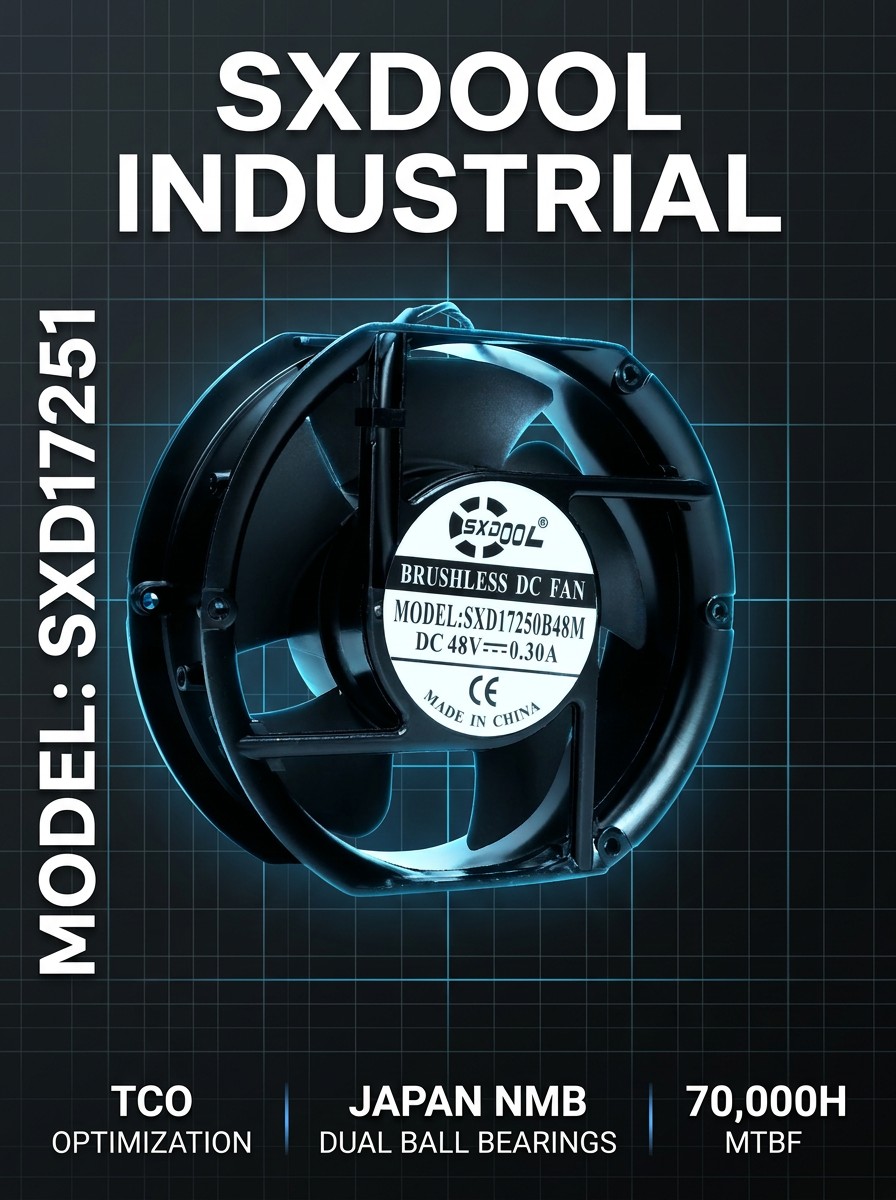
Selecting an industrial cooling fan based solely on initial purchase price is a common pitfall in OEM engineering. Total Cost of Ownership (TCO) accounts for energy efficiency, downtime costs, and replacement labor. At SXDOOL, our premium series utilizing Japan NMB dual ball bearings ensures a 70,000-hour L10 life, significantly reducing the long-term cost for critical infrastructure compared to cheaper alternatives.
In the world of industrial procurement and OEM engineering, the allure of a low “Initial Purchase Price” (IPP) is often the strongest gravity in the room. When balancing quarterly budgets, it is tempting to shave a few dollars off the unit cost of components like cooling fans. However, for mission-critical infrastructure—ranging from telecom base stations and data center servers to industrial inverters and medical equipment—selecting an industrial cooling fan based solely on initial purchase price is a common pitfall that can lead to catastrophic long-term financial consequences.
At SXDOOL, we advocate for a shift in perspective: from viewing cooling as a commodity expense to viewing it as a strategic investment in reliability. This is the essence of the Total Cost of Ownership (TCO) model. Total Cost of Ownership (TCO) accounts for energy efficiency, downtime costs, and replacement labor, painting a much more accurate picture of a component’s true cost over its operational life. Our premium series, utilizing Japan NMB dual ball bearings, ensures a 70,000-hour L10 life, significantly reducing the long-term cost for critical infrastructure compared to cheaper alternatives.
The Anatomy of TCO in Thermal Management
To understand why the “cheapest” fan is often the most expensive, we must deconstruct the components of TCO into three primary pillars: Direct Operational Expenses (OpEx), Indirect Maintenance Costs, and Risk-Adjusted Capital Expenditure.
1. Energy Efficiency: The Silent Budget Killer
Cooling fans in industrial environments often run 24/7, 365 days a year. A fan that is 10% less efficient but 20% cheaper at purchase will quickly consume its initial savings in electricity costs. High-quality fans from SXDOOL utilize optimized motor designs—often incorporating 3-phase brushless DC technology—and aerodynamic blade profiles that maximize CFM (Cubic Feet per Minute) while minimizing power draw.
Consider the power curve of a standard 120mm fan. A budget model might draw 15 Watts to achieve 150 CFM. An SXDOOL premium model might achieve the same airflow at 12 Watts. While 3 Watts seems negligible, over 70,000 hours of continuous operation, that represents 210 kWh of saved energy per fan. In a facility with thousands of fans, the energy savings alone can often exceed the original purchase price of the fan by a factor of three or four.
2. Maintenance and Labor Costs: The Hidden Multiplier
The cost of a fan is not just the price paid to the supplier; it is also the cost of the technician who must install it. In complex systems, such as a 5G macro base station mounted on a remote tower or a solar inverter in a desert array, replacing a failed fan may require hours of travel, specialized lifting equipment, and strict safety protocols.
If a “budget” fan with a sleeve bearing fails after 15,000 hours (a common lifespan in high-heat environments), and an SXDOOL fan with NMB ball bearings lasts 70,000 hours, you are not just saving on the cost of four additional fans—you are saving on four separate maintenance events. When you factor in the “truck roll” cost—often cited as $200-$500 per visit in the telecom industry—the $10 saved at purchase becomes a $1,000 liability.
3. The Exponential Cost of Downtime and Cascade Failures
For a data center or an automated manufacturing line, one hour of downtime can cost thousands, or even millions, of dollars. When a cooling fan fails, the heat-sensitive components it protects (CPUs, MOSFETs, capacitors) can overheat in minutes. High-heat environments accelerate the degradation of electrolytic capacitors, effectively “baking” the motherboard.
If a cheap fan leads to an unplanned shutdown, the initial “savings” of a few dollars becomes a rounding error compared to the loss of production, data integrity, and corporate reputation. Reliability engineering is about minimizing these “tail risks”—the low-probability, high-impact events that can sink a project’s profitability.
The SXDOOL 70,000h Strategy: Engineering for Longevity
Why do we emphasize a 70,000-hour L10 life? Because reliability is a choice made during the design phase, not a fortunate accident.
Defining L10 Life: The Gold Standard of Reliability
In the bearing and fan industry, “Life” is a statistical measure. L10 life refers to the time at which 10% of a population of fans will have failed. If a fan is rated for 70,000 hours L10 at 40°C, it means 90% of those fans are expected to still be running after nearly 8 years of continuous operation. Cheap fans often cite “MTBF” (Mean Time Between Failures), which can be a misleading metric if it doesn’t specify the environmental conditions or the failure distribution. At SXDOOL, we stand by the L10 metric because it provides engineers with a predictable floor for system maintenance.
Japan NMB Dual Ball Bearings
The heart of any high-performance fan is its bearing system. While many manufacturers use cost-effective sleeve bearings or “long-life” hydraulic variants, SXDOOL utilizes genuine Japan NMB dual ball bearings in our premium series. Sleeve bearings rely on a thin film of oil that eventually evaporates or migrates, especially when the fan is mounted in a vertical or non-standard orientation.
Ball bearings, conversely, use hardened steel or ceramic spheres that maintain low friction regardless of orientation. They are significantly more resilient to the high ambient temperatures found in industrial enclosures (up to 70°C). This mechanical superiority is the foundation of our 70,000-hour reliability.
Advanced Materials: PBT and Fiberglass Reinforcement
Longevity isn’t just about the bearing; it’s about the entire assembly’s resistance to “creep” and fatigue. Our fans utilize high-grade PBT (Polybutylene Terephthalate) reinforced with 30% fiberglass. This composite material ensures that the fan housing and blades remain dimensionally stable over decades of thermal cycling. A fan blade that loses its aerodynamic balance—even by a fraction of a millimeter—after 10,000 hours will increase vibration (Harmonic Resonance), which accelerates bearing wear and eventually leads to audible noise and mechanical failure.
Application Focus: Where TCO Matters Most
EV Charging Infrastructure
Electric Vehicle (EV) chargers are exposed to the elements 24/7. They face solar loading during the day and rapid cooling at night. A fan failure in a DC fast charger can throttle the charging speed or shut down the unit entirely, frustrating users and reducing the operator’s revenue. SXDOOL’s 70,000h fans are the preferred choice for global charging network providers who cannot afford the high cost of field repairs in public parking lots.
Renewable Energy Inverters
Solar and wind inverters operate in some of the harshest environments on Earth. Sand, dust, and extreme heat are the norm. Our fans are available with IP68 ratings, combining the 70,000-hour bearing life with vacuum-encapsulated electronics. This ensures that the TCO remains low even when the “environment” is doing its best to destroy the hardware.
Case Study: The Math of Reliability in a Tier-3 Data Center
Consider a medium-sized data center with 1,000 servers, each requiring two cooling fans for redundant airflow.
**Scenario A: The “Budget” Approach (Initial Price Focus)**
– Unit Price: $5.50
– Lifespan (Actual in 45°C Rack): 18,000 hours (Approx. 2 years)
– Replacement Labor & Logistics: $65 per event (including ticket processing and hot-swap labor)
– Total 8-Year Cost per slot: 4 fans ($22) + 4 labor events ($260) = **$282.00**.
**Scenario B: The SXDOOL “TCO” Approach (Value Focus)**
– Unit Price: $16.00
– Lifespan (Actual in 45°C Rack): 70,000 hours (Approx. 8 years)
– Replacement Labor & Logistics: $65 per event
– Total 8-Year Cost per slot: 1 fan ($16) + 1 labor event ($65) = **$81.00**.
By choosing the more “expensive” fan, the facility saves **$201.00 per slot** over 8 years. Across 2,000 fan slots, that is a direct bottom-line saving of **$402,000**. This calculation does not even include the energy savings (estimated at another $40,000) or the reduced risk of a catastrophic thermal event.
Sustainability Through Durability: The ESG Perspective
In the modern B2B landscape, Environmental, Social, and Governance (ESG) criteria are no longer optional. Procurement departments are being measured on their “Scope 3” emissions and waste production. A 70,000-hour fan produces significantly less electronic waste than a series of cheaper fans that must be discarded and replaced every two years. By choosing components that last, engineers contribute to a circular economy and reduce the carbon footprint associated with the manufacturing, shipping, and disposal of short-lived “disposable” hardware.
Conclusion: Strategic Thermal Management
Selecting a cooling fan is an engineering decision, not just a procurement one. At SXDOOL, we understand that our fans are the silent guardians of your most valuable infrastructure. We don’t just sell air movement; we sell peace of mind.
The 70,000-hour strategy is about more than just a number on a datasheet. It is a commitment to the “Math of Reliability.” It is an acknowledgment that in the industrial world, quality has a way of paying for itself many times over.
Don’t let a $10 saving today become a $10,000 headache tomorrow. Look beyond the price tag. Invest in the math of reliability. Choose SXDOOL for your next mission-critical thermal management project. Our team of thermal engineers is ready to help you calculate the TCO for your specific application and prove that the best cooling solution is the one you only have to think about once.
—
**About SXDOOL:**
SXDOOL is a leading manufacturer of high-performance cooling solutions for the OEM and industrial markets. Specializing in long-life AC, DC, and EC fans, we provide the thermal backbone for the world’s most demanding technologies. From 70,000-hour dual ball bearing fans to IP68-rated waterproof blowers, SXDOOL is synonymous with reliability.
Related engineering resource
Continue with Premium Fan TCO vs Purchase Price for the adjacent decision stage. The two pages address different search intents and should be used together.
Project-specific FAQ
What evidence is needed before using 70,000 hours in a TCO model?
Use the selected model datasheet or approved supplier statement, including reference temperature, bearing type and test basis. Record the actual cabinet temperature and duty assumptions separately.
Does L10 life mean every fan will run for the stated time?
No. L10 is a statistical life concept under defined conditions. It should support reliability planning, not be presented as an individual-unit warranty.
How can maintenance teams use a long-life target conservatively?
Apply temperature and duty margins, monitor RPM or alarm signals where available, inspect filters and define replacement triggers before failures affect the equipment.
Project review: Send the operating conditions, target airflow, static pressure, voltage, size, cable and connector requirements to david@sxdool.com for a model-specific review and factory quotation.