Blog
Maximizing OEM Assembly Speed: The Value of Customized Wire Harnesses

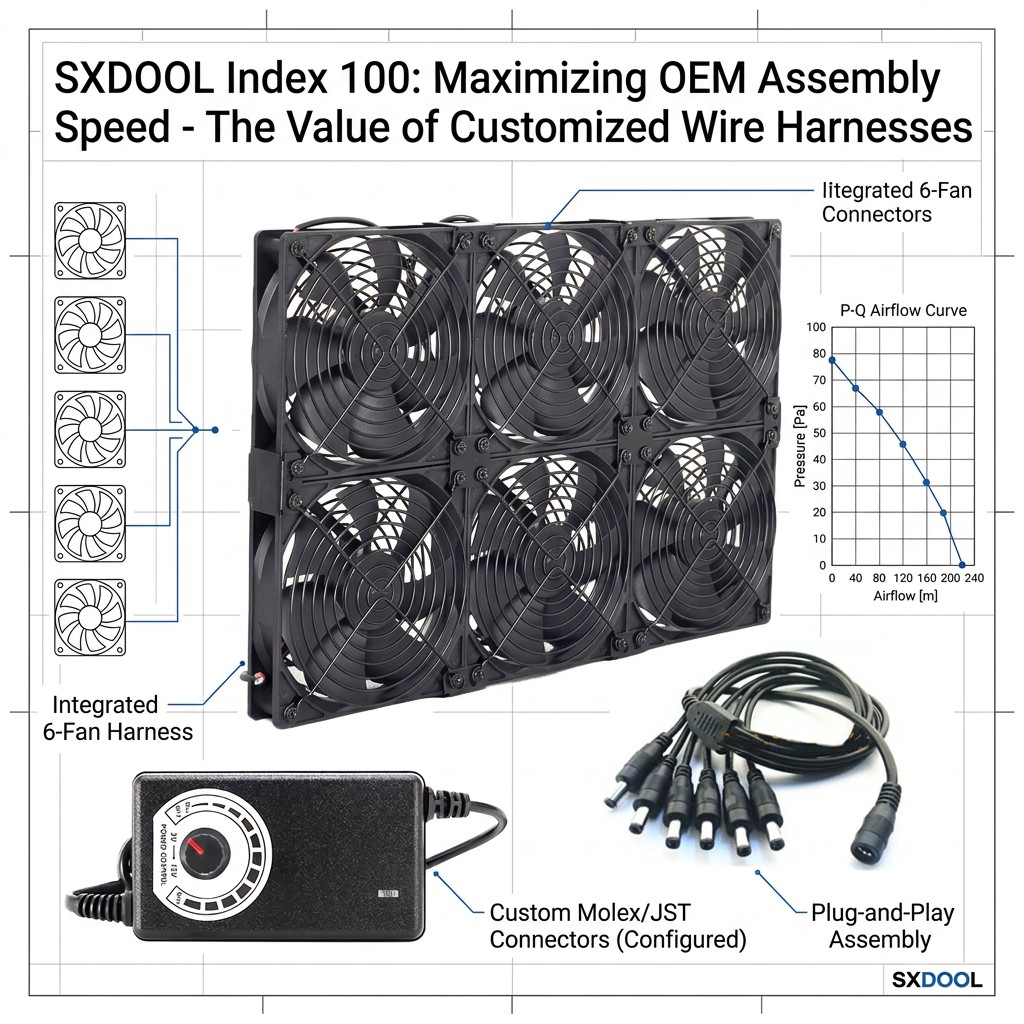
In high-volume OEM manufacturing, every second spent on manual wiring is a loss of margin. At SXDOOL, we offer fully customized fan connectors and integrated wire harnesses (like our 6-fan miner array) to ensure plug-and-play reliability.
The Bottleneck of Standard Cooling Solutions
When designing complex hardware systems, whether it’s an ASIC miner, a high-density server rack, or an industrial power cabinet, cooling is often a critical bottleneck. However, the bottleneck isn’t just about airflow or thermal dissipation—it’s also about assembly.
Standard cooling fans come with stock cable lengths and generic connectors. In an OEM environment where thousands of units are assembled daily, the manual work required to route, crimp, and connect individual fans can slow down the production line significantly. Imagine an assembly line where workers must manually strip wires, crimp pins, and insert them into housings for hundreds of fans per hour. The probability of a loose connection or a crossed wire increases exponentially with volume. These assembly-level failures are often not discovered until the final testing phase, or worse, in the field, leading to costly returns and brand damage.
The SXDOOL Approach: Integrated Wire Harnesses
At SXDOOL, we realized that our customers needed more than just fans; they needed a system. This led to the development of our customized wire harness solutions.
One of our flagship examples is the 6-fan miner array. Instead of shipping six individual fans that a technician must plug into a control board one by one, we provide an integrated assembly. All six fans are pre-wired into a single, high-quality harness with a rugged, high-current connector. This isn’t just a matter of convenience; it’s a matter of engineering precision. Our harnesses are designed using CAD software to ensure that cable lengths are exact, minimizing slack and maximizing the efficiency of the internal airflow path.
Key Benefits of Customized Harnesses:
- Reduced Assembly Time: Technicians can install a cooling array in seconds rather than minutes. This “plug-and-play” capability allows for rapid deployment and minimizes the risk of human error during wiring. In a high-volume scenario, saving just 60 seconds per unit can translate into hundreds of man-hours saved per month.
- Space Optimization: Custom cable lengths mean no excess wire cluttering the internal chassis. This improves airflow—which is the primary goal of the fans in the first place—and makes the internal layout cleaner. Excess wire not only blocks airflow but can also act as a trap for dust and debris, further compromising thermal performance over time.
- Enhanced Reliability: Manual crimping on a factory floor is never as consistent as automated, quality-controlled crimping in a specialized facility. Our harnesses are tested for continuity and voltage drop to ensure long-term stability in harsh environments. We use high-precision crimping machines that monitor the force applied to every single terminal, ensuring a perfect gas-tight connection every time.
- Thermal Management and PWM Integration: By integrating the fan control into a single harness, we can implement more sophisticated PWM (Pulse Width Modulation) control strategies. A single harness can carry a shared PWM signal to all fans while returning individual tachometer signals, allowing the system controller to monitor the health of every fan in the array independently.
Deep Dive: Technical Specifications and Customization
We don’t believe in one-size-fits-all. Our engineering team works closely with OEM partners to specify every detail of the wire harness. The science of a wire harness goes far beyond just copper and plastic.
Wire Gauge and Current Handling
Choosing the correct AWG (American Wire Gauge) is critical. High-performance fans, especially those used in industrial or mining applications, can draw significant current. If the wire gauge is too thin, the resistance will lead to a voltage drop, causing the fans to run slower than intended and generating heat within the wiring itself. We calculate the maximum current draw and select a gauge that provides a generous safety margin, typically using 18AWG or 20AWG for high-power arrays.
Insulation and Environmental Resistance
Standard PVC insulation is fine for office environments, but industrial applications often demand more. We offer:
- Teflon (PTFE) Insulation: For extremely high-temperature environments or where chemical resistance is required.
- Silicone Insulation: For applications requiring high flexibility, such as robotic arms or equipment that undergoes constant vibration.
- Halogen-Free Materials: Increasingly required for data center and telecommunications applications to meet fire safety standards.
Specialized Connectors
The connector is the most common point of failure in any electrical system. We support:
- Standard 4-pin PWM: For general computing and server use.
- Molex Mini-Fit Jr.: A robust choice for high-current power distribution.
- IP67/IP68 Waterproof Connectors: For outdoor telecommunications cabinets or marine applications.
- Custom Over-molded Connectors: We can design and mold custom connector housings that provide superior strain relief and vibration resistance.
Shielding and EMI Management
In sensitive electronics, the cables themselves can become antennas, picking up or emitting electromagnetic interference (EMI). We provide braided shielding and ferrite cores integrated directly into the harness to ensure that the cooling system doesn’t interfere with high-speed data signals.
Case Study: The 6-Fan Miner Array Evolution
Our 6-fan parallel array was designed specifically for the demands of the cryptocurrency mining industry. In this sector, downtime is extremely costly. Miners operate in high-dust, high-heat environments where fan failure can lead to catastrophic hardware damage.
The evolution of this product involved moving from simple “daisy-chaining” to a parallel distribution hub. In early designs, fans were often connected in series or simple parallel loops, which created uneven power distribution. The fan closest to the power source would receive slightly more voltage than the one at the end of the chain. Our current 6-fan harness uses a balanced star-topology distribution, ensuring every fan receives identical voltage and current, leading to uniform RPM across the entire array.
Furthermore, we’ve integrated “hot-swap” capabilities into our premium harnesses. This allows a single fan within the array to be replaced without powering down the entire system—a critical feature for 24/7 industrial operations.
The Manufacturing Process at SXDOOL
How do we ensure every harness meets our standards? It starts with our ISO-certified manufacturing facility.
- Automated Cutting and Stripping: Our machines cut wires to sub-millimeter precision, ensuring zero waste and perfect fitment.
- Precision Crimping: As mentioned, every crimp is monitored for quality. We perform pull tests to ensure the mechanical strength of the connection.
- Automated Testing: Every harness is plugged into a test jig that checks for continuity, resistance, and correct pin-out. If a single pin is out of place, the unit is rejected.
- Final Integration: The fans are mounted into the customized bracket or housing, and the harness is secured with cable ties or clips, ready for the customer to drop into their assembly.
Why SXDOOL?
SXDOOL is not just a fan manufacturer. We are a thermal management partner. Our expertise in DC and EC fans, combined with our capability to design and manufacture custom wire harnesses, makes us the preferred choice for OEM projects worldwide.
We understand the pressures of modern manufacturing. Supply chain delays, labor costs, and quality control are constant challenges. By taking the “wiring problem” off our customers’ hands, we allow them to focus on their core product. Our commitment to quality starts with the raw materials—high-precision ball bearings from Japan, high-grade silicon steel for the motor cores, and aerodynamic blade designs developed in our own wind tunnels.
But the “SXDOOL Difference” is in the integration. We look at the entire assembly process and ask: “How can we make this faster, safer, and more reliable for our customer?” This customer-centric approach has allowed us to partner with some of the biggest names in the industrial and computing sectors.
Conclusion: The Future of Integrated Cooling
As hardware becomes more dense and heat loads continue to rise, the cooling system will only become more complex. The days of simple, standalone fans are coming to an end. The future belongs to integrated, intelligent cooling modules that are optimized for both thermal performance and assembly efficiency.
Customized wire harnesses are a small investment that yields massive returns in terms of assembly speed and product reliability. Don’t let your production line be slowed down by standard parts that don’t fit your needs.
When you choose SXDOOL, you’re choosing a partner dedicated to your production line’s success. From initial design to mass production, our team is here to ensure that your cooling solution is a seamless, high-performance part of your hardware ecosystem.
Maximize your assembly speed. Minimize your errors. Choose SXDOOL customized wire harnesses for your next OEM project.
For more information on our custom cooling solutions and wire harness capabilities, visit SXDOOL.com or contact our engineering team today.
Technical FAQ: Customized Wire Harnesses
1. What is the maximum current capacity for your standard 6-fan harness?
Our standard high-power 6-fan harness is designed to handle up to 30 Amps of continuous current. We achieve this by using 18AWG copper wire and high-temperature insulation to prevent voltage drops and thermal issues.
2. Can we specify different connectors for each fan in the array?
Yes. While most customers prefer a uniform connector type for simplicity, we can customize each individual branch of the harness. This is particularly useful for systems that use a mix of axial fans and blowers with different power requirements.
3. Do you provide EMI shielding for the harness?
Absolutely. For medical or telecommunications applications where electromagnetic interference is a concern, we can add braided metal shielding or ferrite cores to the assembly. This ensures that the cooling system does not interfere with sensitive signal processing.
4. What is the lead time for a custom harness design?
A typical design-to-prototype cycle takes about 7 to 10 business days. Once the prototype is approved, mass production can begin immediately, with lead times depending on the total volume.
5. How do you test the reliability of the connections?
Every single harness undergoes a series of tests before shipping. This includes a pull test for mechanical strength, a continuity test to ensure correct wiring, and a resistance test to verify that the crimps are gas-tight and efficient.
6. Can the harness be integrated with temperature sensors?
Yes, we can integrate thermistors or other temperature sensors directly into the harness assembly. This allows the system to monitor air temperature at various points within the chassis and adjust fan speeds accordingly via PWM control.
7. What environmental ratings do your connectors support?
We offer connectors ranging from standard indoor ratings to IP68-rated waterproof and dustproof solutions. For harsh industrial environments, we also provide UV-resistant and chemical-resistant insulation materials.