Blog
Optimizing Airflow Density: The Power of Integrated Fan Arrays

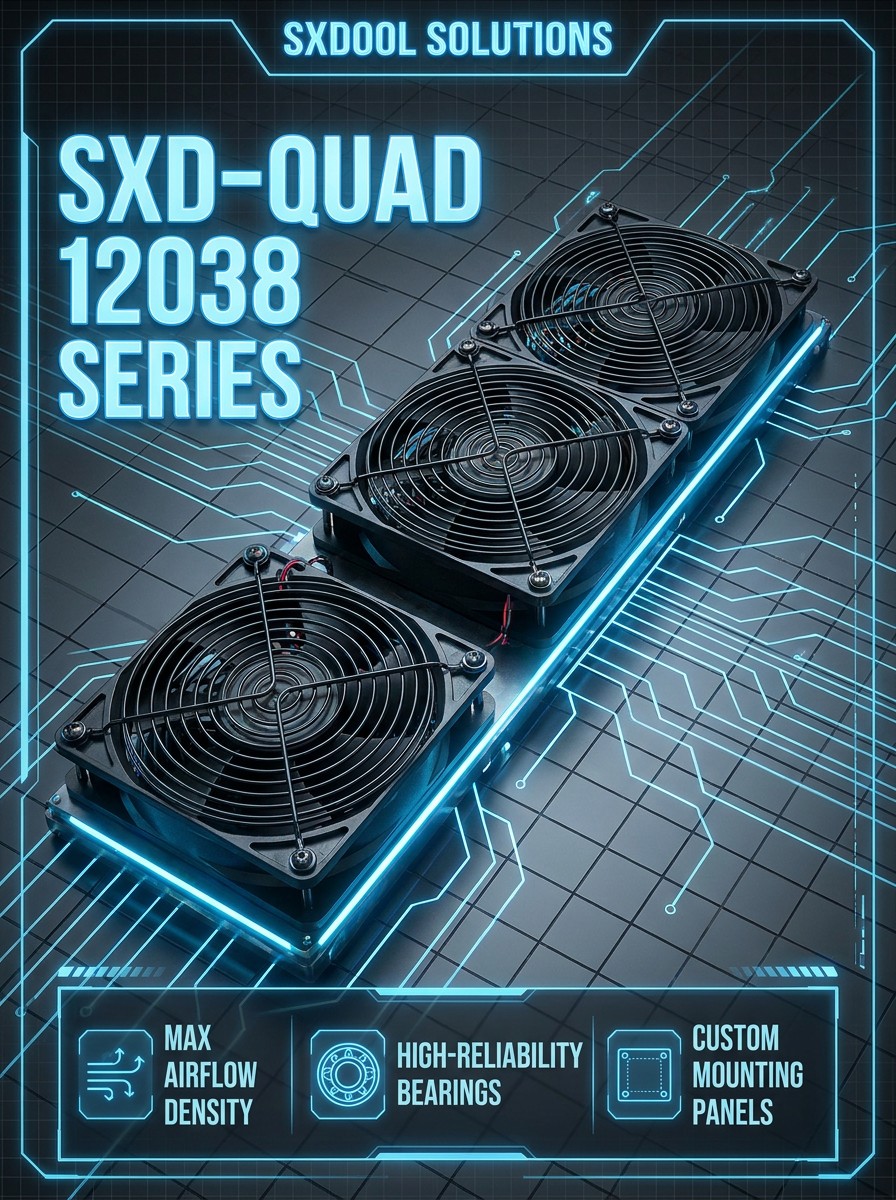
In the evolving landscape of industrial automation, data centers, and telecommunications, thermal management has shifted from a secondary consideration to a mission-critical engineering pillar. As power densities in server racks and industrial control cabinets continue to climb, a single axial fan often reaches its physical limit. This is where Integrated Fan Arrays (or Fan Trays) become the strategic choice for OEM engineers.
At SXDOOL, our SXD-QUAD 12038 Series is designed to address these high-stakes environments. This article explores the technical advantages of using integrated arrays over decentralized cooling and how to optimize them for maximum airflow density.
1. Understanding Airflow Density
Airflow density isn’t just about the volume of air (CFM); it’s about how that volume is distributed across a specific cross-sectional area. In a dense industrial cabinet filled with PCBs, cables, and power modules, “dead zones” (areas with stagnant air) are the primary cause of component failure.
An integrated fan array ensures a uniform “wall of air,” physically covering the entire intake or exhaust plane. This eliminates hotspots and ensures that even components tucked in corners receive consistent cooling.
2. Parallel Configuration: Compounding CFM
When fans are arranged in parallel (side-by-side, like our SXD-QUAD series), the total airflow volume (CFM) increases linearly, while the static pressure remains that of a single fan.
- 1x 12038 Fan: ~150 CFM | 200 Pa
- 4x 12038 Array: ~600 CFM | 200 Pa
This configuration is ideal for systems with low to medium impedance where high volume is required to purge heat rapidly from large internal spaces.
3. Redundant N+1 Strategy
In mission-critical infrastructure, a single fan failure can lead to catastrophic system shutdown. Integrated arrays allow for N+1 redundancy.
By over-speccing the array (e.g., using 4 fans when 3 provide sufficient cooling), the system can maintain safe operating temperatures even if one unit fails. Our SXD-QUAD series supports individual PWM feedback for each fan, allowing the cabinet controller to detect a failure and automatically ramp up the remaining fans to compensate until maintenance can be performed.
4. Why 12038 is the Industrial Workhorse
The 12038 frame (120mm x 38mm) is the global standard for industrial cooling for a reason. Its depth allows for optimized blade pitch and motor torque, producing the high static pressure needed to push air through dense dust filters and heat sinks.
SXDOOL Technical Specs:
- Bearing Type: Japan NMB Dual Ball Bearings
- Service Life: 70,000 hours (L10)
- Protection: IP68 Vacuum Potting (optional) for harsh environments
- Control: 4-wire PWM / FG / RD Signal outputs
5. Conclusion
Switching to an integrated fan array is an investment in system longevity. By maximizing airflow density and building in redundancy, OEM partners can recover margin while providing their end-users with “Iron-Clad” reliability.