Blog
IP68 Cooling Fans for Outdoor 8K Broadcast and LED Systems

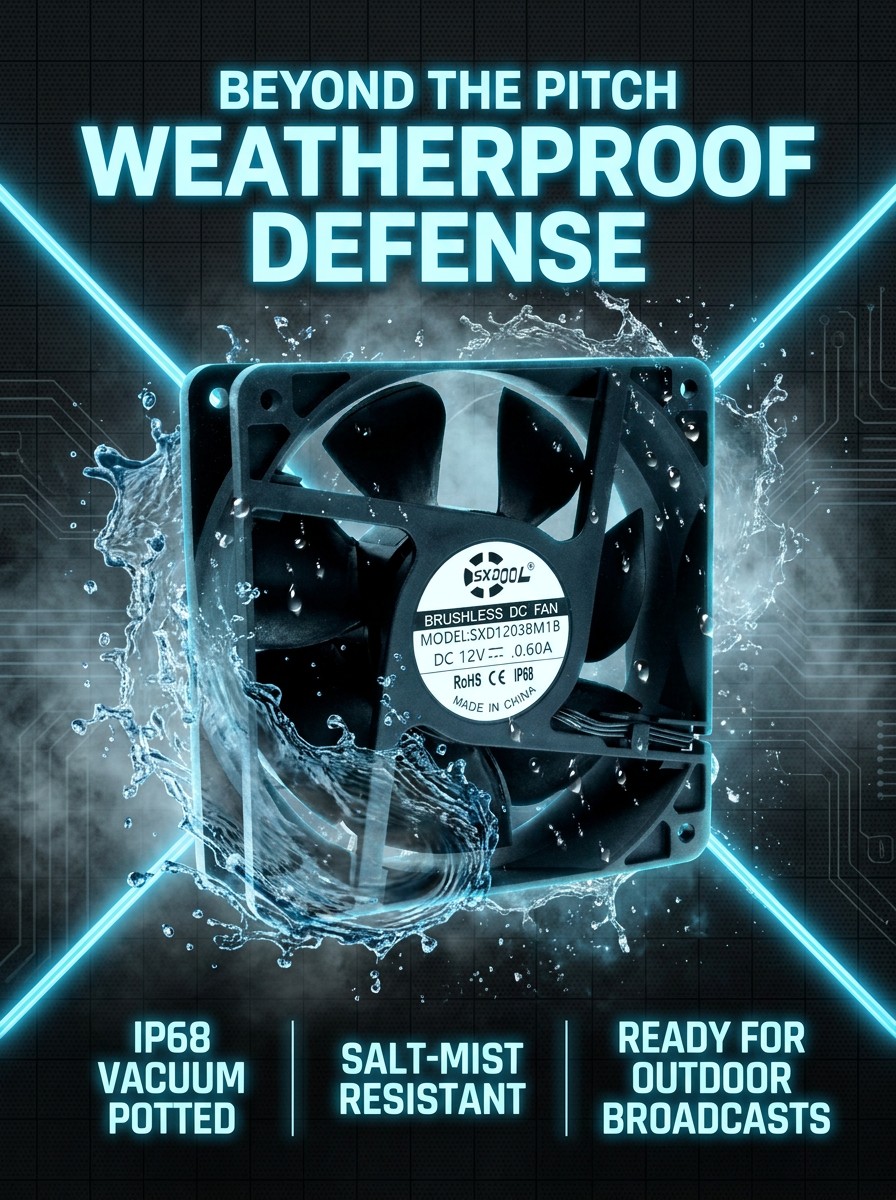
Outdoor broadcast equipment combines high compute density with rain, dust, heat, rapid deployment and limited service access. 8K encoders, LED processors, radio links and power converters can create concentrated heat in sealed or semi-sealed housings, making airflow reliability a production-critical requirement.
An IP68-rated fan can reduce the risk of water or dust entering the motor assembly when tested to defined conditions. It does not automatically make the complete broadcast enclosure IP68. Cutouts, cable glands, doors, vents, seals and installation orientation must be qualified together.
Engineering workflow
- Define the exposure. Specify rain, splash, dust, condensation, washdown, solar load, temperature, altitude and possible salt exposure for each deployment location.
- Separate sealed and ventilated zones. Keep sensitive electronics in protected compartments and design any ventilation path with controlled drainage, filtration and recirculation prevention.
- Select the operating point. Account for grilles, filters, heat sinks and weather shields when comparing the fan P-Q curve with enclosure resistance.
- Monitor cooling availability. Use FG or RD feedback and temperature alarms so a blocked intake, disconnected fan or stalled rotor is detected before transmission is lost.
- Plan redundancy and service. For live events, consider replaceable modules, spare capacity and connectors that can be serviced without disturbing adjacent equipment.
Technical decision table
| Design item | Engineering meaning | Evidence or action | Acceptance focus |
|---|---|---|---|
| Rain and splash | Water reaches vents and cable entries | Ingress and drainage test | No unsafe water path or retained moisture |
| Dust | Filter loading and motor contamination | Dust exposure and pressure trend | Required airflow remains available |
| Solar heating | Enclosure temperature exceeds ambient | Outdoor thermal soak | Component temperatures remain within limits |
| Fan failure | Loss of airflow during live operation | Stall/disconnect simulation | Alarm and redundancy response |
| Transport vibration | Connector or mounting loosens | Transport and post-test inspection | No damage or airflow obstruction |
Validation in the finished system
Test the representative enclosure in its intended orientation with production seals, glands, filters and cable routing. Combine environmental exposure with powered thermal operation where the qualification plan requires it. After testing, inspect for water paths, corrosion, connector movement and reduced airflow, then verify alarms and recovery.
Information to include in the OEM RFQ
- Equipment heat load, enclosure drawing and target component temperatures
- Required airflow and pressure with weather protection installed
- Exposure profile, requested IP test condition and corrosion environment
- Voltage, current, PWM, FG/RD and cable/connector requirements
- Mounting orientation, service method and redundancy target
- Sample quantity, deployment schedule and qualification evidence
Frequently asked engineering questions
Does an IP68 fan make the finished enclosure IP68?
No. The enclosure rating depends on the complete tested assembly, including cutouts, vents, seals, cable glands, fasteners and orientation.
Is a waterproof fan enough for coastal broadcast events?
Not necessarily. Salt corrosion, UV exposure, condensation and connector sealing may require additional material and system-level controls beyond water-ingress resistance.
Which feedback signal is useful for live-event cooling?
FG speed feedback or an RD alarm can help detect a fan problem, but temperature and airflow-path monitoring are also important because a spinning fan does not prove that a blocked system is delivering cooling.
Work with SXDOOL engineering
SXDOOL supports factory-direct OEM/ODM cooling fan projects with application review, dynamic balancing and 100% end-of-line testing for the agreed production specification. Review IP68 waterproof fan testing and DC cooling fan platforms, then send the operating point, drawing, electrical interface and expected quantity through the contact page or email david@sxdool.com.