Blog
Managing High-Speed Airflow Transitions in Under-Carriage Electronic Bays

Managing High-Speed Airflow Transitions in Under-Carriage Electronic Bays
In the world of high-speed rail, every component must contend with a dynamic and unforgiving environment. While passengers enjoy a smooth, climate-controlled ride at speeds exceeding 300 km/h (186 mph), the infrastructure beneath their feet—specifically the under-carriage electronic bays—is engaged in a constant battle with extreme aerodynamic forces. For thermal management engineers, the challenge is not just dissipating heat, but managing the complex airflow transitions that occur at high velocities.
Under-carriage bays house critical systems such as traction converters, auxiliary power units, and braking resistors. These components generate significant heat and require reliable active cooling. However, when a train is moving at high speed, the external air pressure and flow patterns are drastically different from when it is stationary or moving slowly. This article explores the engineering complexities of managing these transitions and the specialized cooling solutions required for rolling stock.
The Aerodynamic Challenge: Pressure Differentials and Turbulence
When a high-speed train is in motion, the air passing underneath it creates a boundary layer characterized by high velocity and significant turbulence. This leads to several critical issues for cooling systems:
1. Dynamic Pressure Fluctuations
As the train enters tunnels, passes other trains, or navigates different track geographies, the static and dynamic pressure around the electronic bays fluctuates rapidly. Standard industrial fans are not designed to handle these back-pressure spikes. If a fan cannot maintain sufficient static pressure against these external forces, airflow can stall or even reverse, leading to immediate overheating of the electronics.
2. The “Piston Effect” in Tunnels
In tunnel environments, the air is compressed in front of the train and expanded behind it. This creates a massive pressure wave that travels through the under-carriage area. Cooling fans must be resilient enough to continue operating without mechanical failure or stall during these intense pressure cycles.
3. Debris and Contamination
High-speed airflow acts as a transport mechanism for track ballast dust, iron filings from brake wear, and moisture. Any air intake for cooling electronics becomes a vacuum for these contaminants. Managing the transition of air into the bay while filtering out these particles without significantly restricting airflow is a primary design constraint.
Engineering the Solution: High-Static Pressure EC Fans
To overcome these challenges, railway engineers are increasingly turning to high-performance EC (Electronically Commutated) fans specifically designed for rolling stock applications.
1. Robust P-Q Curves
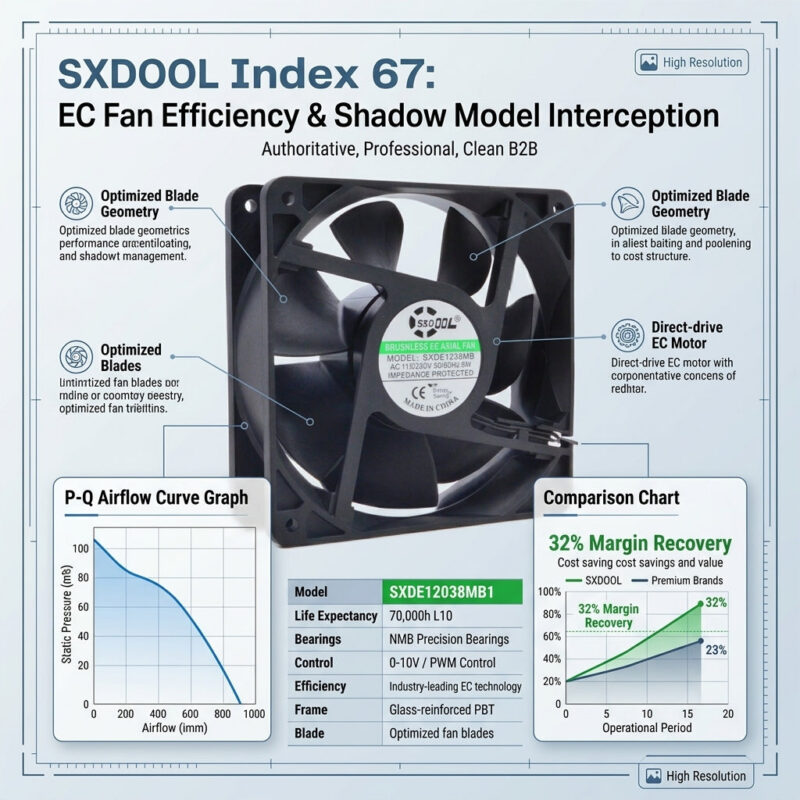
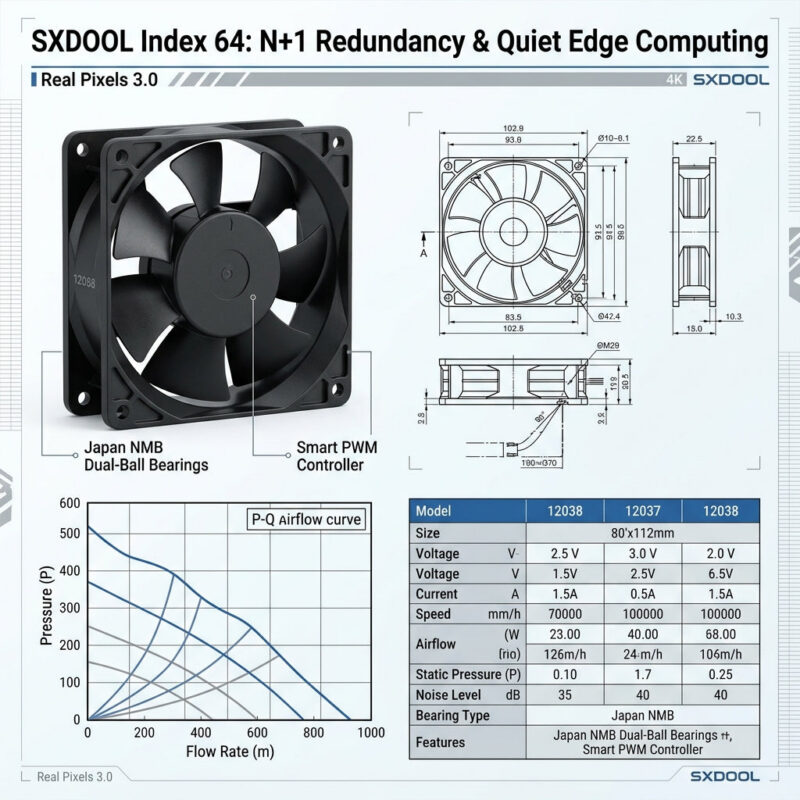
A fan used in an under-carriage bay must have a “steep” P-Q (Pressure vs. Flow) curve. This means it can maintain high airflow even when facing significant resistance (static pressure). SXDOOL’s EC series for rail applications utilizes optimized impeller geometries that maximize air compression, ensuring that cooling continues even during high-speed pressure surges.
2. Smart PWM Control and Pressure Compensation
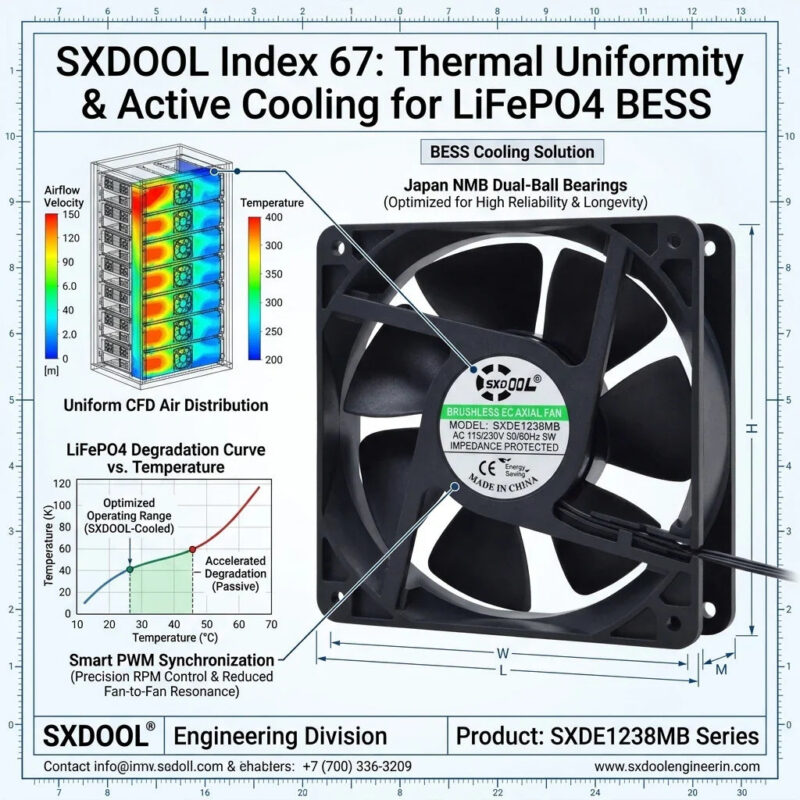
Modern cooling systems use active monitoring to adapt to changing conditions. By using PWM (Pulse Width Modulation) speed control, the train’s thermal management system can increase fan speed as the train accelerates or enters a high-pressure zone. Some advanced systems even incorporate pressure sensors that feed data back to the fan controller, allowing for real-time airflow compensation.
3. Structural Integrity: EN61373 Compliance
The mechanical stress of high-speed transitions, combined with the constant vibration of the rails, requires fans that meet the EN61373 standard for shock and vibration. SXDOOL utilizes magnesium-aluminum alloy housings and reinforced mounting structures to ensure that the fan remains structurally sound over decades of service.
Protecting the “Heart”: Vacuum Potting and Nano-Coating
Given the exposure to environmental contaminants in under-carriage bays, the fan’s internal electronics must be impervious to the elements.
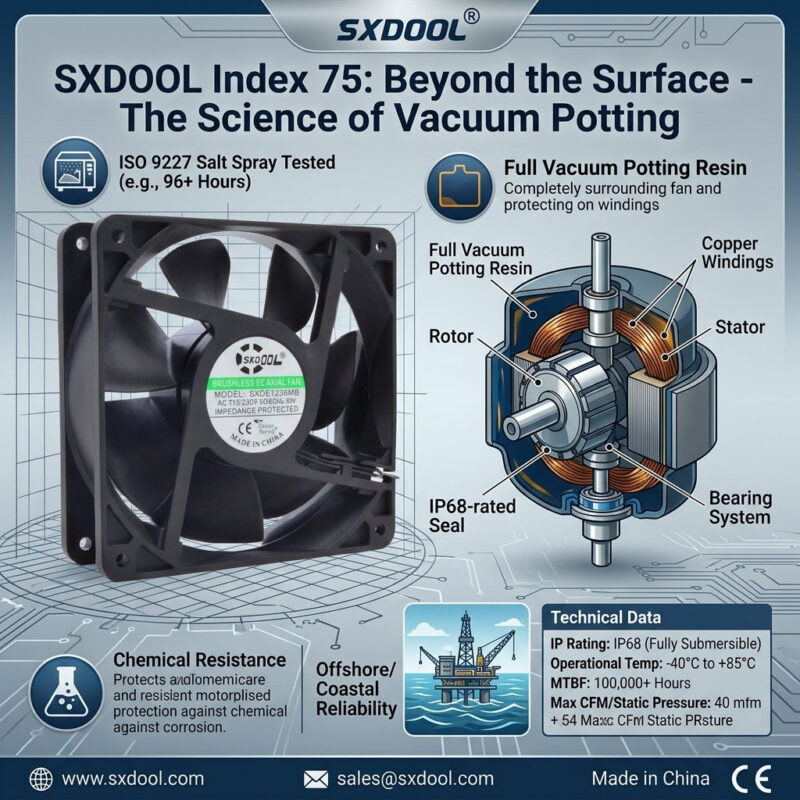
– Vacuum Potting: The entire stator and PCB are encapsulated in a high-grade epoxy resin. This not only protects against moisture and conductive dust but also provides additional mechanical damping against high-frequency vibration.
– Japanese NMB Bearings: To ensure a service life (L10) of over 70,000 hours, we use dual ball bearings from NMB. These are sealed with specialized lubricants that prevent “washout” from high-speed air currents and maintain viscosity across extreme temperature ranges (-40°C to +85°C).
Managing the Exhaust: Avoiding Recirculation
A common mistake in under-carriage design is failing to manage where the hot air goes. In a high-speed environment, hot exhaust air can be caught in the turbulent wake and sucked back into the intake. Strategic placement of louvers and the use of directional airflow fans are essential to ensure that the “cold” intake and “hot” exhaust remain thermally isolated.
Conclusion: Reliability at 300 km/h
The transition from a stationary platform to a high-speed vehicle changes every rule of thermal management. Under-carriage electronic bays are the silent workhorses of the railway industry, and their reliability depends on a cooling system that can handle the unique aerodynamic stresses of the tracks.
By choosing EN50155-compliant cooling solutions with high-static pressure capabilities and ruggedized construction, railway engineers can ensure that their traction and power systems remain cool, regardless of the speed. At SXDOOL, we provide the engineering expertise and high-performance fans necessary to keep the world’s high-speed rail networks moving safely and efficiently.
—
Keywords: High-Speed Rail Cooling, Under-Carriage Electronic Bay, Airflow Transitions, EN50155, Railway Thermal Management, High-Static Pressure Fan, SXDOOL, NMB Bearings.