Blog
Acoustic Design for Passenger Cabin HVAC Fans in High-Speed Rail

Acoustic Design for Passenger Cabin HVAC Fans in High-Speed Rail
In the competitive landscape of modern transportation, passenger comfort is a primary differentiator. High-speed rail (HSR) networks are often marketed as a more relaxing and productive alternative to air travel. A significant portion of this “premium” experience depends on the acoustic environment within the passenger cabin. While the sound of wheels on rails is a given, the hum of the Heating, Ventilation, and Air Conditioning (HVAC) system is something that can—and must—be optimized.
Designing HVAC fans for passenger cabins requires a delicate balance between high airflow (to ensure air quality and temperature consistency) and ultra-low noise levels. In this article, we explore the acoustic engineering principles used to create silent, efficient ventilation systems for high-speed rolling stock.
The Sources of Fan Noise: Aerodynamic vs. Mechanical
To reduce noise, engineers must first understand its origins. In a cooling fan, noise is generally categorized into two types:
1. Aerodynamic Noise (Broadband Noise)
This is the “whooshing” sound caused by air turbulence. As the fan blades move through the air, they create pressure fluctuations. When these fluctuations occur at high frequency, they manifest as broadband noise. Factors influencing this include:
– Blade Pass Frequency (BPF): The discrete tones created as each blade passes a fixed point (like a support strut).
– Vortex Shedding: The turbulence created at the trailing edge of the fan blades.
– Tip Turbulence: Air leaking between the blade tip and the fan housing.
2. Mechanical Noise (Structure-Borne Noise)
This is the humming or buzzing sound caused by the physical components of the fan.
– Bearing Noise: Friction or vibration in the ball bearings.
– Motor Cogging: The magnetic pulses in the motor that can create vibrations.
– Resonance: If the fan’s operating frequency matches the natural frequency of the HVAC ducting or the cabin structure.
Strategies for Silent Ventilation
At SXDOOL, we employ several advanced engineering strategies to minimize both aerodynamic and mechanical noise in our railway-grade HVAC fans.
1. Biomimetic Blade Geometry
Inspired by the serrated edges of owl wings (which allow them to fly silently), we have developed fan blades with specialized “winglets” and serrated trailing edges. These features break up large air vortices into smaller, less energetic ones, significantly reducing the broadband noise generated at high RPMs.
2. Balanced Airflow and Pressure
Noise is often a byproduct of inefficiency. By using Computational Fluid Dynamics (CFD) to optimize the impeller and housing design, we ensure that air moves through the fan with minimal resistance and turbulence. A more efficient air path means the fan can rotate at a lower RPM while still delivering the same volume of air, which is the most effective way to reduce noise.
3. Vibration Isolation and Damping
Mechanical noise is often amplified by the structures to which the fan is mounted. To combat this, our passenger cabin fans feature:
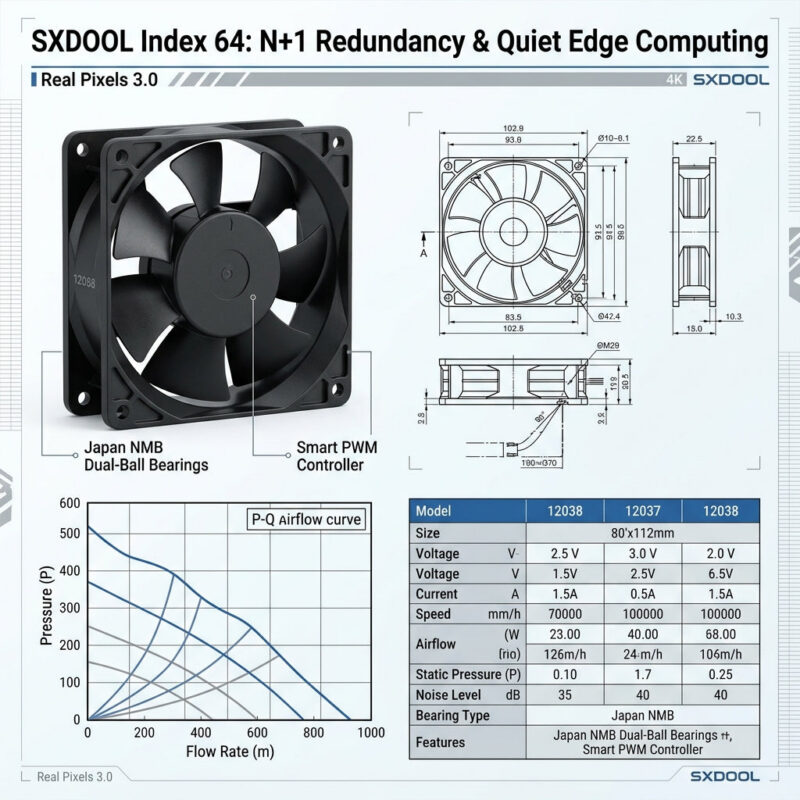
– Precision NMB Ball Bearings: We use ultra-low-noise dual ball bearings from NMB, which are manufactured to micron-level tolerances to minimize friction.
– Rubberized Isolation Mounts: These absorb high-frequency motor vibrations before they can reach the HVAC ductwork.
– Dynamic Balancing: Every impeller is balanced on two planes (G2.5 standard) to ensure that the center of mass aligns perfectly with the axis of rotation.
4. Advanced Motor Control (SVPWM)
Standard DC motors can produce “magnetic noise” due to the sharp switching of electrical phases. SXDOOL utilizes Space Vector Pulse Width Modulation (SVPWM) in our EC fans. This technology creates a smoother, sinusoidal current wave, which eliminates the cogging torque and the high-pitched “whine” often associated with electronic motors.
Psychoacoustics: Not All Noise is Equal
In passenger cabin design, engineers also consider psychoacoustics—the study of how humans perceive sound. A fan that produces a steady, low-frequency hum is often perceived as “white noise” and is less intrusive than a fan that produces a high-pitched tonal sound, even if the absolute decibel level (dB) is the same.
Our acoustic testing labs evaluate fans based on:
– Sound Pressure Level (SPL): The total volume of the noise.
– Sound Quality: Analyzing the frequency spectrum to ensure there are no annoying “peaks” or sharp tones.
– Modulation: Ensuring the noise level doesn’t fluctuate in a way that draws the passenger’s attention.
Integration with the Cabin HVAC System
The fan is only one part of the acoustic puzzle. The design of the ductwork, the placement of the diffusers, and the use of sound-absorbing materials within the HVAC unit all contribute to the final cabin experience. We work closely with rolling stock OEMs to provide fans that are “tuned” to the specific acoustic characteristics of their cabin architecture.
Conclusion: The Sound of Comfort
In the high-stakes world of high-speed rail, the difference between a good trip and a great one often comes down to the details. A silent, efficient HVAC system is a hallmark of premium engineering. By focusing on advanced blade geometry, precision mechanical components, and smart motor control, SXDOOL provides the cooling solutions that allow passengers to enjoy the journey in peace and quiet.
When reliability and silence are paramount, SXDOOL is the partner of choice for the world’s leading rail manufacturers. Our commitment to acoustic excellence ensures that the only thing your passengers will notice is the comfort.
—
Keywords: Passenger Cabin HVAC, High-Speed Rail Ventilation, Low-Noise Cooling Fan, Acoustic Engineering, Psychoacoustics, SXDOOL, NMB Bearings, EN50155.