Blog
Thermal Uniformity Challenges in Containerized Battery Energy Storage Systems

Thermal Uniformity Challenges in Containerized Battery Energy Storage Systems (BESS)
Introduction: The Scale of the Thermal Challenge
As the global transition toward renewable energy accelerates, grid-scale Battery Energy Storage Systems (BESS) have become indispensable for frequency regulation, peak shaving, and renewable integration. These systems, often housed in standard 20-foot or 40-foot ISO containers, pack megawatts of power into confined spaces. However, this high energy density brings a critical engineering hurdle: thermal uniformity.
In a containerized BESS, thousands of lithium-ion cells are interconnected. Even minor temperature variances between these cells can lead to significant performance degradation, reduced cycle life, and, in extreme cases, catastrophic thermal runaway. This article explores the physics behind thermal non-uniformity, its impact on battery chemistry via the Arrhenius Law, and the fluid dynamic strategies required to achieve a balanced thermal environment.
—
1. The Physics of Thermal Non-Uniformity: Why Gradients Form
Thermal uniformity refers to the consistency of temperature across all battery cells within a module, rack, and the entire container. In a perfectly uniform system, $\Delta T = T_{max} – T_{min}$ would be zero. In practice, BESS designers strive for a $\Delta T < 3^\circ\text{C}$ to $5^\circ\text{C}$ across the entire pack.
1.1 Internal Heat Generation
The heat generated by a lithium-ion cell during charge/discharge is governed by two primary components: Joule heating and entropic heat.
$$Q_{gen} = I^2R_{int} + I \cdot T \cdot \frac{dE_{oc}}{dT}$$
Where:
$I^2R_{int}$: Irreversible Joule heating (ohmic resistance).
$I \cdot T \cdot \frac{dE_{oc}}{dT}$: Reversible entropic heat (chemical reaction).
In high-density racks, cells in the center of the stack often lack sufficient surface area for heat dissipation compared to those at the periphery, leading to “core-to-surface” and “cell-to-cell” gradients.
1.2 The “Daisy-Chain” Heating Effect
In air-cooled systems, the cooling medium (air) absorbs heat as it travels from the inlet to the outlet.
$$Q_{air} = \dot{m} C_p (T_{out} – T_{in})$$
As the air temperature rises, its ability to remove heat from downstream cells decreases (the $\Delta T$ between the cell surface and the air shrinks), causing a natural temperature gradient along the flow path.
—
2. Impact on SOC and SOH: The Arrhenius Law
Temperature is the primary driver of chemical reaction rates within a battery. The impact of thermal non-uniformity on the State of Health (SOH) and State of Charge (SOC) is mathematically described by the Arrhenius Equation:
$$k = A \cdot e^{-\frac{E_a}{RT}}$$
Where:
$k$: Reaction rate (e.g., SEI layer growth, electrolyte decomposition).
$E_a$: Activation energy.
$R$: Universal gas constant.
$T$: Absolute temperature.
2.1 Accelerated Aging
A cell operating at $10^\circ\text{C}$ higher than its neighbor will age significantly faster. According to the Arrhenius relationship, a $10^\circ\text{C}$ rise can roughly double the rate of parasitic chemical reactions, such as the thickening of the Solid Electrolyte Interphase (SEI) layer. This leads to higher internal resistance ($R_{int}$) and lower capacity.
2.2 SOC Imbalance
Because internal resistance is temperature-dependent, cells at different temperatures will exhibit different voltage drops under the same current load. This causes uneven current distribution in parallel-connected strings, leading to SOC divergence. Over time, the BMS (Battery Management System) must throttle the entire string to protect the “weakest” (hottest/most aged) cell, significantly reducing the usable energy of the BESS.
2. Localized Hotspots and Thermal Runaway Risks
Localized hotspots are regions within a battery module where heat generation significantly exceeds the local cooling capacity. These are often found in the center of dense racks or near busbar connections where contact resistance ($R_{contact}$) adds to the heat load.
2.1 The Critical Temperature ($T_{crit}$)
Once a cell reaches a critical temperature (typically $70^\circ\text{C}$ to $90^\circ\text{C}$ for LiFePO4), the SEI layer begins to decompose exothermically.
$$\frac{dT}{dt} = \frac{Q_{gen} + Q_{exo} – Q_{cool}}{m C_p}$$
If $Q_{exo}$ (heat from chemical decomposition) exceeds $Q_{cool}$ (cooling capacity), the cell enters a self-sustaining heating cycle known as thermal runaway. In a containerized BESS, a single cell in runaway can propagate heat to its neighbors via conduction and radiation, leading to a container-wide fire. Maintaining uniformity is, therefore, the first line of defense against catastrophic failure.
—
3. Fluid Dynamic Challenges: Airflow Bypass and Pressure Drop
Achieving uniformity in a containerized environment is fundamentally a problem of Computational Fluid Dynamics (CFD).
3.1 Airflow Bypass Effects
Air, like electricity, follows the path of least resistance. In a battery rack, if there are gaps between the rack frame and the container wall, the cooling air will “bypass” the high-resistance battery modules. This “short-circuiting” of airflow leaves the center of the modules with stagnant air, creating localized hotspots. Engineering seals and baffles is necessary, but the primary driver of air must be powerful enough to overcome the internal module impedance.
3.2 Pressure-Drop Balancing
To force air through the dense internal structure of a battery module, the fan must overcome significant static pressure. The pressure drop ($\Delta P$) in a packed bed or dense rack can be modeled using a variation of the Darcy-Weisbach equation:
$$\Delta P = f \cdot \frac{L}{D_h} \cdot \frac{\rho v^2}{2}$$
Where $v$ is the air velocity and $f$ is the friction factor. If the system is not balanced, the modules closest to the main blower will receive excessive airflow, while distant modules suffer from starvation. This “flow maldistribution” is a primary cause of the cell-to-cell gradients discussed earlier.
—
4. Engineering Solutions: High-Static Pressure and Reliability
To combat these challenges, BESS designers are moving toward localized, high-performance cooling strategies.
4.1 SXDOOL 12038 High-Static Pressure Fans
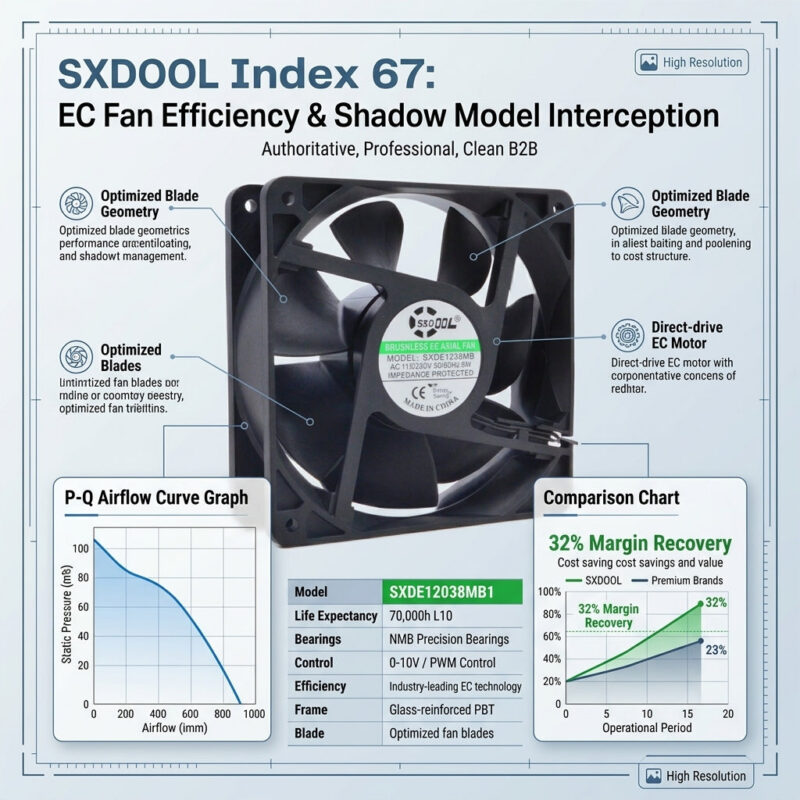
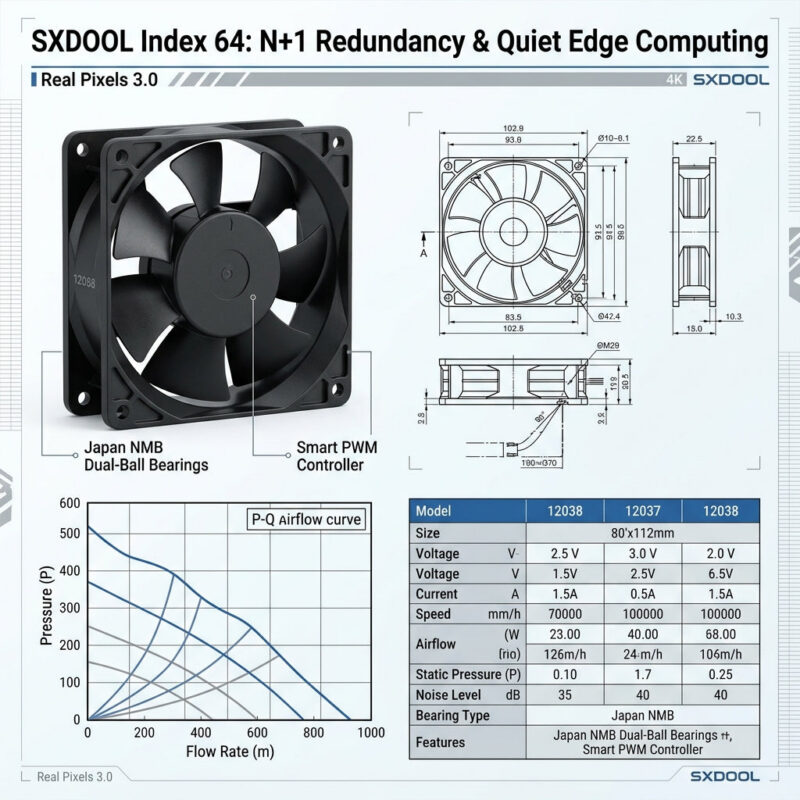
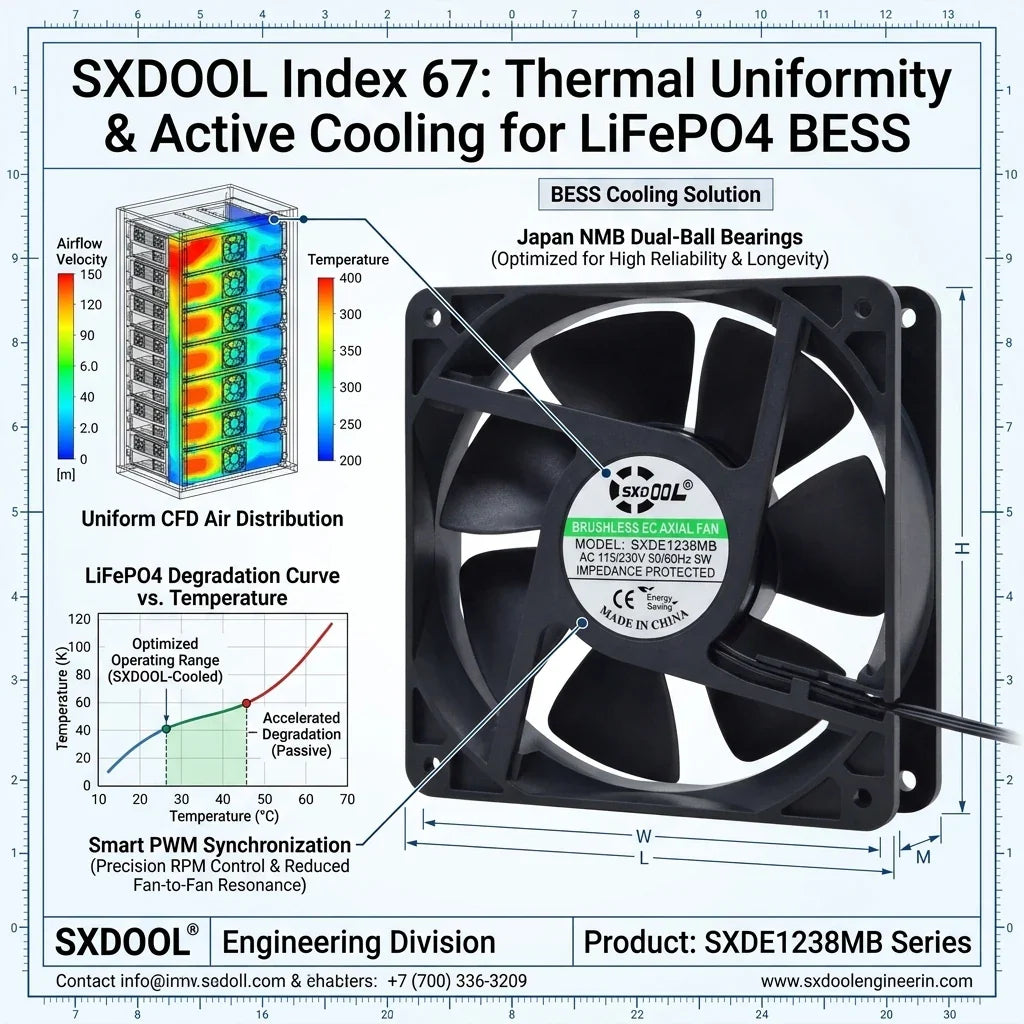
Standard axial fans often stall when faced with the high impedance of a dense BESS rack. The SXDOOL 12038 series is engineered specifically for high-density environments. With a 38mm depth and optimized blade geometry, these fans generate the high static pressure required to penetrate deep into cell arrays, eliminating the “dead zones” where hotspots typically form. The 12038 form factor provides the optimal leverage for the motor’s torque, translating into a steeper P-Q (Pressure-Flow) curve that remains stable even as filters become clogged with dust.
4.2 Precision Engineering with Japan NMB Bearings
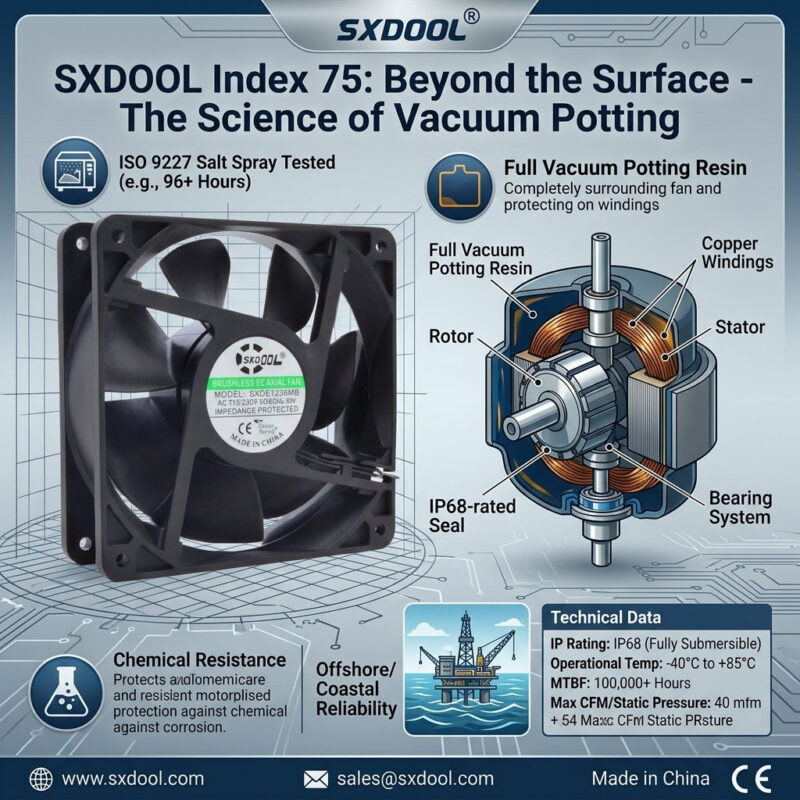
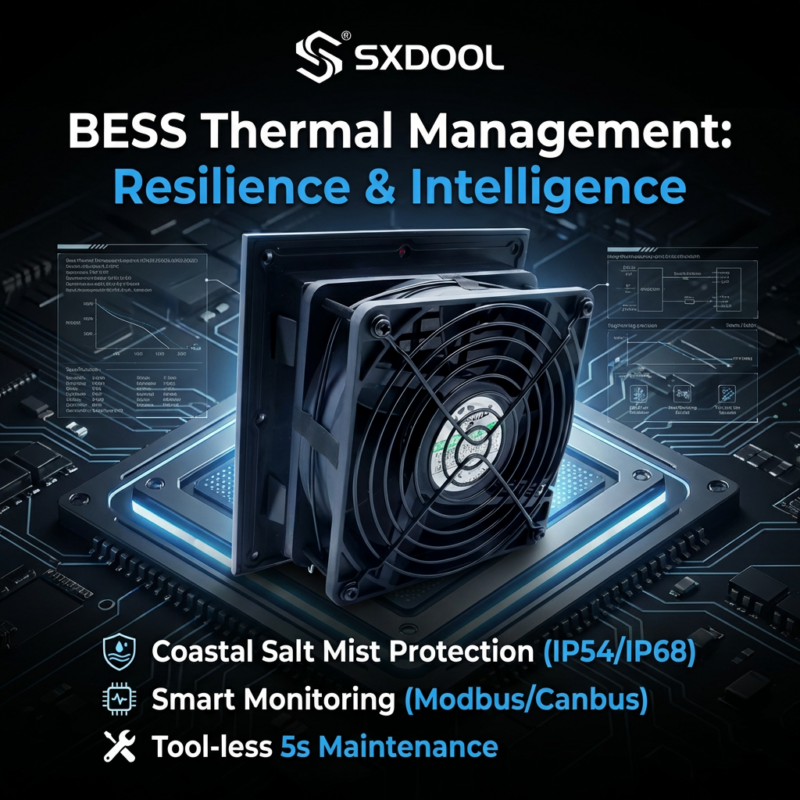
BESS containers are often deployed in harsh environments—from desert solar farms to coastal wind parks. Fan failure is not an option. SXDOOL integrates Japan NMB double ball bearings into their 12038 fans, providing:
**Extended L10 Life:** 70,000+ hours of continuous operation at rated temperatures.
**Vibration Resistance:** Maintaining axial stability even at high RPMs, which prevents blade-shroud interference.
**Thermal Resilience:** Stability across a wide operating temperature range (-10°C to +70°C), matching the survival range of the battery cells themselves.
4.3 1:1 Drop-in Replacement for Legacy Systems
Maintenance and retrofitting are major O&M costs for grid-scale BESS. SXDOOL fans are designed as 1:1 drop-in replacements for industry-standard sizes.
**Universal Mounting:** Standard hole patterns for easy installation.
**Plug-and-Play Connectors:** Compatible with existing BMS wiring harnesses (3-pin/4-pin PWM).
**Interchangeability:** Allows operators to replace lower-grade OEM fans with industrial-grade SXDOOL units without modifying existing rack hardware or control logic. This ensures seamless integration with existing PWM-based cooling loops while immediately improving the container’s thermal uniformity profile.
—
Technical Summary
**Thermal Gradient Goal:** Maintain $\Delta T < 5^\circ\text{C}$ to ensure balanced SOH across thousands of cells.
**Chemical Impact:** Use the Arrhenius Law to calculate the cost of non-uniformity in terms of cycle life loss.
**Fluid Dynamics:** Mitigate airflow bypass and solve pressure-drop imbalances with high-static pressure solutions.
**Hardware Choice:** Utilize 12038-sized fans with NMB bearings for the optimal balance of airflow, pressure, and long-term reliability.
—
SEO Checklist for BESS Thermal Management
[ ] **Primary Keyword:** Containerized BESS Thermal Management.
[ ] **Secondary Keywords:** Thermal Uniformity, Battery Hotspots, Li-ion Cell Gradients, BESS Cooling Fans.
[ ] **Formula Optimization:** Use LaTeX for technical formulas to increase authority.
[ ] **Internal Links:** Link to SXDOOL 12038 fan product specifications.
[ ] **Alt-Text:** Ensure all CFD diagrams and fan images have descriptive alt-text.
[ ] **Meta-Description:** Technical deep dive into thermal uniformity challenges in grid-scale BESS and high-static pressure solutions.