Blog
Air-side fan selection for liquid-to-air radiators

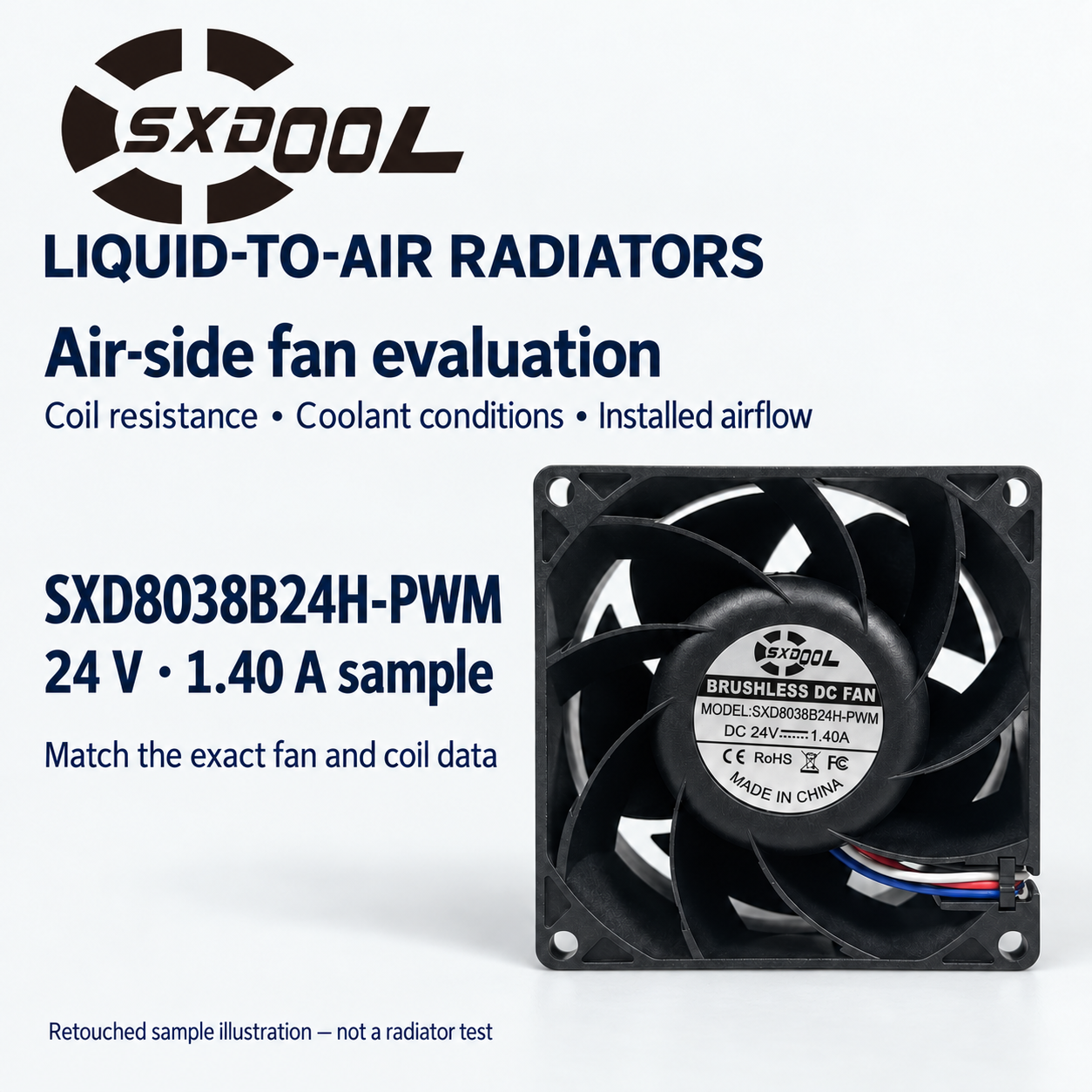
For a liquid-to-air radiator, choose the air-side fan against the coil’s pressure drop at the airflow needed for the required heat rejection. Check coolant flow and inlet temperatures as well. A fan’s maximum free-air flow is not the radiator’s cooling capacity.
Define the heat-rejection duty first
This guide focuses on compact equipment radiators serving electronics liquid loops. Industrial outdoor dry coolers use the same heat-rejection principle but require separate scale, environmental and fan-system evaluation. Do not treat a compact DC fan as a qualified dry-cooler solution.
A liquid loop carries heat from the load to the radiator; the radiator then rejects that heat to air. The target coolant temperature must leave a usable temperature difference above the available air temperature. A radiator does not act as a refrigerator. Include the actual loop heat inputs, coolant properties and allowable temperatures in the design brief.
Eaton’s liquid-cooling heat-exchanger overview describes heat transfer to a secondary air or liquid flow. Select the air-rejection architecture deliberately; a liquid-to-liquid exchanger has different equipment requirements.
Match the fan curve to the complete air path
The coil fin stack, guard, intake filter and enclosure all contribute resistance. Obtain their pressure-drop information or measure the assembled air path. Intersect that system requirement with the exact fan’s pressure–airflow curve at the intended supply and control condition. Maximum static pressure and maximum free-air flow occur at different operating conditions; they cannot be combined as simultaneous performance.
| Input | Why it changes the decision |
|---|---|
| Heat load and allowable coolant temperature | Define the required radiator duty; include the actual loop’s added heat sources. |
| Air and coolant inlet conditions | Determine the usable heat-transfer driving conditions and worst operating case. |
| Coolant flow and fluid specification | Required alongside the exchanger’s thermal data; more air cannot repair inadequate liquid circulation. |
| Coil and enclosure pressure drop | Set the fan’s installed operating point and identify restrictions. |
| Fan bank and control behavior | Require checks for flow distribution, recirculation, fault response and acoustic limits. |
Investigating an SXDOOL compact-radiator candidate
The SXD8038B24H-PWM model reference is worth investigating for a compact restricted air path when the available mounting space, power and controls can support the exact fan version. It is not already validated against a radiator coil. Request the matching drawing and measured curve before selecting an operating point.
The illustrated sample is identified as 24 V, 1.40 A on its label. The linked product page’s 24 V, 0.80 A reference is a separate version. Do not apply that reference’s current, speed or other performance figures to this sample. Supply sizing needs exact running and startup evidence; connector colors alone do not establish a signal interface.
Two checks before approving the radiator fan
The SXD8038B24H-PWM candidate must pass both an air-path check and a complete-loop thermal check. A curve intersection can support fan selection, but it does not establish the radiator’s heat-rejection capacity. Keep the illustrated 24 V, 1.40 A sample’s drawing and measured curve separate from the linked 0.80 A reference.
- Confirm a feasible radiator duty. Use the radiator maker’s thermal data for the proposed coolant, flow and air/coolant inlet conditions. If that duty cannot meet the required coolant temperature, revise the exchanger or cooling architecture before choosing a fan.
- Confirm the air-side operating point. Compare the exact fan curve at the intended supply and control setting with the coil, guard, filter and enclosure resistance. Include the shroud, bypass paths and intake/exhaust separation in the assembly being evaluated.
- Measure the complete loop. With the enclosure assembled, record coolant flow, inlet and outlet temperatures, air inlet condition, heat load and fan control setting. Compare the result with the equipment’s coolant-temperature and acoustic limits.
- Check the service condition. Repeat the required evaluation at the defined fouling or filter-service condition and verify maintenance access. Apply the equipment maker’s protection plan to fan and circulation fault checks.
Accept or revise the design: retain the candidate only when the complete assembly meets the specified duty and operating limits. If coolant temperature is too high, diagnose coolant flow, air recirculation, bypass and restriction before changing fan speed. If the target requires cooling below the available air temperature, this air-rejection architecture needs to be reconsidered. Keep the fan version, radiator configuration and test conditions together in the qualification record.
These checks are design guidance, not a claimed SXDOOL field result. No outdoor IP rating, dry-cooler capacity, coolant compatibility, service life or certification is assigned to the candidate without exact supporting documentation. A failed pump, blocked liquid circuit or leaking loop requires liquid-side diagnosis. For comparison of system architectures, see immersion and direct-to-chip cooling with secondary airflow.
Liquid-to-air radiator fan questions
Can a liquid-to-air radiator cool below ambient air temperature?
A radiator rejecting heat to ambient air does not provide refrigeration. It needs a usable temperature difference for heat transfer. If the required coolant temperature is below the available air temperature, evaluate a different cooling architecture.
Can the maximum free-air rating determine radiator cooling capacity?
No. The fan must operate against the radiator and enclosure pressure drop. Cooling capacity also depends on coolant flow, fluid properties, inlet temperatures and the heat exchanger’s thermal data.
Does the SXD8038B24H-PWM sample qualify a dry cooler?
No. It is a candidate for investigating compact equipment airflow where mounting and operating-point data support it. A large outdoor dry cooler requires separate fan-system, environmental, control and heat-exchanger evidence.
Request a fan evaluation for this equipment
Send the compartment or radiator drawing and the operating conditions above. Identify the exact sample version and the criteria it must meet; an inquiry does not establish tested compatibility.
Discuss this equipment’s cooling requirements