Blog
Selecting cooling fans for LED stage lighting

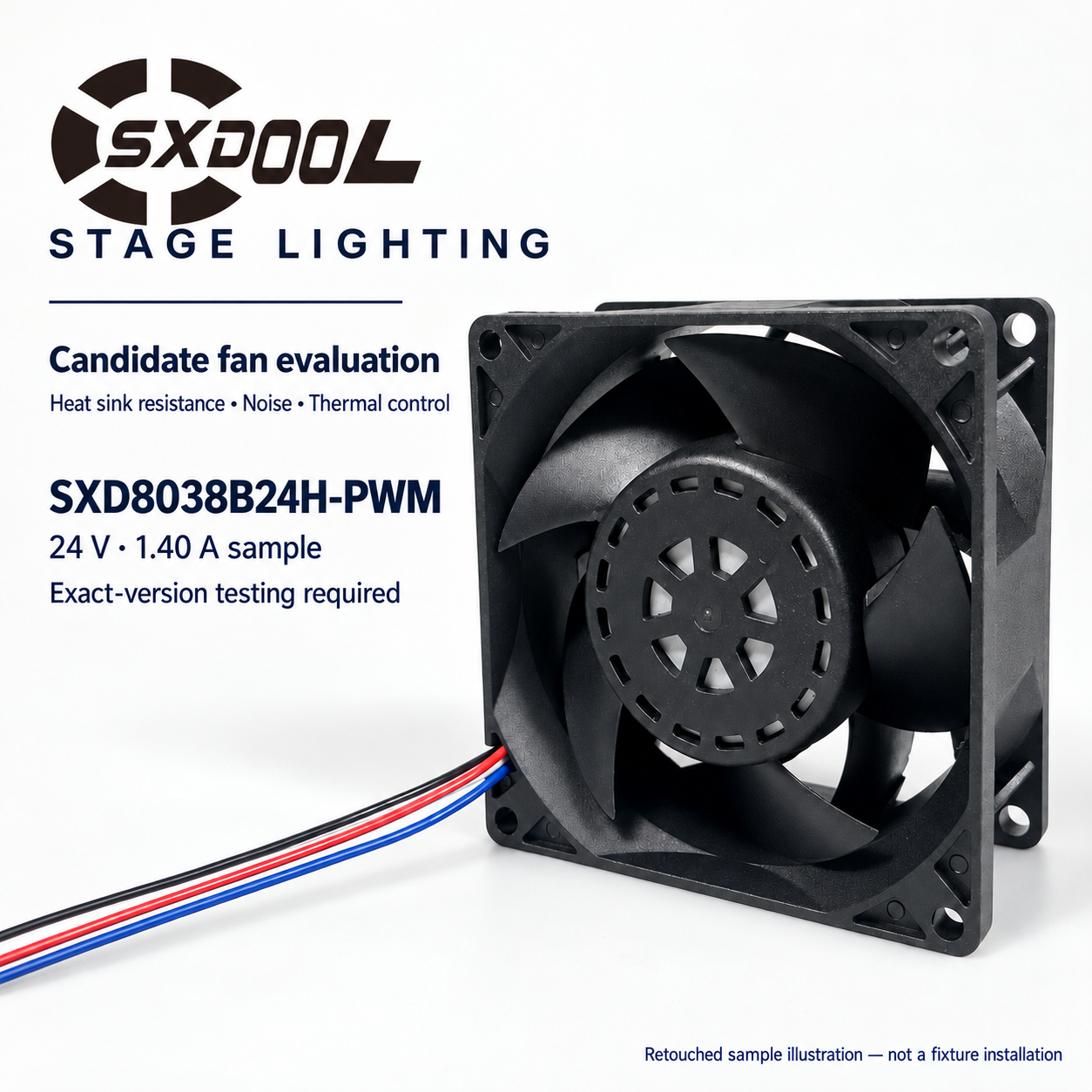
For LED stage fixtures, evaluate light output, heat-sink temperature and audience-area noise together. A fan that fits the frame is only a candidate. Validate the assembled fixture’s airflow path, dust exposure and thermal-control modes before approving it.
Separate the head from the base
A moving-head fixture can put the LED engine and optical assembly in the head while its power supply and control electronics occupy the base. Map both zones. A head fan may need to push air through a dense heat sink; a base fan may primarily ventilate electronics. Moving axes, guards, cables and nearby surfaces can restrict an otherwise open exhaust. Check the complete movement envelope rather than only a stationary bench setup.
Do not direct dirty intake air into optics without checking the fixture design. Keep maintenance access and the manufacturer’s cleaning procedure in the design review. Residue associated with the venue’s operating environment can change the airflow path over time.
Specify quiet operation as a measured condition
For broadcast studios, theatres and other noise-sensitive venues, state the microphone or listener location, background conditions, fixture operating mode and permitted sound level. A free-standing fan sound measurement alone does not establish fixture noise. Guards, ducts and mounting can introduce tones or vibration.
The official Martin MAC Ultra Performance safety and installation manual describes fan modes and output limits associated with reduced cooling. Use that example to plan simultaneous temperature and output checks, not to assume the same controls or limits for every fixture. The exact fixture manual governs its permitted modes.
| Use condition | What to compare |
|---|---|
| Quiet scene or recording | Acoustic behavior, steady temperatures and available output at the defined quiet setting. |
| Long bright scene | Heat-sink and driver temperatures after thermal stabilization at the specified inlet condition. |
| Dust or haze exposure | OEM-approved maintenance interval, accessible air paths and resistance at the defined service condition. |
| Moving head or fan fault | Cable clearance, exhaust obstruction and the controller’s protective response. |
SXDOOL candidate for a restricted heat-sink path
SXD8038B24H-PWM is a model to investigate if the fixture design can accommodate the corresponding fan assembly and its control interface. Its product page positions the reference for restricted airflow paths. That positioning is a reason to request technical evidence, not proof of an installed operating point or quiet operation.
The illustrated desktop sample is labeled 24 V, 1.40 A. The linked listing separately identifies a 24 V, 0.80 A reference. Keep these versions separate: request the dimensional drawing, startup-current limits, signal definition and pressure–airflow data for the exact sample being quoted. Do not transfer speed, noise, life or protection claims between versions. A high-speed candidate may be unsuitable where the acoustic limit cannot be met.
When should this fan candidate move to a fixture trial?
Move the SXD8038B24H-PWM candidate to an assembled-fixture trial only after its exact drawing and electrical interface match the head or base being cooled. For the illustrated 24 V, 1.40 A sample, request matching test documents; the linked 0.80 A reference cannot supply its acceptance data.
- Define the operating modes. For each required quiet, normal or high-output mode, record the required light output, component temperature limits, inlet condition and permitted sound level at the agreed microphone or listener position.
- Check the heat-sink air path. Compare the exact sample’s pressure–airflow curve with the assembled heat sink, guards and vents. Inspect cable and exhaust clearance across the fixture’s movement envelope.
- Verify the electrical configuration. Match the supply and startup limits, connector, PWM input and any specified fault output to the fixture controller. A matching model name alone is insufficient.
- Test the complete mode. Record light output, stabilized temperatures and acoustic behavior together at the same control setting. Include the defined maintenance condition and the fixture maker’s required fault-response checks.
Accept or revise the design: retain the candidate only when the required output, temperatures and sound limits pass together. If a quiet setting fails the thermal target, first review heat-sink and air-path restrictions or the permitted output; simply increasing speed may conflict with the acoustic requirement. If clearance or the controller interface fails, resolve that mismatch before further testing. Record the sample label, drawing revision, control setting and fixture configuration with the result.
A fan is not a substitute for the fixture’s heat-sink design or thermal protection. No lighting certification, outdoor protection rating or tested fixture compatibility is implied here. For broader equipment context, see lighting and audiovisual cooling applications.
Stage-lighting fan questions
Can a quiet-mode fan setting replace thermal testing?
No. Validate light output and component temperatures together at the hottest rated inlet condition. Reducing fan speed may require reduced fixture output; the allowed behavior is defined by the fixture manufacturer.
Can a PWM fan connect directly to DMX?
Do not connect it directly. DMX is a fixture control network; a fan’s PWM or tachometer interface is an electrical component interface. Confirm the fixture controller, signal levels, pinout and fault behavior against the exact fan drawing.
Is the illustrated SXD8038B24H-PWM already approved for stage fixtures?
No. The photograph identifies a 24 V, 1.40 A sample selected for evaluation. It is different from the linked product page’s 0.80 A reference. No stage-fixture fit, acoustic performance or pressure–airflow result is established by the photograph.
Request a fan evaluation for this equipment
Send the fixture head/base layout, heat-sink and air-path drawings, and the operating conditions above. Identify the exact sample version and the criteria it must meet; an inquiry does not establish tested compatibility.
Discuss this equipment’s cooling requirements