Blog
CNC Control Cabinet Cooling: Electronics, Air Paths and Maintenance

CNC control cabinet cooling starts with the electronics, the available air path and the machine’s working environment. A fan is a candidate only when it can deliver the required airflow through the installed restrictions, use the available supply and preserve the enclosure’s protection strategy. This guide covers control and drive electronics; spindle liquid cooling and machining-zone mist extraction require separate designs.
Identify which part of the CNC cabinet needs cooling
Map the controller, servo and spindle-drive electronics, power supplies, PLC and communication hardware before choosing a fan. Rittal lists these equipment types among enclosure heat sources in its Climate Solutions Handbook. Their arrangement matters: a cabinet exhaust fan, a local electronics fan and a fan inside an existing cooling unit perform different jobs.
For a new cabinet, ask the machine builder for component losses and permitted inlet temperatures over the intended machining cycle. For a replacement, record the installed fan’s complete identification and the machine’s service part number. Motor output power is not a substitute for cabinet heat loss. A matching frame size alone does not establish replacement compatibility.
Choose the air circuit before choosing the fan
| Cabinet condition | Possible approach | Decision boundary |
|---|---|---|
| Usable, cooler ambient air | Filtered intake and a defined discharge path. | Check contamination control, installed airflow and the maximum permitted electronics temperature. |
| Localized hot spot inside a protected cabinet | Internal circulation or directed airflow around the affected electronics. | Circulation redistributes heat; the cabinet still needs a way to reject that heat. |
| Ambient air unsuitable for direct intake, or insufficient temperature margin | Evaluate a separate enclosure heat exchanger or cooling unit. | The machine designer must select the complete system. A bare fan cannot replace its cooling or contamination-control function. |
Rittal’s filter-fan guidance identifies cooler surrounding air and the enclosure’s thermal load as starting conditions. Do not expect ventilation alone to maintain cabinet air below the intake-air temperature.
Machining environments also require a contamination assessment. Record coolant mist, airborne oil, fine or conductive particles and cleaning exposure at the proposed intake. Filter media and the cooling architecture must be suitable for that exposure; a generic dust filter is not evidence of oil-mist protection. Rittal’s filter-selection guidance distinguishes the needs of direct ambient-air intake from separate cooling circuits.
Check pressure loss and prevent hot-air recirculation
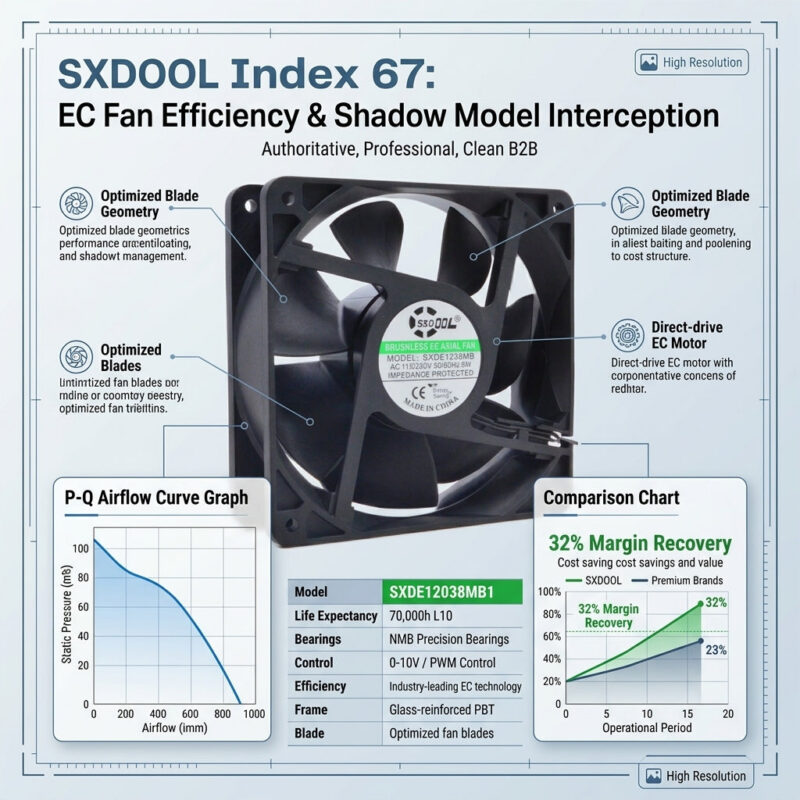
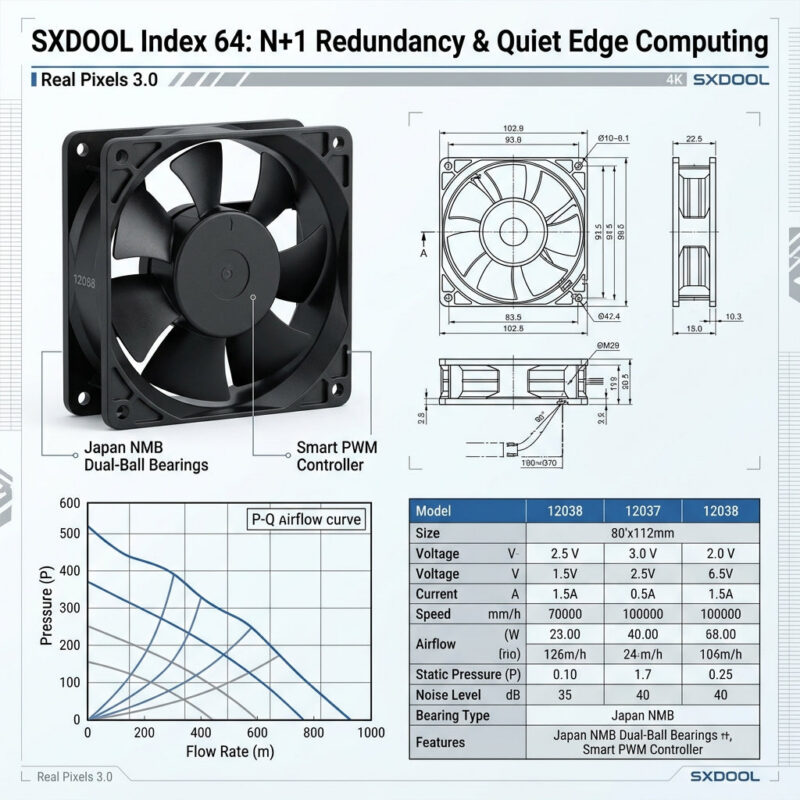
Size the fan against the complete air path: filter, protective grille, duct turns, cable obstruction and electronics passages. The free-air airflow value does not show how much air reaches the components after installation. Request a fan pressure–airflow curve and evaluate its operating point against the system resistance, including the agreed filter service condition.
Keep the discharge from returning directly to the intake. Review partition openings, cable penetrations and the pressure path around the drive; a fan can be running while heated air recirculates. Confirm clearances from the exact drive and machine documentation rather than copying dimensions from another platform.
During an approved equipment test, compare intake temperature, the affected component temperatures and exhaust temperature under the representative worst-case duty. Also check the fan’s noise during quiet or idle machine periods: more speed can increase noise without fixing an obstructed or recirculating air path.
Make filter access and fault detection part of the design
Leave enough access to inspect and service the filter without moving sensitive wiring. Record the filter condition, intake blockage and visible deposits when investigating recurring temperature alarms. Haas identifies a clogged intake filter and a damaged or obstructed fan as possible causes of inadequate airflow in its Cabinet Cooler troubleshooting guide. That is a diagnostic example for its equipment, not proof that a particular SXDOOL fan fits a Haas machine.
Set the inspection interval from the machine manual and the actual environment. For example, the Haas MM/SMM maintenance schedule lists vector-drive vents and filter cleaning. Its interval applies to that equipment and should not be treated as a universal CNC maintenance period.
If monitoring is required, specify what the controller must detect. A rotation signal can indicate fan motion, but it does not establish airflow through a blocked filter. Confirm the exact signal type, electrical interface, controller input and required response separately from speed-control requirements.
An SXDOOL product path to evaluate
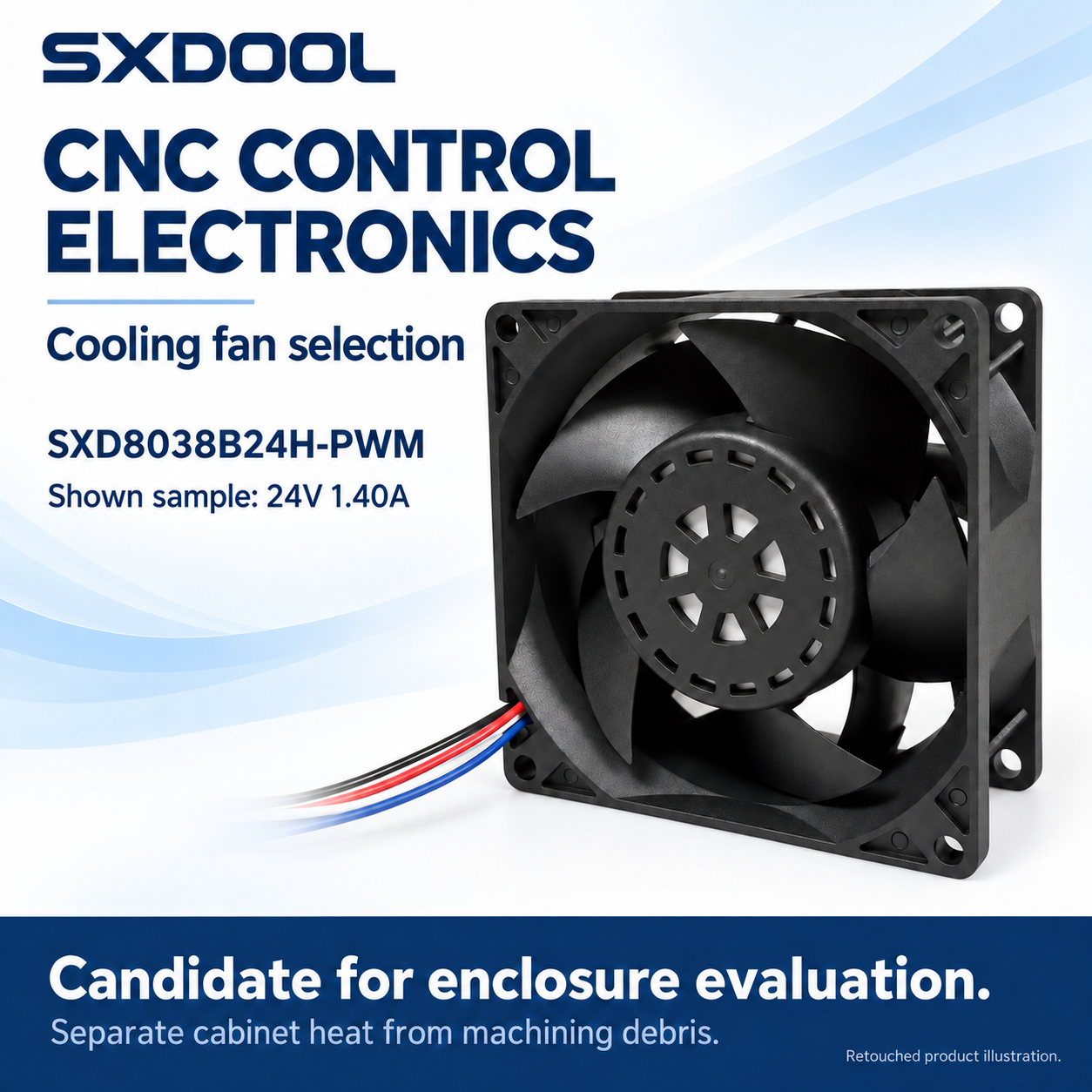
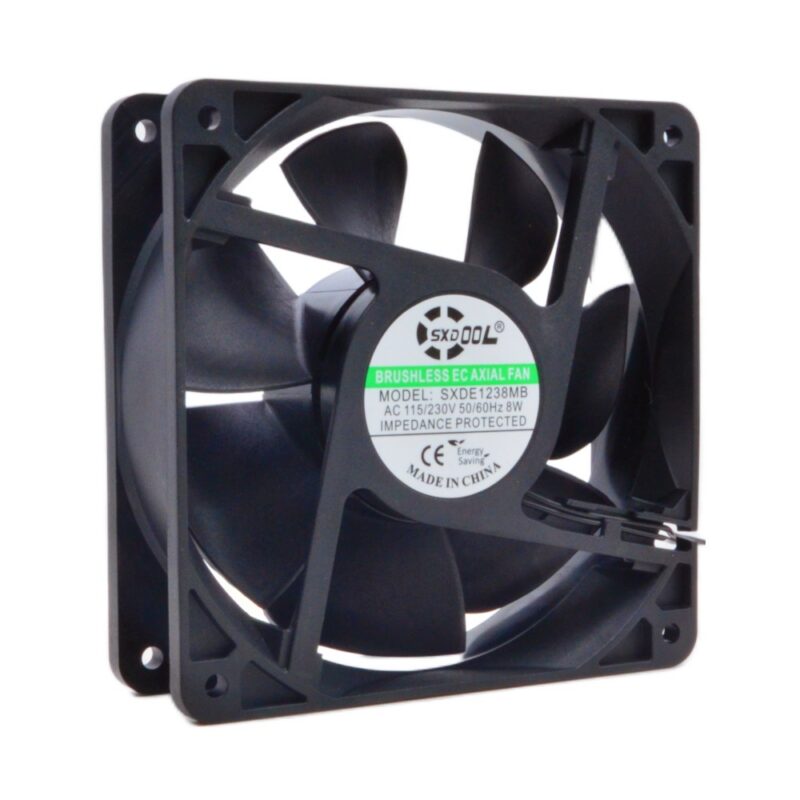
For a new CNC electronics cabinet or a machine-builder-approved design change, use the SXD8038B24H-PWM product reference to request a configuration assessment. Its catalog positioning does not establish installed flow through an oil-contaminated filter or compatibility with an existing drive fan. Ask for the current mechanical drawing, pressure–airflow curve, electrical limits, control and feedback definitions, connector and starting behavior. Compare those with the equipment requirements before ordering a sample. No airflow, pressure, acoustic, service-life or environmental rating is assigned by this application guide.
Qualification boundary: Final selection requires the exact offered configuration and a test in the completed equipment. No named equipment-maker approval, universal fit, guaranteed cooling result or certification is claimed here.
Review the SXDOOL product reference · Technical document resources
Information needed to evaluate an SXDOOL candidate
Send the information below with the application name “CNC control cabinet electronics.” It allows the proposed fan to be assessed against the cabinet rather than selected from a nominal size alone.
- Machine model, cabinet function, existing fan label and relevant service drawing.
- Fan envelope, hole pattern, mounting orientation, air direction and service access.
- Supply type and available voltage, connector, pinout, lead routing and required control or monitoring interface.
- Component heat-loss data or measured temperature problem, ambient conditions and representative operating cycle.
- Filter and grille details, air-path sketch and available airflow or pressure measurements.
- Coolant and cleaning exposure, airborne contamination, noise requirements and required machine approvals.
The resulting model shortlist remains conditional until its current drawing, electrical information and performance evidence have been checked and the machine builder has validated the installed assembly.
CNC cooling questions
Will a higher-airflow fan solve a drive overheating alarm?
Not by itself. First establish the alarm cause and examine the filter, air route, ambient temperature and duty. Compare candidates at the installed pressure requirement, then validate temperatures in the machine. Do not use a larger free-air number as a guaranteed remedy.
Can an electronics cooling fan also remove coolant mist?
That is a separate system requirement. Haas documents coolant-mist and smoke removal under its Enclosure Exhaust system. A cabinet electronics fan should not be assumed to provide mist collection or protect personnel from process emissions.
Can I open the electrical cabinet to improve cooling?
Do not use an open electrical cabinet as a cooling workaround. Follow the machine manufacturer’s service procedure and use qualified personnel. Tormach’s 8L safety guidance requires the cabinet to remain closed in operation and warns that electrical components can retain hazardous voltage after power-off. Isolation, lockout and the equipment-specific stored-energy procedure remain necessary for service.
Manufacturer references explain equipment design and service considerations. They do not establish an endorsement, a replacement approval or a tested compatibility relationship between SXDOOL and the referenced machines.
Updated: (inquiry context and page readability).
Explore industrial cooling fan applications
Conductive dust in CNC workshop PCs · Control cabinet cooling principles