Blog
Cryogenic Cooling Solutions for Quantum Computing and Superconductors


Cryogenic Cooling Solutions for Quantum Computing and Superconductors: The Backbone of the Next Computing Era
Introduction
The horizon of computational power is being redefined by quantum computing and the application of superconducting materials. As we push the boundaries of Moore’s Law, the traditional silicon-based architecture faces physical limitations that only quantum mechanics can transcend. However, the promise of quantum supremacy comes with a formidable engineering challenge: thermal management at the cryogenic scale. Quantum bits (qubits) and superconductors require environments that are among the coldest places in the universe, often reaching temperatures just a few millikelvins (mK) above absolute zero.
This article discusses room-temperature support equipment around cryogenic systems. SXDOOL fan selection for such equipment requires a model-specific engineering review; it does not establish fan operation inside a cryostat or a verified quantum-industry installation.
The Challenge of Absolute Zero: Why Temperature Matters
Quantum computing relies on the delicate states of superposition and entanglement. These states are extremely sensitive to environmental noise, particularly thermal energy. At room temperature, the thermal energy (represented as kT, where k is the Boltzmann constant and T is temperature) is significantly higher than the energy levels associated with qubit operations. This leads to “decoherence”—the loss of quantum information as the qubit interacts with its environment.
To maintain quantum coherence, superconducting qubits typically operate at temperatures below 20 mK. For perspective, deep space is approximately 2.7 K, meaning a quantum computer is over 100 times colder than the void of space. This extreme environment is necessary to suppress thermal phonons—vibrations in the crystal lattice—that would otherwise flip the qubit’s state.
Superconductivity and the Zero-Resistance State
Superconductors are materials that exhibit zero electrical resistance and the expulsion of magnetic fields when cooled below a characteristic critical temperature (Tc). While “high-temperature” superconductors (HTS) can operate at liquid nitrogen temperatures (77 K), the most advanced quantum processors use low-temperature superconductors (LTS) like aluminum or niobium, which require liquid helium cooling (4.2 K) or further sub-Kelvin cooling.
The stability of these temperatures is paramount. Even a micro-Kelvin fluctuation can disrupt the superconducting state and introduce electrical resistance. In high-current applications, such as the superconducting magnets used in MRI machines or particle accelerators, a “quench” (the sudden loss of superconductivity) can lead to catastrophic heat generation and system damage.
The Mechanics of Cryogenic Cooling: Dilution Refrigerators
The workhorse of the quantum computing industry is the dilution refrigerator. This device uses a mixture of two isotopes of helium: Helium-3 and Helium-4. By exploiting the unique phase separation properties of this mixture at sub-Kelvin temperatures, dilution refrigerators can provide continuous cooling power.
The Multi-Stage Cooling Chain
- **Stage 1: Room Temperature to 50 K:** Pulse tube cryocoolers or Gifford-McMahon (GM) coolers are used to dissipate the initial bulk heat. These systems rely on high-power compressors located outside the cryostat.
- **Stage 2: 50 K to 4 K:** The “Cold Head” reaches the temperature of liquid helium. This is a critical transition point where most thermal radiation shields are placed.
- **Stage 3: The 1 K Pot:** This stage uses the Joule-Thomson effect and evaporative cooling of Helium-4 to reach approximately 1.2 K.
- **Stage 4: The Still and Mixing Chamber:** The Helium-3 is “diluted” into the Helium-4 phase, absorbing heat in the process. This final stage is where the quantum chip resides, typically at 10 mK to 15 mK.
- **Intelligent Cooling:** Use of 4-wire PWM (Pulse Width Modulation) fans to allow the system to “breath”—speeding up during intensive computations and slowing down during idle states to conserve energy.
- **Redundant Thermal Arrays:** Just like server power supplies, cooling fans will be deployed in N+1 redundant arrays to ensure zero downtime.
- **Advanced Materials:** Using ceramic bearings or specialized coatings for even longer life in extreme environments.
Supporting Infrastructure: The Unsung Hero of Cryogenics
While the focus is often on the mixing chamber, the success of a cryogenic system depends on the “Warm Side”—the room-temperature electronics and machinery that support the vacuum and refrigeration cycles. This is where thermal management becomes an industrial challenge.
Vacuum System Integrity
To prevent heat transfer via conduction and convection, the interior of a cryostat must be kept at an ultra-high vacuum (UHV). Turbo-molecular pumps and scroll pumps run continuously to maintain this vacuum. These pumps generate significant heat and require active cooling to prevent oil degradation and bearing failure.
Control Electronics and RF Hardware
A quantum computer requires a massive amount of microwave and RF cabling to send control pulses to the qubits. Each cable represents a “thermal leak” from the outside world. The racks of FPGA-based controllers, microwave generators, and cryo-amplifiers generate kilowatts of heat that must be removed from the laboratory environment to ensure the stability of the cryostat’s ambient surroundings.
Fan Qualification for Room-Temperature Support Equipment
For high-availability support equipment, define the airflow, vibration, acoustic and fault-response requirements before selecting a fan. Confirm the installation conditions and qualification evidence for the exact SXDOOL model.
Bearing and Reliability Evidence
Confirm the bearing specification and any named-brand requirement on the approved BOM for the selected model. Review the life definition, temperature, orientation, load and test basis before using a life value in an equipment reliability calculation.
Vibration and acoustic limits should be validated in the intended mounting arrangement. A general bearing description does not establish low vibration, a temperature envelope or a fixed service life for every SXDOOL fan.
Moisture and Environmental Qualification
Describe potential liquid exposure, condensation, particulates and corrosion conditions in the equipment specification. Request the exact fan construction, applicable ingress report and exposure-test evidence for the selected configuration.
Do not infer corrosion resistance, compatibility with cryogenic liquids or unrestricted waterproof operation from an IP designation or a potting description. Confirm the installation and report scope before using a protected fan in the application.
Data-Driven Performance: Static Pressure and Airflow
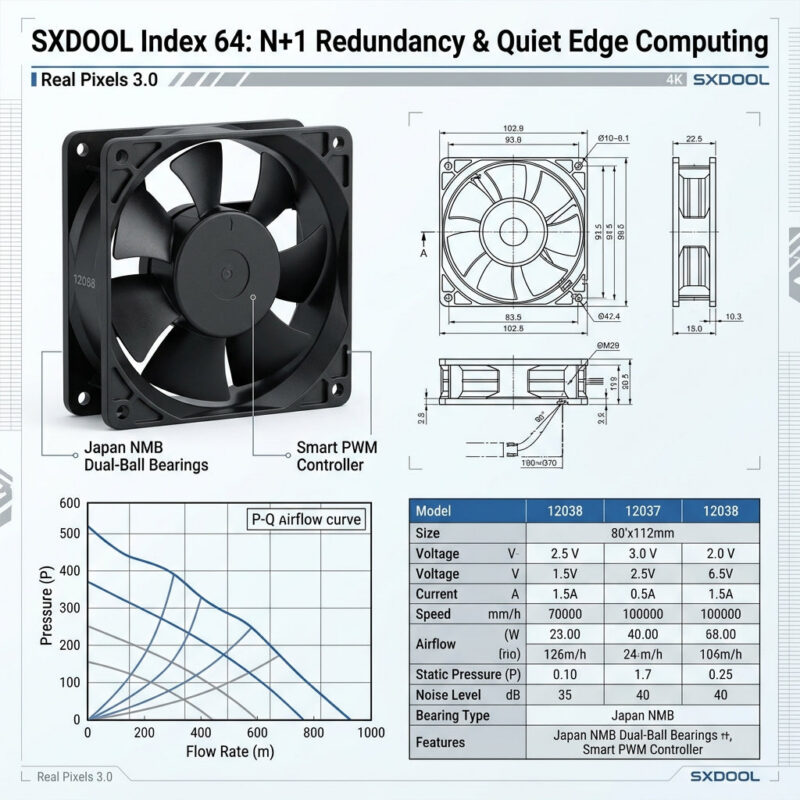
For dense control racks or other restricted airflow paths, match the selected model’s pressure-flow evidence with the equipment system resistance. Request the applicable curve and test conditions, and validate the installed temperature, power and acoustic result before release.
Application Review: External Compressor and Control Equipment
Cooling a room-temperature compressor enclosure or control rack is separate from refrigeration at the cold stage. Fan selection should use the equipment manufacturer’s heat load, airflow resistance, mounting space, supply and monitoring requirements. This example is a selection scenario, not a documented SXDOOL customer case or a claim that a 120mm or 140mm family is already qualified for the equipment.
Future Trends: The Scalable Quantum Data Center
As quantum computers move from the lab to the data center, the scale of thermal management will grow. We anticipate the following shifts:
Conclusion
For a room-temperature support-equipment project, send the operating conditions, airflow path, power architecture, interface and qualification requirements to SXDOOL. Approve the exact model and supporting evidence before production; this application discussion does not establish a bearing brand, IP rating, lifetime or industry approval for every fan.