Blog
Mounting a Fan Vertically: What Changes Inside

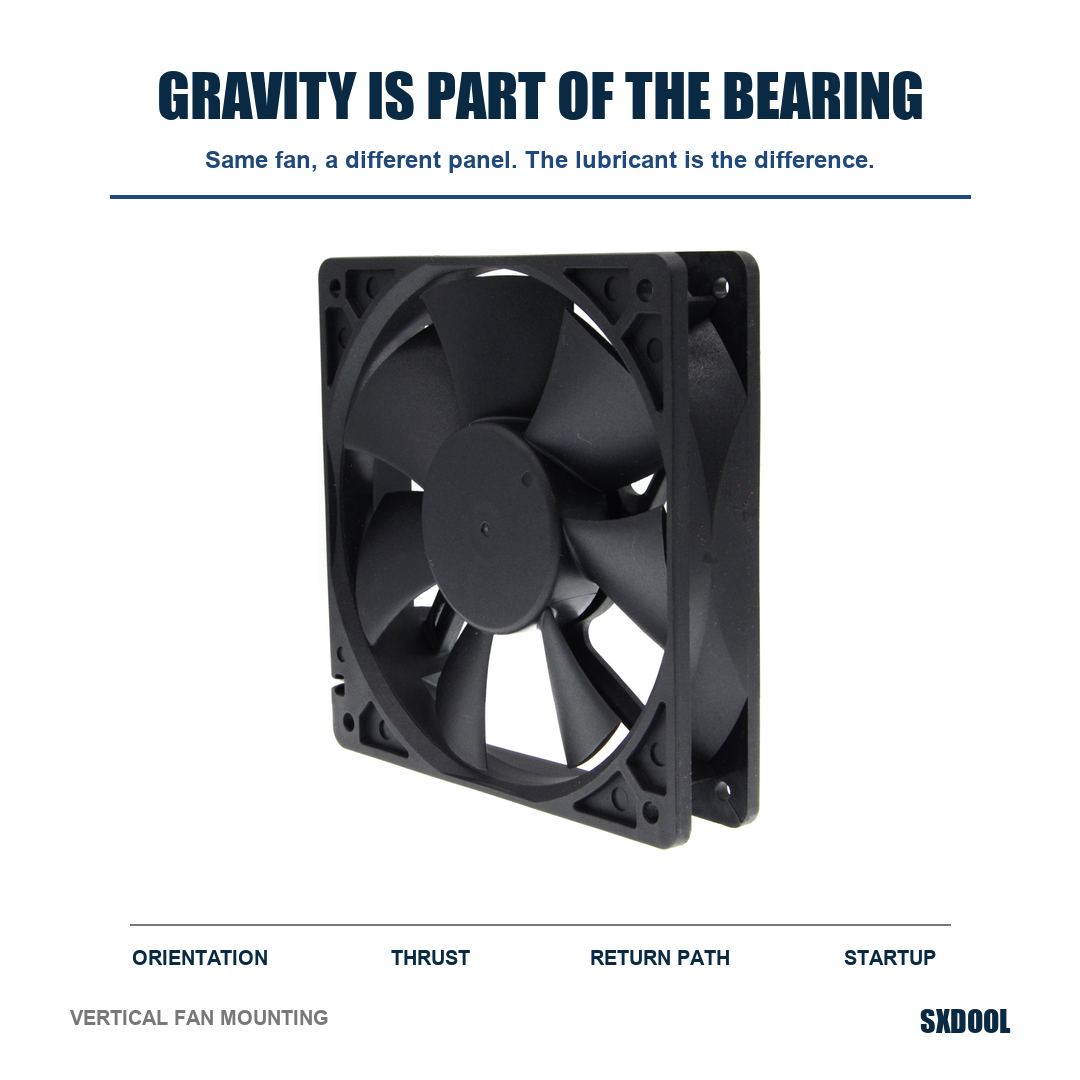
On most enclosure drawings, the fan’s orientation is decided by the panel, not by the fan. The panel has to be a vertical wall, so a fan is bolted to it, and the part number moves from a catalogue into a bill of materials without anyone asking whether that fan was ever qualified in that position.
Nothing visible changes. The frame is the same, the mounting holes line up, the airflow still leaves in the same direction. What changes is inside the bearing, where the lubricant has to stay in a place that gravity is now pulling it out of, and where the weight of the rotor may have started loading a surface it was not arranged to load.
Every life figure has an orientation
A rated life is a measurement, and a measurement has a fixture. The fixture holds the fan in one position, and that position is part of the test condition even when it is not printed beside the figure.
A fan qualified on a horizontal bench and installed in a vertical wall is not outside its specification in any obvious way. The dimensions match, the supply matches, the airflow matches. The difference is that the lubricant in its bearing is now working against a different force, and the load path through the bearing has changed direction. Neither shows up on a dimensional drawing, which is why neither is usually discussed.
This is not an argument against wall mounting axial fans. It is an argument for asking which way the qualification was run before the mounting is treated as a detail.
Grease is a reservoir, not a coating
Grease in a fan bearing is a charge held in the bearing cavity and in the space around it, released into the raceway gradually as the fan turns. The release is fed by rotation, by temperature, and by gravity. The first two do not care how the fan is mounted. The third does.
That is the whole mechanism, and it explains why two identical fans, one on a floor and one on a wall, can age differently in the same installation with the same duty. The fan on the wall is not working harder. Its reservoir is draining in a direction the design did not assume.
What a horizontal shaft does
In the common wall mount, the fan sits in a vertical panel and its shaft lies horizontal. Grease that is mobile enough to be released is also mobile enough to travel, and with the shaft horizontal it tends to collect on the low side of the cavity and along the shaft itself.
The consequence is not immediate. On the low side the bearing is fed more than it needs; on the high side it is fed less. A shield or a seal that was designed to keep grease in the bearing also keeps grease from finding its way back to the part of the raceway that is running dry. Over a long service life the gap between the fed side and the unfed side widens, and the failure, when it arrives, looks like ordinary bearing wear because in a sense it is.
The same reasoning explains why a fan that was quiet on a bench can develop a different tone in a wall: the loaded part of the bearing is a different part.
What a vertical shaft does
A fan mounted in a roof panel or a floor panel has its shaft vertical, and the mechanics change again. Gravity now pulls the lubricant down toward the lower bearing and away from the upper one.
More importantly, the direction of the rotor load changes. With a horizontal shaft the weight of the rotor is carried across the bearing as a radial load, which is the direction an axial fan bearing is normally arranged to carry. With a vertical shaft that same weight becomes a thrust load along the shaft, and whether the bearing is arranged to take it depends on the bearing type and on whether the rotor is retained against movement in that direction.
That is a design question with a definite answer, and it is answered at the bearing, not at the mounting holes. A fan that is perfectly suitable in a wall may need a different rotor retention in a roof, or may simply not be the right fan for that panel.
Throw-out and the return path
Rotation throws excess grease outward, off the rotating parts and into the cavity around them. Whether that grease comes back to the bearing depends on where the cavity drains.
Mount the fan so that the low point of the cavity is away from the bearing and the grease stays where it was thrown, and the reservoir loses volume it will not recover. Mount it so that the low point leads back toward the bearing and the charge circulates instead of accumulating in a corner.
This is also why adding grease is not a field fix. A greased-for-life bearing has no provision for replenishment, and adding more of anything does not make it stay where it was put. Where a fan will be mounted in an orientation the bearing was not designed around, the answer is a different bearing arrangement, chosen before the drawing is released.
Sleeve bearings are less forgiving
A sleeve bearing runs on an oil film generated by rotation in a gap between the shaft and the bore. The film depends on the shaft sitting in that gap with the oil supply arriving where it is needed.
Change the axis and the shaft’s rest position changes. A shaft that rests against a different part of the bore starts from a different place every time the fan is switched on, and the moment of starting is the moment when the film is thinnest. A bearing that is starved at start wears at start, which is why orientation matters more on a fan that cycles than on one that runs continuously.
The angle nobody puts on the drawing
Between vertical and horizontal there is every angle in between: a fan on a sloped roof, a fan on a tilted bracket, a fan in an access door that spends most of its life closed and some of it open.
The drawing usually says “vertical” and the installation is not quite vertical. Since the mechanism is gravity acting on the lubricant and on the rotor, what matters is the angle relative to gravity, not the word on the drawing. If the mounting angle is not known when the fan is chosen, it is worth saying so, because a fan chosen for a wall and installed at a slope is being asked to do something nobody specified.
What belongs in the request
The orientation is a duty condition, so it belongs with the other duty conditions rather than in the installation notes:
- the mounting plane and the angle from horizontal, stated rather than implied
- whether the panel is a wall, a roof, a floor or a door
- which direction the rotor weight will act in that position, and whether the bearing is arranged for it
- the orientation used when the rated life was established
- the rotor retention provided against thrust in the installed direction
- how the fan will be reached for service in that orientation
- the duty cycle, since a fan that stops and starts loads its bearing differently from one that runs continuously
What to confirm before the drawing is released
Ask for the bearing type and whether it is shielded or sealed. Ask whether the grease charge is retained by a shield that also allows return, or by a seal that does not. Ask whether the rotor is retained mechanically against movement along the shaft. Ask which orientation the life figure was measured in, and whether the qualification covered the mounting the panel will actually use.
Then run the sample in the orientation it will live in, not on the bench. A fan that is quiet lying flat and noisy in a wall is telling you something about its bearing, and it is cheaper to hear it in the workshop than on site.
Orientation is not a mounting preference. It is part of the duty, and the part of the fan that cares most about it is the part nobody can see.
Related reading: the cooling fan RFQ guide for the inputs an enquiry should carry, and the quality assurance and document review process behind sample approval.