Blog

#45: Salt Fog Is the Quiet Killer of Coastal Electronics — How ISO 9227 and C5-M Change Fan Specification
Executive Summary
Coastal and offshore electronics fail differently. Not from heat, not from vibration — from salt. A marine cabinet that survives five years inland can fail in eighteen months on a seafront. For cooling fans, the mechanism is unforgiving: chloride ions penetrate seals, corrode bearing races, bridge winding insulation, and turn a 70,000-hour bearing into a 4,000-hour one.
This article explains the science of salt-fog failure, the two standards that matter (ISO 9227 salt spray testing and ISO 12944-2 corrosivity class C5-M), and the concrete specification changes that separate coastal-rated fans from general-purpose ones. If your equipment ships anywhere within roughly 10 km of salt water, this applies to you.
1. Why Salt Is Different from Humidity
Humidity alone is a problem. Salt water aerosol is a different animal entirely:
- Chloride ion attack: Cl⁻ breaks down passive oxide films on steel and aluminum, creating localized pitting that propagates under coatings.
- Electrolytic bridging: Salt deposits absorb moisture and create conductive paths across PCB surfaces and between winding turns — a leakage-current failure mode that eventually becomes a short circuit.
- Bearing chemistry: In ball bearings, chloride accelerates oxidation of the raceway and rolling elements. The grease degrades (saponification), corrosion products (rust debris) become the abrasive lapping compound inside the bearing, and torque rises until the motor stalls.
- Galvanic couples: Coastal cabinets mix aluminum, steel, brass, and stainless fasteners. Saltwater turns every dissimilar-metal junction into a battery.
For a fan, the bearing and the motor winding are the two critical components — and both are vulnerable.
2. The Test That Sorts Fans: ISO 9227 NSS
ISO 9227 (Corrosion tests in artificial atmospheres — Salt spray tests) is the standard method used to rank corrosion resistance. The most common variant is NSS (neutral salt spray):
| Parameter | NSS condition (ISO 9227) |
|—|—|
| Temperature | 35 ± 2 °C |
| NaCl concentration | 50 ± 5 g/L (≈5%) |
| pH | 6.5 – 7.2 |
| Fog rate | 1.0 – 2.0 mL/h per 80 cm² |
| Exposure grades | 24 h / 48 h / 96 h / 240 h / 480 h … |
The test is a relative ranking tool, not a lifetime prediction — an hour in the chamber does not equal an hour at the coast. But it is the industry’s common language. When a spec says “fan must pass 96 h NSS per ISO 9227,” every supplier knows exactly what is being asked.
What to look for in a fan datasheet: the exposure duration (48/96/240 h) and the acceptance criterion (no red rust on functional surfaces, no bearing seizure, insulation resistance within limit).
3. Where C5-M Sits in the Corrosivity Ladder
ISO 12944-2 classifies atmospheric corrosivity from C1 (very low, heated interiors) to CX (extreme, offshore). C5-M (“very high — marine”) covers coastal and offshore areas with high salinity, such as:
- Open-air installations on coastlines
- Offshore platforms and ships’ exterior equipment
- Coastal industrial plants (desalination, ports, power)
- Roof-mounted telecom/antenna equipment within sight of the sea
C5-M is one step below CX (offshore extreme) and demands much more than paint: sealed enclosures, stainless or coated hardware, conformal-coated electronics, and components — including fans — that are specified for the environment rather than assumed to survive it.
4. Fan Specification Changes for Coastal Duty
If your system must operate in C5-M environments, the fan spec changes in four concrete ways:
4.1 Bearing Protection
- Sealed bearings (double-sealed, e.g. 2RS configuration or equivalent) to keep chloride-laden mist out of the raceway.
- Grease formulated for marine exposure — high drop point, oxidation-stable synthetic base.
- The lifespan claim shifts: general-purpose fans quote L10 at room air; coastal fans should be validated in NSS chambers before the L10 number is trusted.
4.2 Shaft and Frame Materials
- Stainless steel shaft (400-series or equivalent) instead of carbon steel — rust on the shaft migrates into the bearing.
- Frame/impeller options: anti-corrosion coating, anodized aluminum, or plastic impellers where mechanical duty allows.
4.3 Electrical Protection
- Conformal coating on the motor winding and lead terminations — the classic defence against electrolytic bridging.
- Moisture-sealed lead exits (strain relief + sealant, not bare grommets).
- Insulation resistance specified and verified after NSS exposure.
4.4 System-Level Verification
- Fan-level NSS testing per ISO 9227 (e.g., 96 h) with post-test functional checks: locked-rotor current, speed recovery, insulation resistance.
- Documentation: test report + statement of which standard grade (48/96/240 h) the part is qualified to.
5. SXDOOL’s Coastal-Ready Configuration
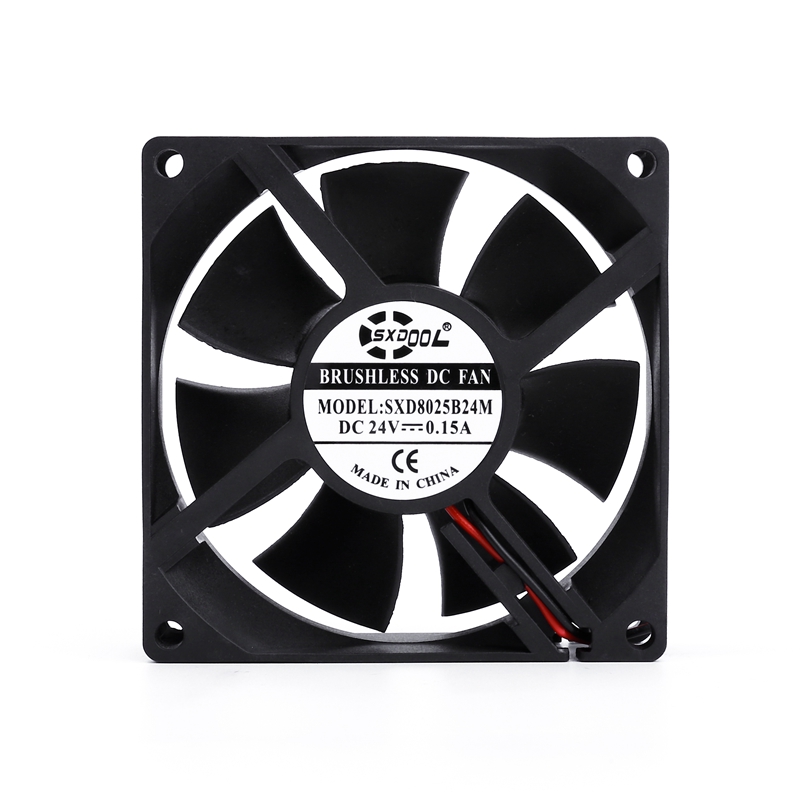
At SXDOOL, standard fans are already a strong baseline: NMB dual ball bearings, precision-balanced impellers, and 70,000 h L10 life. For coastal and marine applications, we offer a salt-fog configuration on our axial fan families (4010 to 12038, AC/DC/EC):
- Stainless steel shaft option
- Sealed bearing option with marine-grade grease
- Conformal-coated motor winding and terminations
- Anti-corrosion frame coating / anodized aluminum
- ISO 9227 NSS qualification per your target grade (48/96/240 h) with test report
- Custom air performance and electrical specs (voltage, current, speed, PWM/FG/RD) to match your exact duty point
If your application is coastal, offshore, or marine-adjacent, we will spec the fan for the environment — not just for the airflow. Send us the duty point and the NSS grade your system targets, and we will return a validated configuration.
References & Standards
- ISO 9227 — Corrosion tests in artificial atmospheres: salt spray tests
- ISO 12944-2 — Classification of environments (corrosivity categories C1–CX)
- ISO 12944-5 — Protective paint systems (C5-M guidance)
Specify the environment before you specify the fan. The salt doesn’t care about the datasheet.