Blog
Isolating a Fan Is Not the Same as Soft-Mounting It

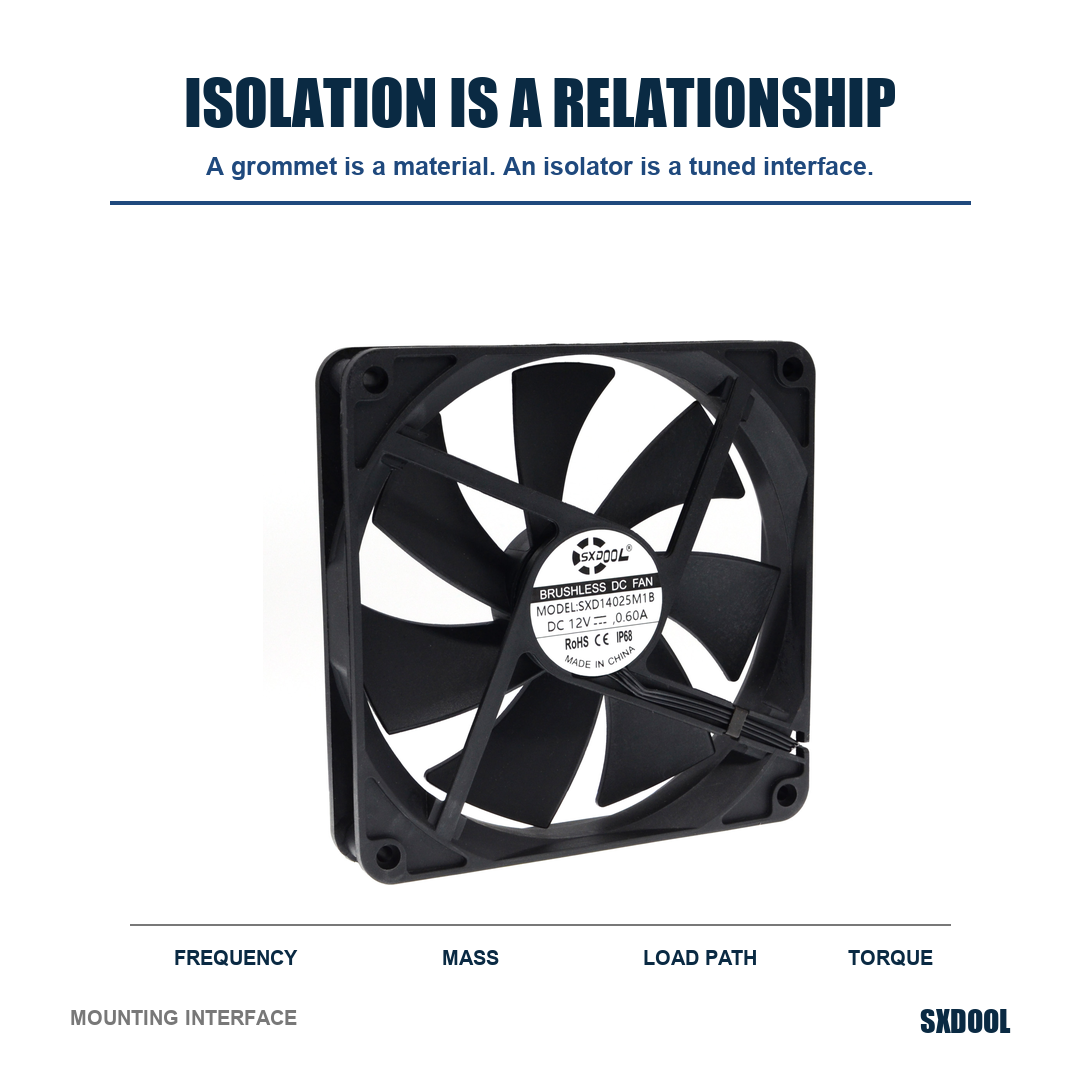
A cooling fan bolted straight to a sheet-metal panel turns that panel into a loudspeaker for everything the rotating assembly produces. The usual correction is to add rubber grommets and call the vibration problem handled. Sometimes that works. Sometimes the mount makes the situation worse, and nobody notices until a bracket cracks or a sensor starts reporting noise that was not there before.
The reason is simple: an isolator is not a material, it is a relationship. What matters is where the mount’s own natural frequency sits relative to the excitation the fan actually presents.
What the fan sends into the structure
A fan does not produce a single vibration. It produces several, and they do not travel the same way.
The most familiar is imbalance at the rotational frequency, the once-per-revolution force that grows with speed and with any offset between the centre of mass of the impeller and the axis of rotation. A badly balanced impeller is a strong source even at moderate speed.
The bearing system adds its own content. Rolling elements passing the races produce tones that are not harmonically related to the rotational frequency, and non-repetitive run-out adds a random component that a simple balance correction cannot remove. These are usually higher in frequency and are exactly the kind of motion that sheet metal radiates efficiently.
Blade passing adds a periodic pressure pulse at the rate the blades sweep past a fixed obstruction. That rate scales with speed, so a fan that is quiet at its nominal setting can present a different excitation during ramp-up, during a low-speed night mode, or when a controller hunts around a setpoint.
Each of these has a different frequency and a different transmission path. A mount chosen to soften the rotational frequency does not automatically address the bearing tones, and it does nothing for a panel that is already being driven at one of its own modes.
Why softer is not a direction
Every elastomeric mount is a spring with mass on it. Its behaviour is described by transmissibility: how much of the motion arriving at one side leaves on the other side.
Below the mount’s natural frequency, motion passes through almost unchanged. Near the natural frequency, the mount amplifies. Above it, the mount attenuates, and the attenuation improves as the ratio of excitation frequency to natural frequency grows.
That single relationship explains most mounting mistakes. A soft mount under a slow fan sits in the amplification region. A stiff mount under a fast fan passes nearly everything. Neither is wrong in itself; each is wrong for one operating condition.
Two consequences follow, and both are frequently missed in a specification. First, the mount carries the mass of the whole isolated assembly, which includes the bracket and anything attached to it, not the fan alone. Second, a fan that ramps from standstill passes through every frequency on the way, including the mount’s natural frequency. The worst moment for a soft mount is often the start, not the steady state.
Three families, and the conditions that pick them
Moulded rubber or EPDM grommets are the default. They are compact, they tolerate being compressed between a fan flange and a panel, and they work well against higher-frequency content. Their limits are creep, compression set and temperature: a grommet that has taken a permanent set no longer behaves like the part that was qualified. The material also has to survive whatever cleaning regime the enclosure sees.
Silicone mounts widen the temperature window and keep their compliance where rubber hardens. Their damping is not automatically higher, and a low-damping mount can amplify more sharply near resonance than the part it replaced. The datasheet for the specific formulation decides, not the family name.
Wire rope isolators suit larger deflections and harsher environments, and they can be arranged to work in more than one axis. They need space, and they need to be installed at the intended preload; a wire rope mount pulled out of its designed position is no longer the isolator that was tested.
The interface decides whether the isolator works
An isolator installed carelessly behaves like a rigid connection with extra parts.
Compression matters. A grommet crushed past its intended deflection becomes a hard spacer. A fastener left loose lets the assembly move and rattle, which is its own source of noise and wear.
The load path matters just as much. A metal washer that bridges the elastomer from the fan flange to the panel short-circuits the isolation completely, no matter how good the mount is. Shoulder washers and the correct stack are part of the design, not assembly detail.
The structure on the other side matters too. Decoupling the fan from a bracket does not help if the bracket has a mode near the excitation and the bracket is what radiates. In some tools the useful fix is a second stage: fan to bracket, bracket to frame.
Orientation is the last omission. A fan mounted on a vertical panel loads its mounts in shear, while the same mount may have been characterised in compression. The rated direction has to match the loaded direction.
Reading a vibration complaint
When the complaint arrives after the equipment is in the field, the order of checks saves time. Establish first whether the disturbance follows fan speed: if it appears only in a particular speed band and disappears above it, the mount or the bracket is being driven through a resonance. If it is present at every speed and scales with it, the source is imbalance or bearing content and the mount is only shaping it.
Next, find what is radiating. Touch or brace the panel and the bracket in turn. A panel that goes quiet under light finger pressure is the radiator, and the fix belongs in the structure, not in a softer mount. If the noise persists with the panel braced, the load path is short-circuiting somewhere, and the washer stack and the fastener torque are the first things to inspect.
Only then consider changing the isolator, and change one property at a time. Swapping the material and the stiffness together leaves no way to tell which change did the work, and the next build inherits a part nobody can justify.
What to put in the request
The mounting decision is only as good as the inputs, so the request for quotation should carry them rather than leaving them to a catalogue page:
- the operating speed range and how the fan ramps, not just the nominal setting
- the mass of the isolated assembly, bracket included
- the axis that needs isolating, and the axis that must stay stiff
- the mount material and part number, with the environment it must survive
- the torque and the exact washer stack
- what will be measured on the sample, and at which operating point
What to check on the sample
Confirm that the mount fitted is the one specified, and not a dimensionally similar substitute with a different hardness. Check the compression under the specified torque. Check the load path for any metal-to-metal bridge. Look at the bracket and the panel interface for the mode that will be driven. Ask for the fan’s balance grade in writing, because the mount is the second line of defence, not the first.
None of this requires a laboratory. It requires that the interface be specified rather than improvised, and that the accessory be treated as an engineering part with its own conditions.
Related reading: vibration-isolated fan mounting for precision equipment, and the quality assurance and document review process behind sample approval.