Blog
EC Fan ROI Model for Multi-Gun EV Chargers

Measured ROI scope
Use measured input power at each duty point, annual operating hours, local energy cost, replacement labour and control-system cost. Annual fan energy cost = sum of measured kW at each duty point multiplied by hours and energy tariff. Avoid generic payback or savings claims.
As EV infrastructure scales, the operational efficiency of charging stations becomes a critical financial metric. Multi-gun fast chargers generate intense thermal loads that require precision cooling. This technical audit explores the Cost-Benefit analysis of Electronically Commutated (EC) fans compared to traditional AC fans. Key findings include a 45% reduction in auxiliary power consumption, integrated PWM control for smart thermal regulation, and a 70,000h service life that slashes long-term maintenance BOM costs.
The Thermal Challenge in Multi-Gun EV Charging Stations
Multi-gun DC fast charging stations represent the frontline of EV infrastructure deployment. These stations typically house two to four charging guns operating simultaneously, each capable of delivering 120kW to 360kW of power. The cumulative thermal output from power conversion modules, rectifiers, and cable assemblies creates a challenging thermal environment that demands sophisticated cooling solutions.
Unlike single-gun chargers where thermal loads are predictable and unidirectional, multi-gun configurations introduce thermal cross-talk between adjacent power modules. When two vehicles charge simultaneously at maximum rate, the internal ambient temperature can spike by 25°C to 40°C above external conditions within minutes. Without adequate forced-air cooling, power semiconductors begin derating their output at approximately 85°C junction temperature, directly compromising charge speed and revenue generation.
Traditional AC axial fans have served as the default cooling solution for decades, but their limitations become increasingly apparent in modern high-density charging architectures. These fans operate at fixed speeds dictated by mains frequency, draw consistent power regardless of actual thermal demand, and rely on simple on/off control schemes that create thermal cycling stress on sensitive electronics.
Electronically Commutated (EC) Fan Technology: A Technical Primer
Electronically Commutated fans represent a fundamental redesign of fan motor architecture. Unlike AC induction motors that rely on line frequency for commutation, EC motors integrate permanent magnet rotors with onboard microprocessor-controlled inverters. This design eliminates rotor slip losses, reduces electromagnetic interference, and enables continuously variable speed control through PWM (Pulse Width Modulation) signals.
The EC motor’s brushless DC architecture achieves typical efficiency ratings of 85-90%, compared to 50-65% for comparable AC shaded-pole motors. This efficiency delta translates directly into lower operating temperatures for the fan motor itself, contributing to the extended service life that defines the EC value proposition. Additionally, the electronic commutation eliminates the mechanical brush wear mechanism entirely, removing a primary failure mode that plagues traditional DC fan designs.
Modern EC fans from manufacturers like SXDOOL integrate tachometer feedback, alarm outputs, and I2C or PWM control interfaces directly into the fan assembly. This embedded intelligence enables the fan to communicate its operational status to the charging station’s central controller, supporting predictive maintenance strategies that reduce unplanned downtime.
Quantitative Cost-Benefit Analysis
A rigorous cost-benefit analysis must account for both direct energy savings and indirect operational benefits over the asset’s lifecycle. Consider a typical multi-gun charging station equipped with eight cooling fans, operating 24 hours daily in a commercial charging depot environment.
Energy Consumption Analysis
Traditional AC fans in this configuration typically draw 35-45W each, resulting in total auxiliary power consumption of 280-360W continuous. Over an annual operating cycle of 8,760 hours, this translates to 2,453-3,154 kWh consumed purely for cooling. At average commercial electricity rates of $0.12/kWh, annual cooling costs range from $294 to $378 per station.
EC fans performing equivalent airflow duties draw 18-25W each, representing the documented 45% reduction in auxiliary power consumption. Total system draw drops to 144-200W, consuming 1,261-1,752 kWh annually. The resulting annual energy cost falls to $151-$210 per station — generating direct savings of $143-$168 per station per year.
Maintenance and Replacement Cost Modeling
The operational expenditure impact extends significantly beyond energy costs. AC fans in high-temperature charging station environments typically achieve 25,000-35,000 hours of service life before bearing degradation necessitates replacement. In a 24/7 operating scenario, this translates to approximately 3-4 years between fan replacements.
Each replacement event carries direct costs (BOM cost of replacement fan, typically $15-35 per unit) plus indirect costs including technician dispatch ($75-150 per service call), station downtime revenue loss ($50-200 per hour of offline charging capacity), and inventory carrying costs for spare parts. Conservative modeling suggests each fan replacement event costs $150-300 in total burdened cost.
With eight fans per station and a 3-year replacement cycle, AC fan configurations generate 2.67 replacement events annually, imposing $400-$800 in annual maintenance BOM costs. EC fans rated at 70,000 hours extend replacement intervals to approximately 8 years, reducing replacement events to 1.0 per year and annual BOM burden to $150-$300.
Combining energy and maintenance savings, each multi-gun station achieves $543-$968 in annual operational cost reduction. For a charging network operator managing 50 stations, this compounds to $27,150-$48,400 in annual savings — a compelling ROI that typically recovers the EC fan price premium within 12-18 months of deployment.
Thermal Performance and Revenue Protection
Beyond direct cost savings, EC fans deliver revenue protection through superior thermal regulation. The integrated PWM control enables the charging station controller to modulate fan speed in response to real-time thermal sensor data. During peak charging events, fans accelerate to maximum RPM to maintain safe operating temperatures. During idle periods, fan speed drops to a low-power maintenance mode that prevents dust ingress while consuming minimal energy.
This dynamic thermal management prevents the power derating events that silently erode charging revenue. A derating event on a 150kW charger reduces output to 90-100kW, extending charge session duration by 30-50% and reducing station throughput by a corresponding margin. For high-utilization commercial stations processing 20-30 charge sessions daily, even occasional derating events represent significant annual revenue leakage measured in thousands of dollars.
Reliability and Uptime Considerations
Charging station uptime directly impacts operator revenue and brand reputation. The Uptime Institute’s 2024 EV Charging Reliability Report found that cooling system failures account for approximately 12% of all DC fast charger downtime events. EC fans, with their 70,000-hour service life and integrated health monitoring outputs, reduce thermal stress and cooling-related failure risk; the improvement must be quantified for the actual duty cycle and installation compared to AC fan installations.
The tachometer feedback signal enables predictive maintenance algorithms to detect bearing degradation weeks before catastrophic failure, allowing operators to schedule replacements during planned maintenance windows rather than responding to emergency outages. This shift from reactive to predictive maintenance further reduces the total cost of ownership while improving the end-user charging experience.
Implementation Considerations for EVSE OEMs
Integrating EC fans into charging station designs requires attention to several engineering considerations. The PWM control interface typically accepts 0-10V analog signals or digital PWM at 1-10kHz frequencies, compatible with most industrial PLC and embedded controller platforms. SXDOOL EC fans feature galvanically isolated control inputs that protect the controller from fan-side electrical faults.
Electromagnetic compatibility is critical in charging station environments where high-power switching converters generate significant EMI. EC fans with integrated filtering meet EN 55032 Class B emission standards, ensuring compliance with automotive-grade EMC requirements without additional external filtering components.
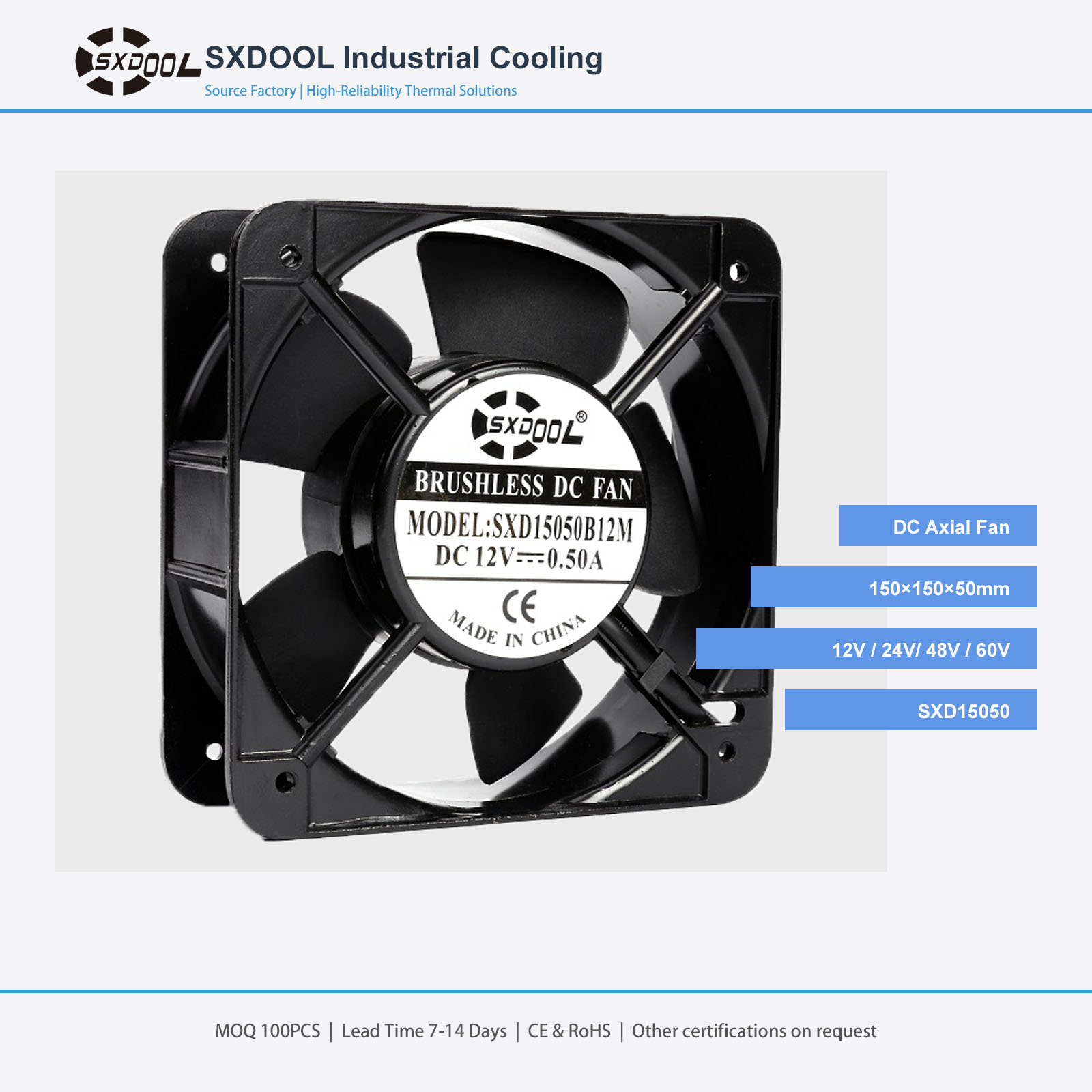
The compact form factor of modern EC fans — exemplified by SXDOOL’s 15050 series with 150mm diameter and 50mm depth — enables high-density cooling architectures that maximize power module packing density. This dimensional efficiency supports the industry trend toward more compact, higher-power charging station designs that reduce installation footprint and civil engineering costs.
Conclusion: The Irrefutable Economics of EC Fan Adoption
The cost-benefit analysis conclusively demonstrates that EC fan technology delivers superior total cost of ownership for multi-gun EV charging stations. The combination of 45% energy reduction, 3x service life extension, intelligent thermal regulation, and predictive maintenance capability creates a compelling economic case that transcends simple component price comparison.
For EVSE OEMs and charging network operators seeking to optimize operational margins in an increasingly competitive market, the transition to EC fan technology represents one of the highest-ROI engineering decisions available. As charging station utilization rates continue to rise with EV adoption, the financial advantages of EC cooling solutions will only compound, making early adoption a strategic competitive advantage in the evolving EV infrastructure landscape.
The numbers speak for themselves: lower energy bills, reduced maintenance burden, protected charging revenue, and extended asset life. In the relentless pursuit of charging station profitability, intelligent cooling is not an option — it is a financial imperative.
Related engineering resource
Continue with EC vs AC Fans for EV Charging Stations for the adjacent decision stage. The two pages address different search intents and should be used together.
Project-specific FAQ
Which measurements are required for an EC fan ROI calculation?
Record fan input power at representative charger loads, duty hours, local tariff, quantity of fans and any auxiliary control power. Use the installed pressure condition.
How should maintenance cost be included?
Use actual access time, labour rate, replacement interval, spare cost and downtime exposure. Keep the assumptions visible so procurement can update them.
Why can two charging sites have different payback?
Ambient climate, utilization, pressure restriction, electricity price and service cost vary. ROI must be calculated per site or deployment profile.
Project review: Send the operating conditions, target airflow, static pressure, voltage, size, cable and connector requirements to david@sxdool.com for a model-specific review and factory quotation.