Blog
Cooling a Display Cabinet: Which Limit Binds

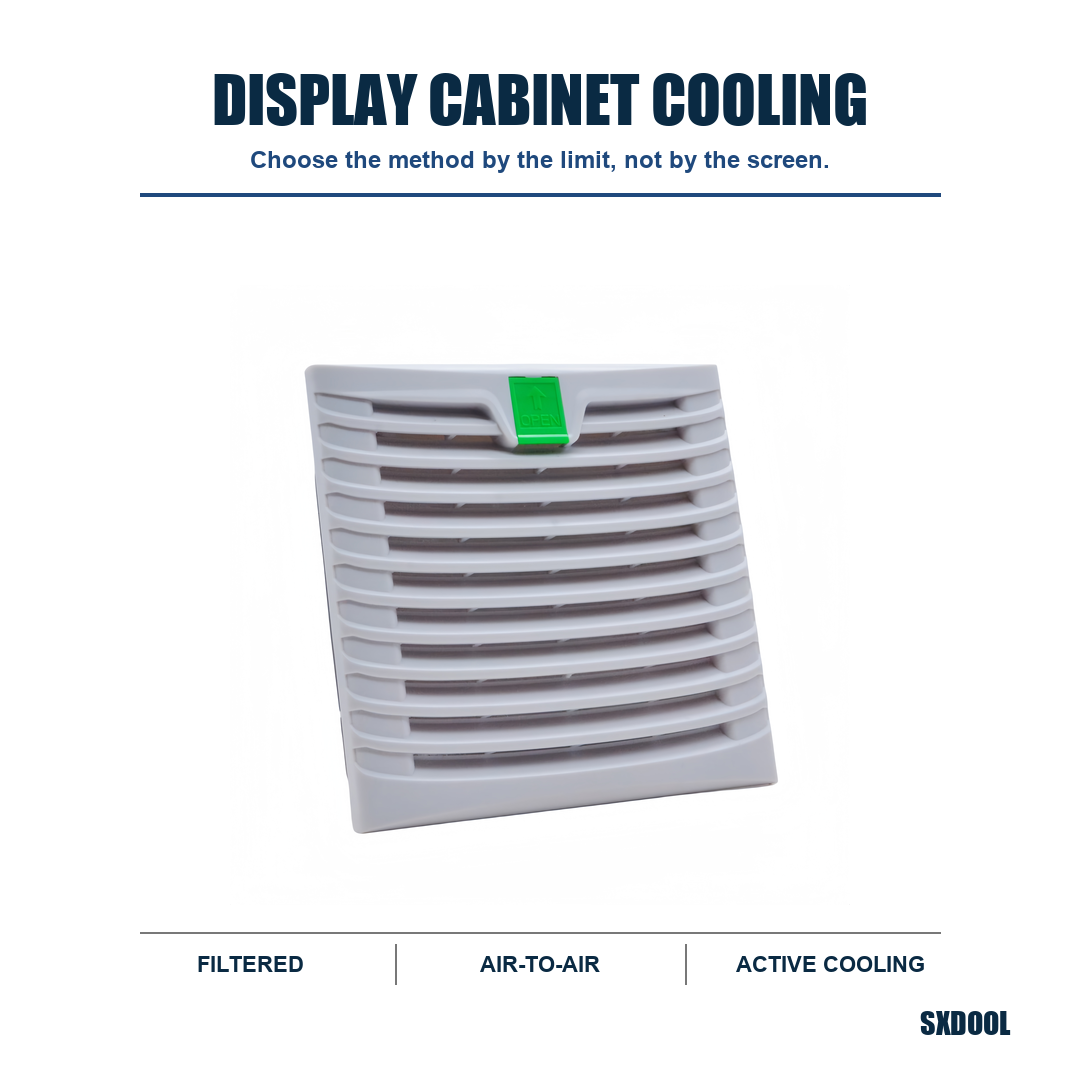
A display cabinet is usually discussed as a screen problem. It is an enclosure problem. The screen contributes heat, but the glazing, the sun, the power supply, the media player and the path the air is allowed to take decide whether the cabinet holds its conditions at all.
That distinction matters because the two questions have different answers. A brighter screen asks for more airflow. A cabinet in the sun asks which limit binds first, and the answer may be that no amount of airflow from outside will hold the internal temperature.
The cabinet has a daily cycle, not a design point
An enclosure is commissioned on a mild morning and judged in July. Between those two moments the cabinet goes through a cycle: cool at start-up, loaded through the middle of the day, shut down in the evening, cooled overnight, restarted.
The display and its supporting electronics have to stay inside their specified operating conditions through that whole cycle, not at the moment the installer closes the door. A window-facing retail unit, an indoor wayfinding kiosk and an outdoor advertising cabinet can look similar and still need different arrangements, because the exposure is different even when the equipment is the same.
Indoor installation is where assumptions slip. Room temperature is not the design input for a cabinet sitting behind glass in direct sun. The glazing, the orientation and the space around the unit have to be assessed at the cabinet, not at the thermostat on the wall.
The method is chosen by the binding limit
Filtered forced ventilation is the route when the outside air is genuinely cooler than the cabinet is allowed to reach, and when exchanging air with the surrounding space is acceptable. The filter and grille resistance belong inside the fan selection. A fan chosen against a clean opening will not deliver the same working point once the filter is fitted and loaded.
A separated air-to-air heat exchanger keeps the internal and external air streams apart, which is what matters where dust, washdown or contamination makes open ventilation unacceptable. It still rejects heat to the ambient air, so it needs ambient that is cooler than the internal target. It does not cool below ambient, and it is not a substitute for active cooling when ambient itself is the problem.
Enclosure air conditioning becomes the honest answer when the required internal temperature cannot be held with ambient air. Its rated capacity has to be read at the actual operating conditions rather than at a nominal point, and condensate handling and service access are part of the decision rather than installation details to be settled later.
The mistake is treating these as a ladder of increasing quality. They are boundaries. Each one holds under a condition and stops holding outside it.
The air path has to be drawn, not assumed
Draw the intake-to-exhaust path through the assembled cabinet before choosing a fan. Cable bundles, mounting rails, the screen’s own vents and the player’s heatsink all sit in that path.
The failure that turns up most often is an intake drawing its own exhaust back in. The exhaust leaves the cabinet, finds a short return path around a door seal or through the space between the cabinet and the wall, and re-enters at the inlet. Air is moving, the fan is running, and the components sit in their own heat. The fan is not the fault; the arrangement is.
The same applies to internal recirculation. Air that leaves the outlet and returns to the inlet inside the cabinet can keep a display region cool while the power-supply compartment stays hot. Mapping the temperature check points separately — display and backlight region, power supply, player — is how that becomes visible.
The fan runs where the system puts it
A fan curve on its own says nothing about the airflow in a cabinet. What matters is where that curve meets the resistance of the assembled enclosure: the fitted filter, the louvres, the guards and any ducting.
Filter loading moves that intersection. As dust accumulates, resistance rises, the working point migrates and delivered airflow falls. Cabinet temperature then climbs with no event that triggers an alarm, which is why the maintenance interval belongs in the design and not in a site manual nobody reads. Provide access to change the filter without dismantling the display, and set an inspection trigger based on observed airflow or temperature change rather than on a calendar guess.
Moisture and sound are separate requirements
A fan with an ingress rating does not make the cabinet weatherproof. The enclosure, the openings, the seals and the cable entries decide that, and any ingress claim has to be supported for the assembled configuration rather than for the fan alone.
Condensation is its own question. Circulating air does not remove moisture; it moves it. Surfaces that fall below the dew point of the air around them collect water, and the overnight cooldown before a warm, humid restart is exactly when that happens. Keeping susceptible surfaces above the dew point may require heating or another measure, and that decision cannot be replaced by adding airflow.
Sound is defined at the listener, not at the fan. A retail queue or a reception desk is where the target applies, and the assembled enclosure should be tested across its intended control range rather than at a single setting.
What belongs in the inquiry
The inputs that change the recommendation are unglamorous and specific: enclosure drawings, supply voltage, heat-load estimate, component temperature limits, worst-case ambient, filter details, airflow direction, mounting space, sound target and maintenance interval. Control, monitoring and connector requirements belong in the same conversation.
Model selection stays provisional until exact-model documentation is available and the candidate has been validated inside the finished cabinet. Anything short of that is a starting point for review, not a result.
The application note this article supports, including the cooling-method comparison and the selection boundaries:
Cooling Fans for Digital Signage and Display Enclosures