SXDOOL · application engineering guide
Cooling Fans for Digital Signage and Display Enclosures
Plan display-enclosure cooling around solar exposure, component heat, airflow resistance, moisture, acoustics and maintenance, with SXDOOL selection entry points.
Updated · Application selection guidance
A digital-signage cabinet must keep its display and supporting electronics within their specified operating conditions throughout the installation’s daily cycle. Start with the enclosure layout, location and temperature limits before choosing a fan. Window-facing retail displays, indoor wayfinding kiosks and outdoor advertising cabinets can require different cooling arrangements.
Map the heat and the installation
Record the display’s heat dissipation at the intended brightness and operating mode, together with losses from the power supply, media player and network equipment. Identify the display/backlight region, power-supply compartment and player location as separate temperature-check points. This is a proposed validation plan; the exact hot spots depend on the assembly.
Keep the display manufacturer’s ventilation clearances and orientation requirements. Sharp/NEC’s C750Q/C860Q manual illustrates why enclosure clearance is an installation requirement; its dimensions must not be transferred to other screens. Embedded players can also require a specific conductive cooling path, as BrightSign’s XS156 guidance demonstrates. Display installation manual, player thermal integration.
For outdoor cabinets, add solar exposure to the internal heat assessment. Rittal identifies solar gain and double-wall construction as enclosure design considerations. For an indoor window display, assess the actual sunlit location and glazing conditions rather than using room temperature as the complete design input. Outdoor enclosure design.
Choose the cooling method
| Approach | Selection boundary |
|---|---|
| Filtered forced ventilation | Suitable for evaluation when outside air is sufficiently cooler than the permitted cabinet temperature and air exchange is acceptable. Include filter and grille resistance. |
| Separated air-to-air heat exchanger | Keeps internal and external air streams separate, but still needs cooler ambient air to reject heat. |
| Enclosure air conditioning | Consider when the required internal temperature cannot be maintained using ambient air. Check rated capacity at the actual operating conditions, condensate handling and service access. |
These distinctions follow enclosure thermal-management guidance; they do not establish the capacity of any SXDOOL fan or complete cabinet. Cooling-method comparison.
Plan airflow, filtration and maintenance together
Draw the intake-to-exhaust path through the assembled cabinet. Check that cable bundles, mounting rails and the screen’s own vents do not obstruct it. Prevent exhaust from returning directly to the inlet or bypassing the components. Manufacturer air-routing guidance identifies short-circuit airflow as a design issue. Air routing.
Compare the fan curve with the enclosure’s resistance. Oriental Motor explains that their intersection determines actual airflow. Build the check around the fitted filter, louvres, guards and ducts. Include a filter-loading allowance and a service trigger; dust accumulation can restrict airflow. Provide access for filter replacement without dismantling the display. Fan operating point, filter maintenance.
Check moisture and acoustics
Review temperature and humidity through shutdown, overnight cooling and restart. Condensation control may require heating or other measures to keep susceptible surfaces above the dew point; simply circulating air does not establish moisture protection. Enclosure humidity control.
Define the sound target at the listener’s position, particularly near retail queues or reception desks. Test the assembled enclosure across its intended control range. Low-noise operation is an identified digital-signage design requirement. Digital-signage fan considerations.
What to include in a fan inquiry
Provide enclosure drawings, supply voltage, heat-load estimates, component temperature limits, worst-case ambient conditions, filter details, airflow direction, mounting space, sound target and maintenance interval. Add control, monitoring and connector requirements. SXDOOL model selection remains conditional until exact-model documentation and cabinet validation are available.
Frequently asked questions
Can a window-facing display use the indoor room temperature for fan selection?
Use measured or specified conditions at the cabinet. Direct sunlight and restricted installation spaces need separate assessment, even when the equipment sits indoors.
Does a sealed air-to-air heat exchanger cool below ambient?
It needs a cooler external air stream. If ambient conditions exceed the required internal temperature, evaluate active cooling and its operating envelope.
Does a moisture-protected fan make the entire signage cabinet weatherproof?
No. Assess the complete enclosure, openings, seals, cable entries and installed cooling assembly. Any ingress claim needs evidence for that configuration.
How often should a display-cabinet filter be changed?
Set the interval from the site’s contamination level and observed airflow or temperature change. Start with inspection access and a recorded maintenance plan, then refine it using operating evidence.
SXDOOL candidates to review
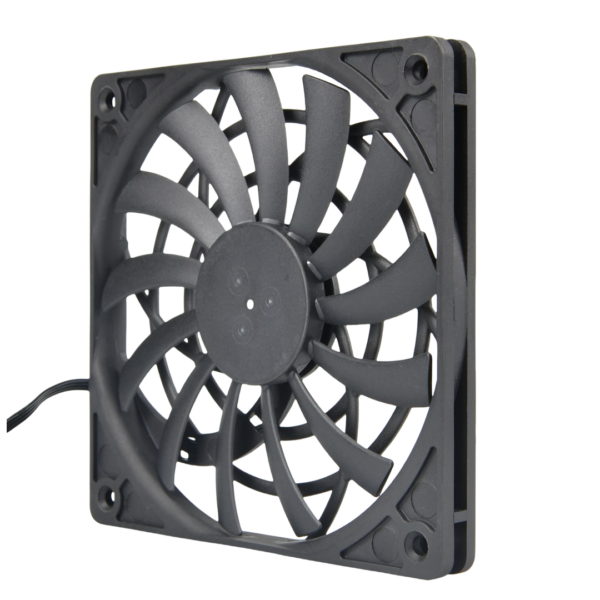
For a depth-limited ventilated enclosure, the SXDOOL 12012 slim DC family is a starting point for configuration review. The current product page identifies its pictured sample as SXD12012S12M; that sample does not establish the specification of every family variant. Request the exact voltage, dimensional drawing, pressure–airflow curve, noise conditions and connection details for the proposed order before choosing it.
Selection boundary: Do not infer that a thin frame will overcome a dense filter or narrow duct. No outdoor sealing, solar-load capacity, below-ambient cooling, display-brand compatibility or low-noise result is established for this family by this guide.
Review the 12012 family and identified sample · View technical document resources
Discuss this candidate for a display enclosure
Include the application name, equipment drawing and operating conditions in your inquiry. Request a sample only after checking the exact configuration.