Blog

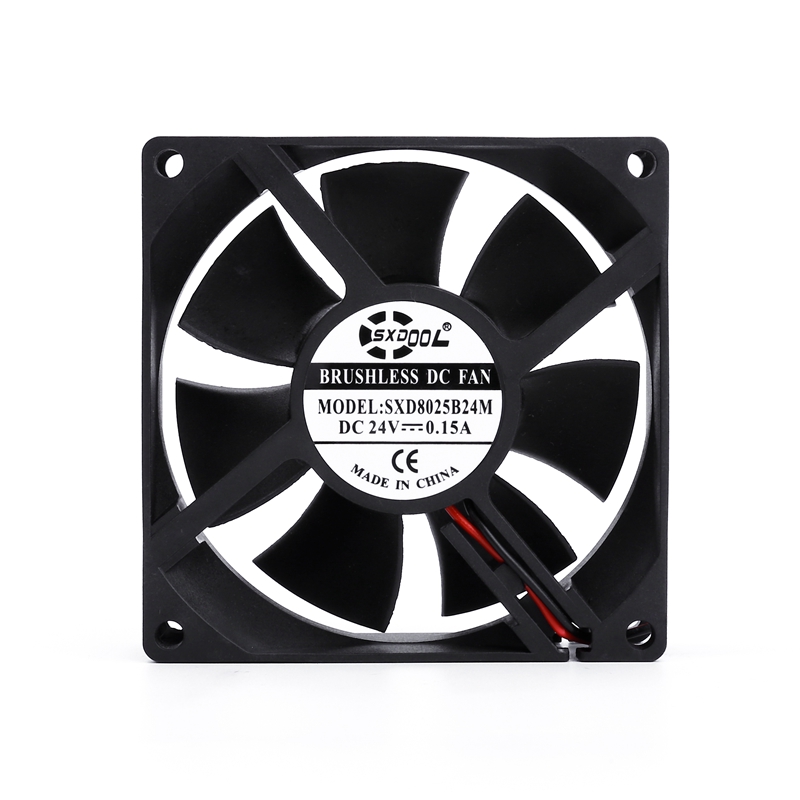
The Chemistry of Longevity: How SXDOOL Wide-Temperature Fans Conquer Lubricant Degradation (-40°C to +85°C)
Introduction: Why Cooling Fans Fail When the Steel is Still Perfect
In industrial and telecommunications infrastructure, the failure of a cooling fan is rarely a failure of the steel ball bearings or the plastic impeller. In 90% of cases, the “end of life” is defined by the chemical exhaustion of the lubricant. As thermal management requirements expand into extreme environments—from Arctic 5G base stations to desert-based solar inverters—the operating window of $-40^\circ C$ to $+85^\circ C$ has become the new baseline.
Benchmarking against the world-class tribology of NMB (MinebeaMitsumi) and Sanyo Denki, this article explores the molecular-level challenges of fan longevity. We analyze why SXDOOL’s decision to standardize on Japan NMB dual ball bearings and original NMB grease formulations (L77/L100) positions our fans as the ultimate ‘Supply Chain Safety Net’ for high-reliability industrial applications.
1. The $L_{10}$ vs. Grease Service Life Paradox
In fan engineering, the $L_{10}$ Life is defined as the time during which 90% of a group of identical bearings will survive without showing signs of fatigue. However, for the small-bore bearings used in 40mm to 120mm fans, the fatigue limit of the steel is almost never reached.
The actual limiting factor is the Grease Service Life. Once the lubricant loses its ability to form a hydrodynamic film between the ball and the raceway, metal-to-metal contact occurs, leading to rapid torque increases and eventual “Torque Lock.”
The “Rule of 10” and Arrhenius Law
The degradation of lubricant is a chemical reaction—specifically, the oxidation of the base oil. This process follows the Arrhenius Equation:
$$k = A e^{-\frac{E_a}{RT}}$$
Where:
– $k$ is the rate of reaction (degradation).
– $A$ is the pre-exponential factor.
– $E_a$ is the activation energy.
– $R$ is the universal gas constant.
– $T$ is the absolute temperature (Kelvin).
For most high-quality synthetic greases, a practical rule of thumb is that every $10^\circ C$ rise in operating temperature doubles the oxidation rate, effectively halving the grease life. While a fan might be rated for 70,000 hours at $40^\circ C$, that same fan operating at $80^\circ C$ will see its life expectancy plummet to less than 10,000 hours.
2. High-Temperature Survival: Oxidation & Arrhenius Dynamics
At $+85^\circ C$, standard mineral-based lubricants undergo rapid evaporation and polymerization. The base oil separates from the thickener (typically Lithium or Polyurea), leaving behind a hard, “waxy” residue that increases friction.
SXDOOL’s Solution: The NMB L100 Advantage
SXDOOL fans designed for high-heat environments utilize NMB L100 grease, a specialized formulation using a high-stability Ester base oil.
– Oxidation Resistance: L100 contains proprietary antioxidants that significantly increase the ‘Oxidation Induction Time’ (OIT).
– Lower Evaporation Rate: By selecting molecules with a narrow molecular weight distribution, L100 minimizes the loss of the volatile components that cause grease to dry out.
By integrating these NMB formulations into SXDOOL’s wide-temperature series, we provide a 1:1 drop-in replacement for Sanyo Denki’s ‘Long Life’ series, ensuring that the ‘Supply Chain Safety Net’ does not compromise on chemical integrity.
3. Sub-Zero Rheology: Conquering the -40°C Start-Up
The opposite extreme is equally challenging. At $-40^\circ C$, the primary enemy is Viscosity Increase. A fan that works perfectly at room temperature may fail to start in a cold-weather environment because the motor’s starting torque cannot overcome the “Internal Friction” of the frozen grease.
Torque Lock & Viscosity-Temperature Relationship
The relationship between viscosity ($\nu$) and temperature is modeled by the ASTM D341 equation:
$$\log \log (\nu + 0.7) = A – B \log T$$
For standard lubricants, the viscosity curve is steep; as temperature drops, the grease turns into a solid-like “glassy” state.
The NMB L77 Formula for Arctic Start-Up
SXDOOL Wide-Temperature fans (marked with the ‘-W’ suffix) utilize NMB L77 grease, which employs a Synthetic Hydrocarbon (PAO) base oil.
– Low Pour Point: PAO molecules remain mobile at temperatures as low as $-50^\circ C$.
– Low Starting Torque: L77 ensures that even at $-40^\circ C$, the initial “Breakaway Torque” is kept within 15% of the room-temperature value, preventing controller “Stall Errors” in mission-critical equipment.
4. Grease Channeling & Migration: The High-Speed Challenge
At high RPMs (e.g., 10,000+ RPM), centrifugal force tends to push the grease away from the balls and toward the outer race. This is known as Grease Migration.
If the grease is too “fluid,” it will leak out of the bearing shields. If it is too “stiff,” it will undergo Grease Channeling, where the balls carve a dry path through the grease and can no longer be re-lubricated by the reservoir.
SXDOOL Design Optimization:
- Dynamic Sealing: SXDOOL uses high-precision non-contact labyrinth seals in conjunction with NMB bearings to retain the lubricant within the active raceway zone.
- Optimized Fill Volume: Following the NMB technical standard of a 25-35% fill ratio, SXDOOL avoids “Churning Losses” which would otherwise generate excess heat and accelerate the Arrhenius-driven degradation.
Conclusion: SXDOOL — The Engineering Choice for the Supply Chain
Choosing a cooling fan is not just about CFM and Static Pressure; it is about the chemistry inside the bearing. By benchmarking our wide-temperature fans against the industrial elite (ebm-papst, Sanyo Denki) and standardizing on Japan NMB dual ball bearings with L77/L100 grease, SXDOOL offers more than just a cost advantage.
We offer Technical Parity.
Our fans are engineered for the engineer who knows that a $10^\circ C$ difference is the difference between a 10-year service life and a catastrophic field failure. SXDOOL stands as your Supply Chain Safety Net—providing high-depth, evidence-based thermal solutions that keep your systems running, from the coldest peaks to the hottest servers.
SEO Checklist & Metadata
- Focus Keyword: Lubricant Degradation, Wide-Temperature Fans, Arrhenius Law.
- Secondary Keywords: SXDOOL industrial fans, NMB L77 grease, L100 grease specifications, bearing life calculation, sub-zero fan performance.
- Slug: /chemistry-longevity-wide-temperature-fan-lubricants
- Meta Description: A technical analysis of how lubricant chemistry determines fan lifespan. Learn about Arrhenius Law, sub-zero rheology, and the SXDOOL/NMB synergy for wide-temperature environments.
- Image Alt-Text: “Microscopic Analysis of Lubricant Oxidation in Ball Bearings”, “SXDOOL Wide-Temperature Fan series for -40C to +85C”.
- Internal Links: Link to SXDOOL Industrial Fan Catalog, Link to PWM Control Whitepaper.