

Selecting Fire-Resistant Fans for Grid-Scale Energy Storage Enclosures
Selecting Fire-Resistant Fans for Grid-Scale Energy Storage Enclosures
The global transition toward renewable energy has catalyzed the rapid deployment of Battery Energy Storage Systems (BESS) at an unprecedented scale. As grid operators and industrial utilities integrate massive lithium-ion battery arrays to balance load and store intermittent solar and wind power, the density of these energy enclosures continues to increase. However, with increased density comes a critical safety challenge: thermal management. In the high-stakes environment of grid-scale storage, a cooling failure isn't just a maintenance issue—it is a potential precursor to thermal runaway. Selecting the right components, particularly fire-resistant cooling fans, is paramount for the safety, reliability, and longevity of these multi-megawatt installations.
The Critical Role of Cooling in Preventing Thermal Runaway
Grid-scale energy storage enclosures typically house thousands of lithium-ion cells. These cells generate significant heat during charging and discharging cycles. If this heat is not efficiently dissipated, it can lead to a localized temperature rise that triggers a chain reaction known as thermal runaway. During thermal runaway, the internal temperature of a battery cell increases until it causes a fire or explosion, which can then spread to adjacent cells and modules.
Active cooling systems, powered by high-performance axial fans, are the first line of defense. These fans must operate continuously in harsh conditions, ensuring that every battery rack remains within its optimal operating temperature range (typically 15°C to 35°C). In a BESS environment, the cooling fan is more than just a ventilation tool; it is a safety-critical component that must perform flawlessly even when the system is under maximum load or exposed to external environmental stressors.
Safety Standards: Deciphering the UL94V-0 Requirement
In the industrial OEM and energy storage sectors, "fire-resistant" is not a vague marketing term—it is defined by rigorous international standards. The most recognized benchmark for plastic materials used in electronic components is the UL 94 standard, established by Underwriters Laboratories.
For grid-scale BESS applications, UL94V-0 is the gold standard. But what does it actually mean? The "V" stands for vertical burning, and the "0" represents the highest level of flame retardancy in this category. To achieve a V-0 rating, the material must meet the following criteria during testing:
- Burning stops within 10 seconds after the flame is removed.
- No flaming drips are allowed (which could ignite other components below).
- Total flaming combustion time for five samples must not exceed 50 seconds.
By specifying UL94V-0 rated fans, BESS designers ensure that the fan itself will not contribute to the spread of a fire. In the event of an internal electrical fault or an external fire source, the fan housing and impeller will self-extinguish, providing a crucial window for fire suppression systems to activate and preventing the fan from becoming a "wick" that transports flames throughout the enclosure.
Material Science: Why PBT is the Industry Gold Standard
The choice of material for the fan’s impeller and frame is vital for both fire resistance and mechanical performance. Leading manufacturers like SXDOOL utilize PBT (Polybutylene Terephthalate), often reinforced with glass fiber, for their high-performance industrial fans.
PBT is a thermoplastic engineering polymer that offers several advantages for BESS applications:
- Thermal Stability: PBT maintains its structural integrity at high temperatures, ensuring the fan doesn't warp or lose its aerodynamic profile when the enclosure gets hot.
- Chemical Resistance: In industrial environments, fans may be exposed to various chemicals or battery off-gassing. PBT is highly resistant to oils, alcohols, and many acids.
- Electrical Insulation: PBT is an excellent insulator, which is critical for components placed in close proximity to high-voltage battery strings.
- Flame Retardancy: When formulated with appropriate additives, PBT easily achieves the UL94V-0 rating without compromising its mechanical strength.
For grid-scale enclosures, where fans may be 120mm, 172mm, or even larger, the use of PBT ensures that the fan can withstand the high static pressure and centrifugal forces required to move massive volumes of air through densely packed battery racks.
Reliability and Longevity: The NMB Dual Ball Bearing Advantage
A fire-resistant fan is only useful if it is spinning. In BESS applications, fans are expected to run for years with minimal maintenance. The primary failure point for any cooling fan is the bearing system. While sleeve bearings are common in consumer electronics, they are wholly inadequate for the 24/7, 365-day operation required in grid-scale energy storage.
SXDOOL fans utilize Japanese NMB Dual Ball Bearings, widely regarded as the pinnacle of bearing technology in the cooling industry. The benefits of this system include:
- Extended Lifespan: NMB dual ball bearings typically offer an operational life of over 70,000 hours (L10) at 40°C. This translates to more than 8 years of continuous operation.
- High Temperature Tolerance: Unlike sleeve bearings, which use a lubricant that can dry out or become viscous at high temperatures, dual ball bearings maintain low friction across a wide temperature spectrum.
- All-Orientation Mounting: Ball bearing fans can be mounted in any orientation—horizontal, vertical, or at an angle—without affecting their lifespan. This provides BESS designers with the flexibility needed to optimize airflow paths within custom enclosures.
Protection in Harsh Environments: IP68 and Beyond
Grid-scale BESS units are often located in remote, outdoor environments—ranging from salt-misted coastal regions to dusty deserts and humid tropical zones. Standard industrial fans would quickly fail due to corrosion, short-circuits, or particulate ingress.
To ensure survival in these conditions, fans must be rated for IP68 protection. The Ingress Protection (IP) rating system defines the level of sealing effectiveness.
- IP6X: Complete protection against dust (dust-tight).
- IPX8: Protection against long periods of immersion under pressure.
In a cooling fan, IP68 is achieved through advanced encapsulation techniques. The motor's PCB and stator are completely sealed in a specialized resin or epoxy, protecting the sensitive electronics from moisture, salt spray, and fine dust. For BESS operators, this means a significantly lower risk of "fan-related" downtime and reduced O&M (Operation and Maintenance) costs over the life of the project.
Designing for Scale: Integrating Fire-Resistant Fans into BESS Enclosures
When selecting fans for a grid-scale enclosure, engineers must consider the "System Impedance" of the battery racks. Densely packed cells create high resistance to airflow. Therefore, the chosen fan must not only be fire-resistant and durable but must also possess a high static pressure capability to overcome this resistance.
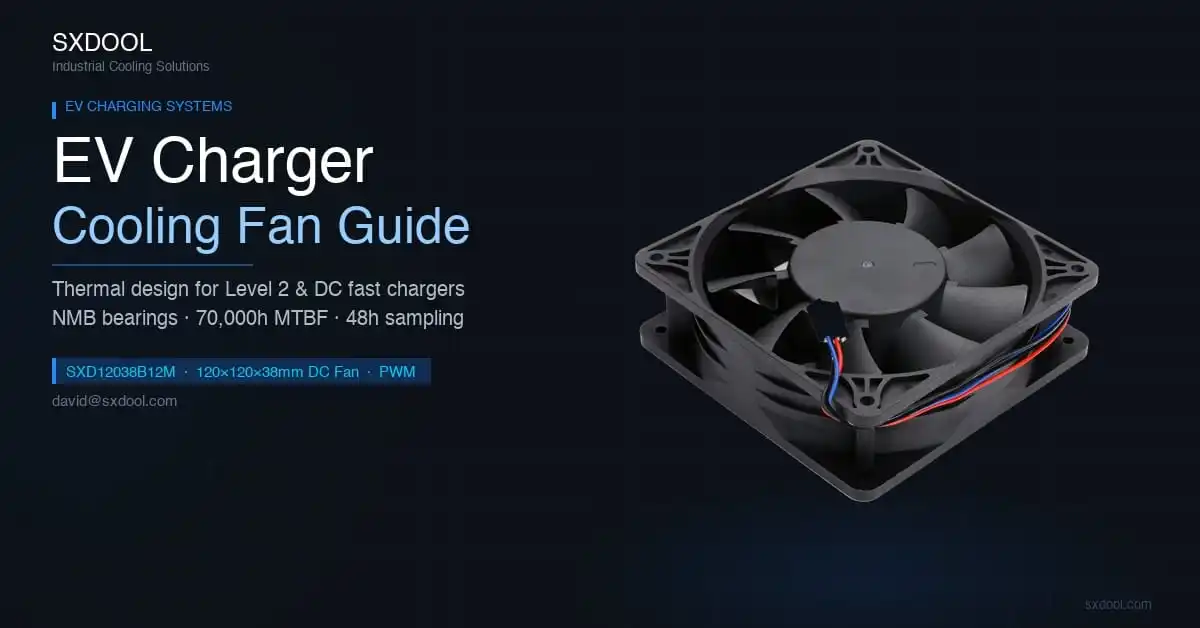
Furthermore, communication and control are essential. Modern BESS cooling units rely on PWM (Pulse Width Modulation) to adjust fan speeds based on real-time temperature data. This ensures that fans only run at full speed when necessary, saving energy and further extending the life of the bearings. High-quality fans come equipped with tachometer outputs (FG signal) and PWM inputs, allowing the BESS controller to monitor fan health and performance in real-time.
Maintenance and Monitoring: The Digital Twin Approach
In the age of Industry 4.0, grid-scale energy storage operators are increasingly adopting "digital twin" technology to monitor the health of their assets. Fire-resistant fans from SXDOOL are designed to integrate seamlessly into these digital ecosystems. By utilizing the FG (Frequency Generator) signal output, the Battery Management System can track the real-time RPM of every fan in the enclosure.
This data allows for predictive maintenance rather than reactive repairs. For instance, if a fan’s speed begins to fluctuate or deviates from the commanded PWM signal, it can indicate early-stage bearing wear or a blockage in the intake. In a BESS environment, where thousands of cells are at risk, this early warning system is invaluable. Combined with the UL94V-0 PBT construction, which ensures the fan won't fail catastrophically during a thermal event, these smart features provide a holistic safety and maintenance solution that reduces the Total Cost of Ownership (TCO) for the utility provider.
Conclusion: Choosing SXDOOL for Future-Proof Energy Storage
As the energy storage industry matures, the focus is shifting from simple capacity to long-term safety and operational efficiency. The cooling fan may seem like a small component in a multi-million dollar BESS project, but its role as a safeguard against thermal runaway cannot be overstated.
SXDOOL stands at the forefront of this technology, providing industrial-grade cooling solutions that meet the most stringent safety standards. By combining UL94V-0 rated PBT materials, legendary Japanese NMB dual ball bearings, and IP68-rated environmental protection, SXDOOL fans provide the reliability and peace of mind that grid-scale storage projects demand. When safety is non-negotiable, selecting fire-resistant, high-performance fans is the only choice for the engineers building the grid of tomorrow.








0 Comentarios