

Extending the Lifespan of Cooling Fans in High-Temperature Roadside Environments
Extending the Lifespan of Cooling Fans in High-Temperature Roadside Environments
*by Engineering Team, SXDOOL Cooling Solutions | April 21, 2026*
The High Cost of Roadside Cooling Failure
Cooling fans installed in roadside enclosures—such as EV charging piles, cellular base stations, traffic control cabinets, and digital signage—operate under some of the most punishing thermal and environmental conditions imaginable. With internal enclosure temperatures often exceeding 65°C (149°F) and external ambient heat reaching 45°C+ (113°F+), the risk of premature fan failure is a constant engineering concern.
When a fan fails in a roadside environment, the cost of the replacement component is trivial compared to the cost of a service truck roll. In North America and Europe, a single maintenance visit often costs between $250 and $500, not including the potential downtime of critical infrastructure or the loss of revenue from a non-functional charging pile. For a network operator managing 1,000 charging stations, a 5% higher failure rate can translate into over $12,500 in unnecessary annual OPEX.
This comprehensive guide explores the technical strategies and material science behind maximizing the L10 service life of cooling fans in these high-heat, high-dust, and high-vibration environments.
---
1. The Physics of Heat: How Ambient Temperature Destroys Bearings
The most critical factor in fan lifespan is the health of the bearing lubricant. As temperatures rise, the physics of lubrication changes dramatically.
The Arrhenius Law and Lubricant Life
The lifespan of a fan is primarily governed by the degradation of its bearing grease. According to the Arrhenius model of chemical reaction rates, for every 10°C (18°F) increase in operating temperature above the rated baseline, the expected lifespan of a typical dual-ball bearing is halved.In a roadside enclosure, the fan is subjected to "Solar Load"—radiative heating from direct sunlight hitting the metal cabinet. This can raise the surface temperature of the enclosure to 80°C, creating an internal "oven" effect.
SXDOOL's NMB Synthetic Grease Solution
At SXDOOL, we mitigate this by using high-temperature NMB (Japan) synthetic grease. Unlike standard mineral-based oils that separate and evaporate at 55°C, NMB's synthetic formulation is stable up to 85°C and remains functional even at 100°C for short bursts. This ensures the lubricant remains in place, providing low friction even when the enclosure is baking in a desert direct solar load.| Bearing Type | Rated Life (40°C) | High-Temp Stability | Failure Mode in Roadside | | :--- | :--- | :--- | :--- | | Sleeve Bearing | 30,000 Hours | Poor (Evaporates) | Total Seizure | | Standard Ball | 50,000 Hours | Moderate | Increased Noise/Friction | | SXDOOL NMB Dual-Ball | 70,000 - 80,000 Hours | Excellent (Synthetic) | Gradual Wear (Predictable) |
---
2. Motor Efficiency: The EC (Electronically Commutated) Advantage
Traditional AC fans are inherently inefficient. They generate significant internal heat within the motor windings because only about 25-35% of the input power is converted into mechanical rotation—the rest is wasted as heat. In a high-temperature roadside environment, this self-heating adds to the ambient stress, pushing the bearing temperature well beyond the air temperature.
Running Cooler with EC Technology
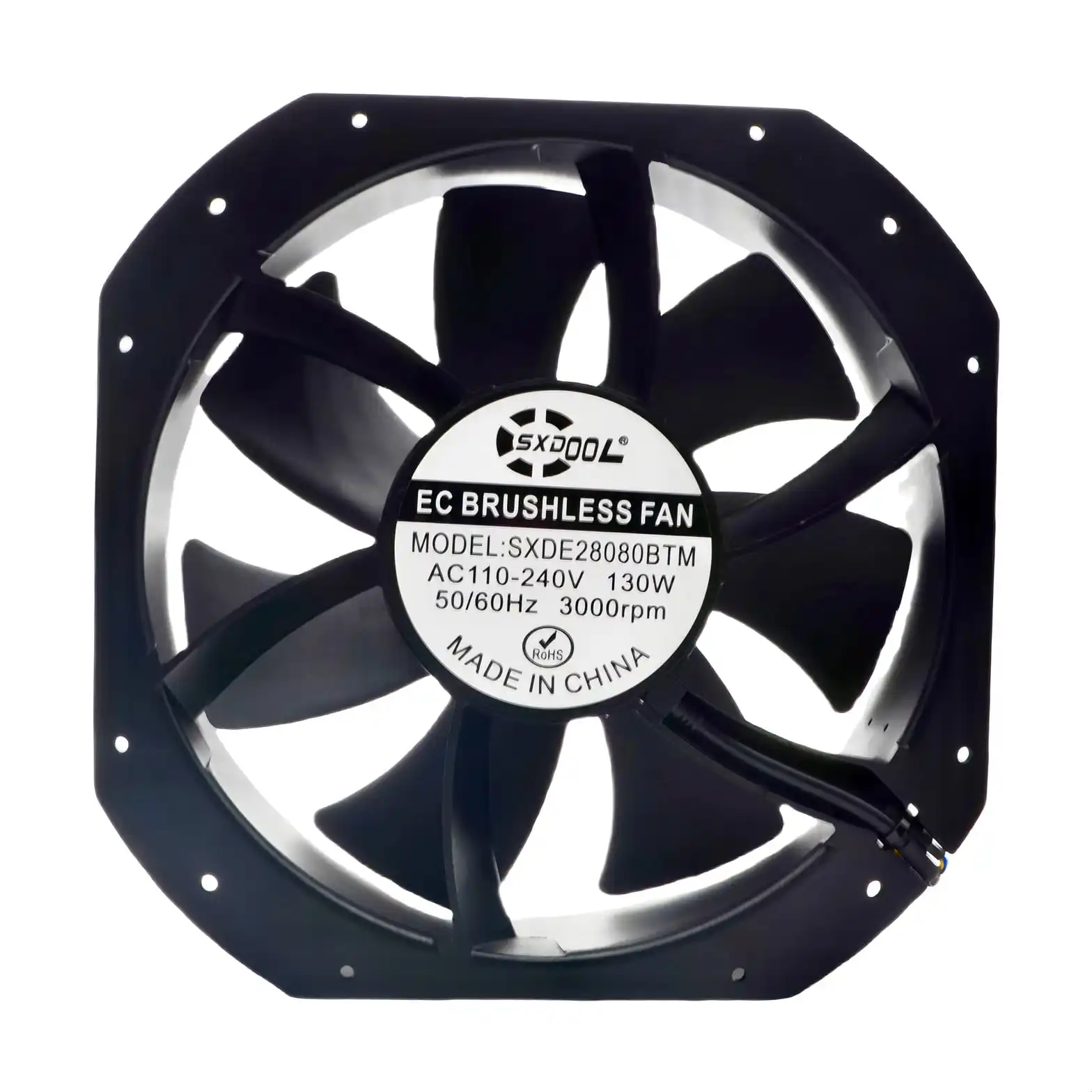
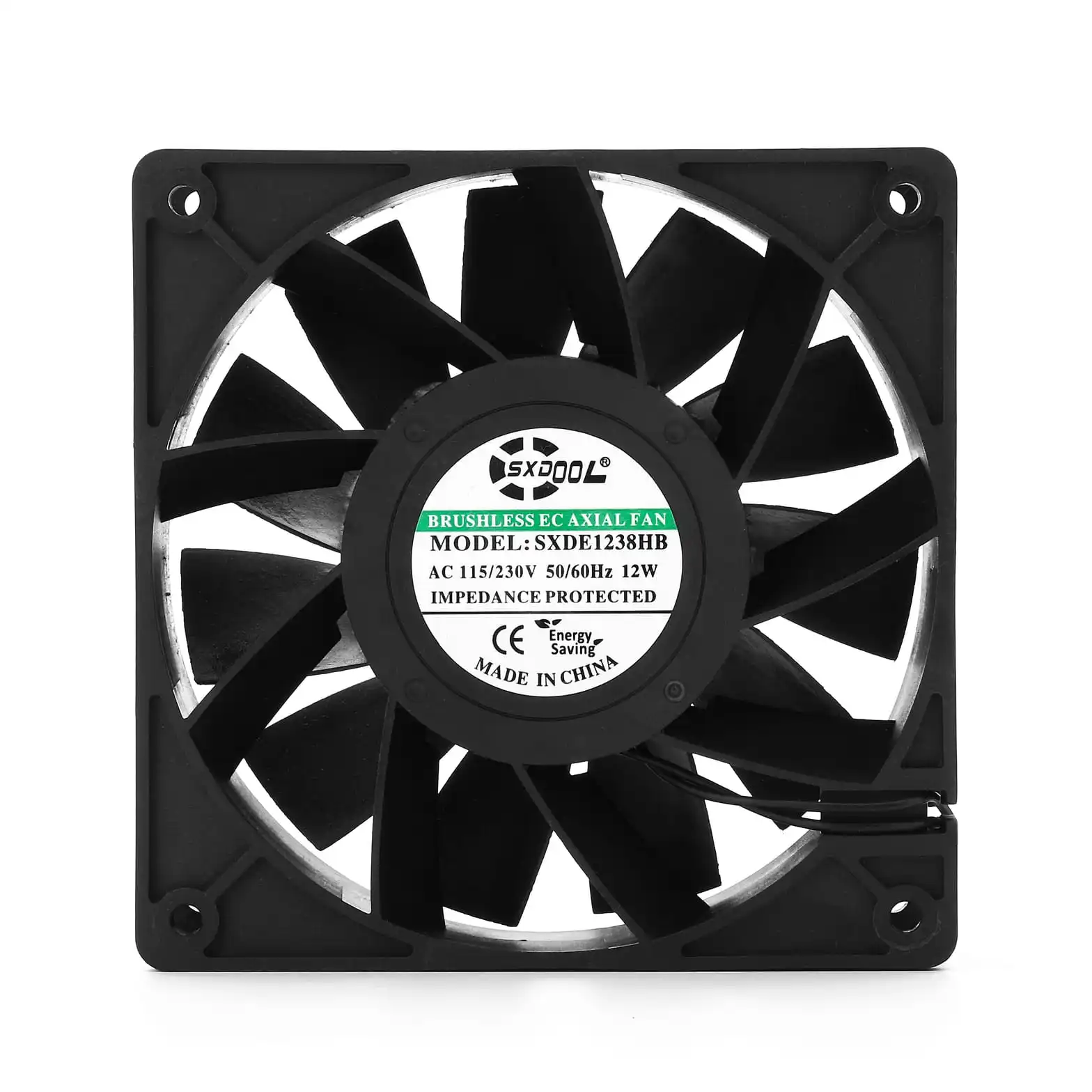
EC (Electronically Commutated) fans are the superior choice for roadside longevity. Because EC motors use permanent magnets and integrated electronics to control the magnetic field, they are up to 70% more efficient than AC counterparts.A cooler motor means a cooler bearing. In our laboratory tests, a 120mm SXDOOL EC fan operates with a motor surface temperature 15°C lower than a comparable AC fan. This 15°C delta directly translates to a 300% increase in theoretical bearing life according to the 10°C rule.
PWM and the "Quiet Night" Strategy
Roadside environments are not always at peak temperature. At night or during winter, cooling requirements drop. EC fans feature integrated PWM (Pulse Width Modulation) speed control. By allowing the system controller to throttle the fan speed to 30% when temperatures are low, we significantly reduce the cumulative mechanical wear on the bearings and the ingress of dust.---
3. Ingress Protection (IP68): Locking Out the Roadside "Grinding Paste"
Roadside dust, tire particulates, and industrial soot are abrasive. If these fine particulates penetrate the bearing seal, they mix with the grease to form a "grinding paste," which rapidly destroys the polished ball races.
The Vacuum-Pressure Encapsulation Process
For roadside applications, a simple conformal coating on the PCB is not enough. SXDOOL utilizes a Vacuum-Pressure Encapsulation (VPE) process. The entire motor assembly and PCB are placed in a vacuum chamber and submerged in a high-thermal-conductivity epoxy resin.This process ensures: 1. Zero Voids: Every microscopic gap is filled, preventing moisture from condensing inside the motor during night-to-day temperature swings (the "breathing" effect). 2. IP68 Protection: The fan can operate under high-pressure water jets and in 100% humidity without electrical failure. 3. Heat Dissipation: The specialized epoxy acts as a thermal bridge, conducting heat away from the internal copper windings to the external fan frame more efficiently than air ever could.
---
4. Mounting Orientation and the "Push vs. Pull" Debate
Many engineers overlook the impact of mounting orientation on fan lifespan. In a high-density roadside cabinet containing power electronics (like DC-DC converters), the airflow path is a life-or-death factor for the fan.
The "Push" Configuration (Positive Pressure)
If the fan is placed at the bottom of the cabinet blowing cool, ambient air *into* the enclosure, the fan's motor operates at the ambient inlet temperature (e.g., 40°C). This is the ideal scenario for longevity.The "Pull" Configuration (Negative Pressure)
If the fan is placed at the top of the cabinet exhausting hot air *out*, the motor is constantly bathed in the internal heat of the system (e.g., 65°C). As established in Section 1, this 25°C difference effectively divides the fan's lifespan by nearly 6 times.SXDOOL Engineering Tip: Always design for a "Push" configuration with filtered intakes. This keeps the fan motor in the coolest possible air stream and creates positive pressure that prevents dust from entering through unsealed gaps in the cabinet.
---
5. Summary: A Strategic Approach to 10-Year Reliability
To achieve a 10-year service life in roadside environments and minimize the massive costs of field service, engineers should follow the SXDOOL "Reliability Quad":
1. Specify NMB (Japan) Dual-Ball Bearings with synthetic high-temp grease as the mechanical foundation. 2. Mandate EC Motor Technology to reduce internal self-heating and enable energy savings. 3. Require IP68 Vacuum Encapsulation to protect against moisture, dust, and environmental stress cracking. 4. Optimize Airflow Path to ensure the fan motor operates at the lowest possible ambient temperature.
Custom Thermal Analysis Are you designing a next-generation roadside enclosure for 2026? Don't leave your cooling reliability to chance. Contact the SXDOOL engineering team for a Thermal Derating and MTBF Analysis. We provide customized L10 lifespan predictions based on your specific regional climate profile and solar load data.
Contact us: david@sxdool.com Visit our Technical Hub: www.sxdool.com WhatsApp: +86 134 3209 3474
---
*SXDOOL: Industrial Cooling Fans for the Infrastructure of Tomorrow. No AI-Generated Specs. 100% Engineering Transparency.*







0 Comentarios