Blog
Cooling Fan Certifications for Global Markets: CE, UL, RoHS, PSE, and KC Explained


Selling industrial cooling fans—or products containing them—across multiple international markets requires navigating a matrix of country-specific safety, electromagnetic, and environmental certifications. A fan that is fully compliant for sale in the United States may be non-compliant in Japan. A design cleared for European markets may fail Korean electromagnetic compatibility requirements. This guide provides a consolidated reference for procurement engineers, compliance managers, and product designers working with industrial fan manufacturers across developed-market regions.
European Union: CE Marking
CE (Conformité Européenne) marking is mandatory for cooling fans and products containing fans sold in the European Economic Area (EU plus Norway, Iceland, and Liechtenstein). CE is a self-declaration by the manufacturer confirming compliance with applicable EU directives—it is not a third-party certification, though it requires documented technical evidence.
Applicable EU Directives for Industrial Cooling Fans
- Low Voltage Directive (LVD) 2014/35/EU: Applies to electrical equipment operating between 50V AC and 1000V AC, or 75V DC and 1500V DC. Covers electrical safety, insulation, and protection against shock. Most AC fans and high-voltage DC fans fall under LVD.
- EMC Directive 2014/30/EU: Limits electromagnetic emissions and defines immunity requirements for electrical equipment. All fans with electronic controllers (EC fans, PWM-controlled DC fans) require EMC testing to CISPR 32 / EN 55032 for emissions and EN 61000 series for immunity.
- RoHS Directive 2011/65/EU (RoHS 2): Restricts 10 hazardous substances in electrical and electronic equipment. Mandatory for all fans intended for EU sale.
- ErP Directive (Energy Related Products) 327/2011: Mandates minimum efficiency standards for fans used in specific HVAC applications. Applies to fans with shaft power 125W-500kW used in commercial ventilation; not applicable to most small industrial DC fans.
- REACH Regulation (EC) 1907/2006: Restricts substances of very high concern (SVHCs) in articles. Fan suppliers must provide REACH compliance declarations for components above 0.1% by weight threshold.
What CE Documentation to Request from Suppliers
- EU Declaration of Conformity (DoC) — signed, with specific directive references and applicable harmonized standards
- Technical File summary — confirming compliance evidence exists (you may request the full technical file for due diligence)
- Test reports from accredited laboratory (DEKRA, TÜV, SGS, Intertek, Bureau Veritas) for EMC and LVD testing
United States: UL and FCC
UL Certification (Safety)
UL (Underwriters Laboratories, now UL Solutions) provides product safety certification widely required by U.S. market channels. Key designations:
- UL Listed: Complete product tested to UL standards; carries the UL mark. Relevant standard for fans: UL 507 (Electric Fans).
- UL Recognized (cURus): Component certification for items built into other products; relevant for OEM fan procurement. The “c” prefix indicates simultaneous Canadian (cCSAus) coverage.
- UL 508C: Standard for power conversion equipment—relevant for EC fans with integrated power supplies operating from AC mains.
FCC (Electromagnetic Compatibility)
FCC Part 15 limits electromagnetic emissions from electronic devices. DC fans with PWM electronics and EC fans with integrated inverters are Class B digital devices requiring:
- FCC Part 15 Subpart B testing to ANSI C63.4
- FCC Supplier’s Declaration of Conformity (SDoC) for Class B devices
- FCC ID registration for intentional radiators (e.g., fans with wireless connectivity)
Japan: PSE Certification
Japan’s Electrical Appliance and Material Safety Act (DENAN Law) requires PSE (Product Safety Electrical Appliance & Materials) certification for electrical products sold in Japan. This is mandatory—non-certified products cannot legally be imported or sold.
PSE Mark Types
- Diamond PSE (◇): For specific regulated products listed in Appendix 1 (includes fans with AC motors). Requires third-party testing by a Registered Conformity Assessment Body (RCAB).
- Circle PSE (○): For products in Appendix 2. Allows self-declaration by manufacturer or importer using registered design.
AC cooling fans typically require Diamond PSE, which involves testing to J60065 (AV equipment safety, basis for fan testing) or J60335 by a Japanese RCAB such as JET, UL Japan, TÜV SÜD Japan, or Intertek Japan. Lead time for PSE testing: 8-14 weeks.
Practical PSE Considerations for Industrial Buyers
- PSE applies to the importer of record in Japan—even if the Chinese manufacturer has PSE for a product, the Japanese importer must be registered
- DC fans at 42V or below are generally exempt from PSE (check current METI guidance)
- EC fans with AC input always require Diamond PSE testing
South Korea: KC Mark
Korea’s KC (Korean Certification) mark is mandatory for electrical products sold in South Korea under the Electrical Appliances Safety Control Act. The KC system is administered by the Korea Agency for Technology and Standards (KATS).
KC Requirements for Cooling Fans
- Testing to KC-specific standards based on IEC 60335-2 series for AC fans
- Testing lab must be KAS (Korea Accreditation System) accredited
- Registration with KATS required before market entry
- Annual renewal and factory surveillance requirements
Lead time for KC certification: 10-16 weeks. SXDOOL can support KC certification processes for major OEM customers through our partner testing laboratories.
Australia and New Zealand: RCM Mark
Australia and New Zealand require the RCM (Regulatory Compliance Mark) for electrical products, administered by the Electrical Regulatory Authorities Council (ERAC). RCM combines electrical safety (to IEC 60335 or IEC 60950/62368 as applicable) and electromagnetic compatibility (to CISPR 32 / AS/NZS CISPR 32) in a single mark.
- Supplier registration required with the RCM database
- Test reports from NATA-accredited (Australia) or IANZ-accredited (New Zealand) laboratories
- AC fans: Test to AS/NZS 60335-2 series
- EMC: Test to AS/NZS CISPR 32
Products carrying CE marking with equivalent IEC-based test reports can often achieve RCM with reduced additional testing—confirm with an Australian EMC consultant.
Israel: ISED and Standards Institute of Israel (SII)
Israel requires compliance with Standards Institute of Israel (SII) standards for electrical equipment. Most electrical standards in Israel adopt IEC standards directly. CE-marked products from EU-based manufacturing can often enter Israel with CE documentation plus an import permit, though SII registration is recommended for ongoing commercial relationships.
RoHS: The Universal Requirement
RoHS compliance is no longer just an EU requirement. The following markets have adopted equivalent RoHS regulations:
| Market | Regulation | Restricted Substances |
|---|---|---|
| European Union | RoHS 2 (2011/65/EU) | 10 substances (Pb, Hg, Cd, Cr VI, PBBs, PBDEs, 4 phthalates) |
| United Kingdom | UK RoHS (SI 2012/3032) | Same as EU RoHS 2 |
| China | China RoHS (GB/T 26572) | 6 original RoHS substances |
| South Korea | Korea RoHS (RRA Act) | 6 original + 4 phthalates |
| California (USA) | Electronic Waste Recycling Act | 4 original (Pb, Hg, Cd, Cr VI) |
SXDOOL products are manufactured to full RoHS 2 compliance (10 substances), providing compliance headroom for all market requirements without reformulation.
SXDOOL’s Global Certification Portfolio
SXDOOL maintains certifications for the major markets served by our global OEM customer base:
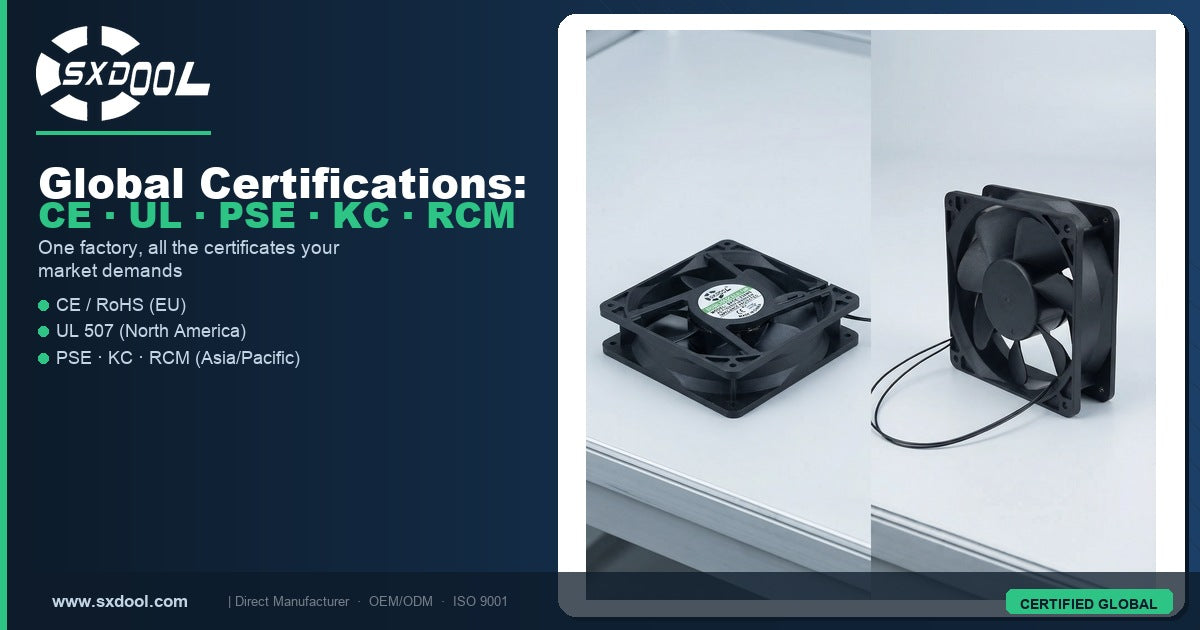
- ✅ CE (EU + EEA) — LVD, EMC, RoHS
- ✅ FCC Part 15 (USA)
- ✅ cURus UL Recognized (USA + Canada)
- ✅ RoHS 2.0 — All markets
- ✅ ISO 9001:2015
- 🔄 PSE (Japan) — Available for major OEM programs
- 🔄 KC (Korea) — Available for major OEM programs
- 🔄 RCM (Australia/NZ) — Available with CE base documentation
For market-specific certification documentation requests or to discuss certification support for your OEM program, contact david@sxdool.com. We provide complete documentation packages for vendor qualification processes at no charge to qualified buyers.