

Impact of UV Exposure on Fan Housing Materials in Outdoor Charging Piles
Impact of UV Exposure on Fan Housing Materials in Outdoor Charging Piles
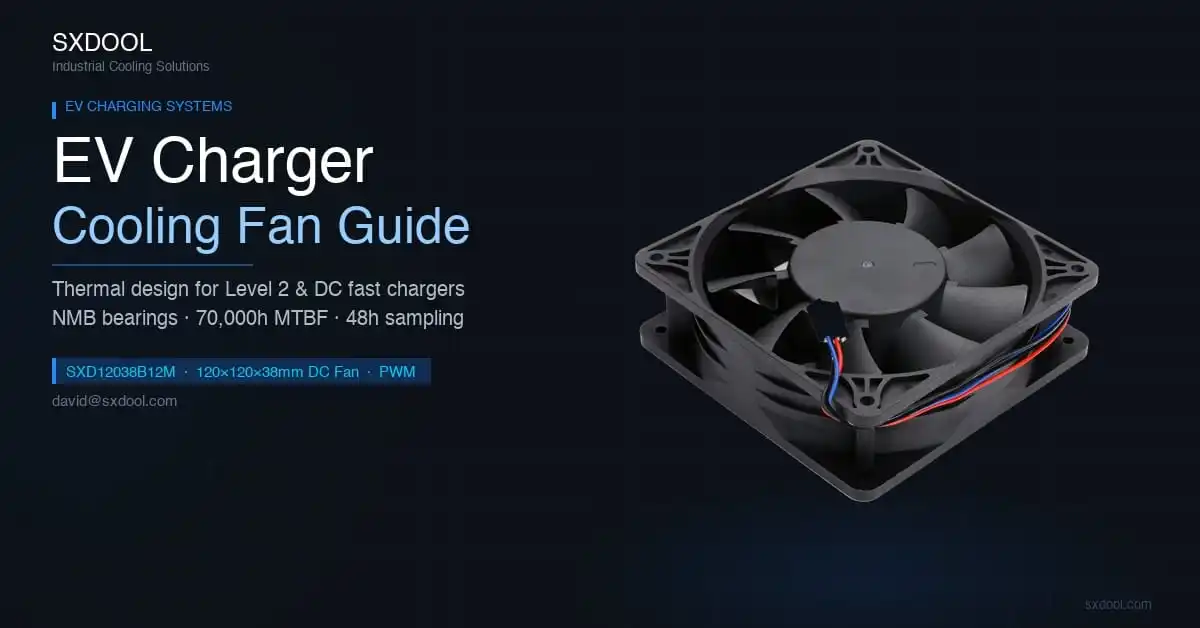
As the global infrastructure for Electric Vehicles (EV) expands, charging stations—commonly referred to as charging piles—are being deployed in increasingly diverse and harsh outdoor environments. From the high-altitude regions with intense solar radiation to the humid, sun-drenched coastal areas, these systems are subjected to relentless ultraviolet (UV) exposure. While much of the engineering focus remains on power electronics and battery management, the reliability of the thermal management system, specifically the cooling fans, is a critical failure point. This article examines the technical impact of UV exposure on fan housing materials and how high-performance materials like UL94V-0 rated PBT, combined with expert engineering from SXDOOL (Sensda Electronics), ensure operational continuity.
The Invisible Threat: UV Radiation and Polymer Degradation
Ultraviolet radiation, specifically the UVA (315–400 nm) and UVB (280–315 nm) spectrums, possesses enough energy to break the chemical bonds within many common polymers used in industrial manufacturing. When a cooling fan is installed in an outdoor charging pile, the housing and impeller are often exposed to direct or reflected sunlight. This initiates a process known as photodegradation.
The Mechanism of Photodegradation
In most technical polymers, UV photons are absorbed by "chromophore" groups within the molecular structure. This absorption triggers the formation of free radicals, which subsequently react with oxygen to cause chain scission—the breaking of the long polymer chains that give the material its strength. For outdoor EV charging piles, this degradation is not merely cosmetic; it is a structural and functional hazard. Based on chemical analysis, polymers that lack specific UV-stabilizing additives will experience a rapid decline in molecular weight, leading to surface chalking, discoloration (yellowing), and significant loss of impact resistance.
Comparative Analysis: PBT vs. PC and Nylon in Outdoor Environments
When selecting a material for fan housings, engineers often weigh the pros and cons of Polybutylene Terephthalate (PBT), Polycarbonate (PC), and Nylon (PA66). Understanding the chemical response of each to UV radiation is essential for long-term reliability.
- Polycarbonate (PC): While PC offers excellent impact strength and transparency, it is highly susceptible to UV degradation. Without significant stabilization, PC quickly turns yellow and loses its mechanical properties. More importantly, PC is prone to stress cracking when exposed to certain chemicals and moisture, making it less ideal for the unmanaged environments of public charging stations.
- Nylon (PA66): Nylon is a strong engineering plastic, but it is hygroscopic—meaning it absorbs moisture from the air. This absorption leads to dimensional changes, which can be catastrophic for a high-speed fan where tolerances are measured in microns. Furthermore, UV exposure causes "photo-oxidation" in Nylon, leading to a brittle surface that flakes away over time.
- PBT (Polybutylene Terephthalate): PBT strikes the perfect balance for SXDOOL fans. It has excellent dimensional stability, low moisture absorption, and high chemical resistance. By utilizing a PBT matrix specifically formulated with UV absorbers, SXDOOL ensures that the housing remains robust even after years of direct solar exposure.
Decoding the Data: Accelerated Aging and Weathering Tests
At Sensda Electronics (SXDOOL), we don't just rely on theoretical data. Our fans undergo rigorous accelerated aging tests to simulate a 10-year or 15-year lifecycle in just a few months. This is achieved through Xenon Arc testing or Fluorescent UV testing (ASTM G154).
During these tests, the fan housings are subjected to cycles of intense UV light followed by moisture (condensation or water spray). We measure three critical metrics:
- Tensile Strength Retention: We pull the material to its breaking point to ensure it still meets the original specifications after exposure.
- Color Change (Delta E): While yellowing is aesthetic, it often correlates with internal structural damage.
- Impact Resistance: We use Charpy or Izod impact tests to ensure the housing won't shatter if hit by debris or handled roughly during maintenance.
Facts show that SXDOOL's UV-stabilized PBT retains over 90% of its mechanical properties after 2,000 hours of accelerated weathering, a benchmark that inferior "generic" fans often fail to meet by more than 40%.
The Role of NMB Bearings in a Degraded Housing Environment
It is an engineering inference, supported by field data, that many bearing failures are actually symptoms of housing failure. As UV radiation degrades the PBT housing, the internal geometry of the fan frame can shift. Even a 0.1mm warp can cause the NMB bearings to experience axial loads they were not designed to handle.
NMB (MinebeaMitsumi) bearings are the industry standard for a reason: they are manufactured with incredible precision. However, this precision depends on the fan housing maintaining its structural integrity. By using UV-stabilized UL94V-0 PBT, SXDOOL ensures that the "bed" in which the bearing sits remains perfectly aligned. This synergy between high-grade plastic and precision Japanese bearings is why SXDOOL fans can offer an MTBF (Mean Time Between Failures) that exceeds the lifespan of the charging pile itself.
IP68 Protection: Beyond Just Waterproofing
The IP68 rating is often marketed simply as "waterproof," but for outdoor charging piles, its role is much more complex. The potting material used to seal the motor and PCB must also be compatible with the PBT housing. If the housing becomes brittle and porous due to UV damage, the bond between the plastic and the potting compound can fail. This creates "micro-channels" through which capillary action can pull moisture directly into the electronics.
SXDOOL’s vacuum-potting technology ensures a seamless bond that resists the thermal expansion and contraction cycles common in outdoor environments. When paired with UV-resistant materials, the IP68 protection remains a fortress against the elements, preventing the corrosion of copper windings and the short-circuiting of control logic.
Economic Analysis: The Cost of Material Failure
For procurement professionals, the "unit cost" of a fan is a misleading metric. The true cost includes the expense of a field technician traveling to a site, the cost of the replacement part, and the loss of revenue while the charging station is offline. In a 500-unit deployment, a 5% increase in failure rate due to UV-related housing issues can cost an operator upwards of $50,000 in maintenance and downtime. In contrast, specifying SXDOOL fans adds a negligible amount to the initial Bill of Materials (BOM) while virtually eliminating these recurring operational expenses.
Material Focus: Why PBT is the Gold Standard for SXDOOL Fans
In the world of industrial cooling, Polybutylene Terephthalate (PBT) is the preferred choice for fan housings and impellers. However, not all PBT is created equal. For outdoor EV charging applications, SXDOOL utilizes a specialized grade of PBT that meets the stringent UL94V-0 flame retardancy standard.
The Importance of UL94V-0 and UV Stabilization
The UL94V-0 rating ensures that the material will stop burning within 10 seconds on a vertical specimen, which is crucial for fire safety in high-voltage charging environments. However, the flame retardants themselves can sometimes be sensitive to UV light. At Sensda Electronics (SXDOOL), our engineering team integrates UV stabilizers and carbon black or titanium dioxide pigments that act as physical shields, reflecting or absorbing the UV energy before it can damage the polymer matrix. Factually, untreated PBT can lose up to 50% of its tensile strength within 1,000 hours of intense UV exposure, whereas UV-stabilized PBT maintained by SXDOOL shows minimal degradation over years of operation.
Structural Failure and IP68 Integrity
One of the primary roles of an outdoor fan housing is to maintain the IP68 rating of the component. IP68 indicates that the fan is dust-tight and protected against continuous immersion in water. When UV radiation makes the housing brittle, micro-cracks can form. These cracks serve as entry points for moisture and dust, which can eventually reach the internal motor windings and the PCB.
Impact on Internal Components
If the housing integrity is compromised by UV-induced brittleness, the mechanical stress from the fan’s own rotation can cause the housing to warp or the mounting lugs to snap. This misalignment can lead to increased vibration, which puts undue stress on the NMB bearings. NMB precision bearings are known for their longevity and low friction, but they require a stable, vibration-free environment to achieve their 70,000+ hour L10 life. Inferentially, a UV-damaged housing is the leading precursor to premature bearing failure in outdoor environments.
Thermal Management Consequences of Material Degradation
The cooling fan is the heart of the charging pile's thermal regulation. If the impeller becomes brittle due to UV exposure, the risk of "blade shed" increases. A single blade failure at high RPM can cause a catastrophic imbalance, destroying the entire fan assembly and potentially damaging adjacent electronic components. Without active cooling, the power modules within the EV charging station will hit their thermal limits, leading to derating (reduced charging speed) or total system shutdown.
SXDOOL's Engineering Approach to Outdoor Durability
As a leading manufacturer, SXDOOL (Sensda Electronics) employs a multi-layered approach to combat UV exposure in EV infrastructure:
- Material Selection: Only high-grade, UV-stabilized PBT with UL94V-0 certification is used.
- Environmental Testing: Fans undergo accelerated weathering tests (such as ASTM G154) to simulate years of solar exposure.
- Integrated Protection: Combining UV resistance with IP68 potting ensures that the motor remains protected even if the exterior housing experiences minor surface wear.
- Mechanical Precision: By using genuine NMB bearings, SXDOOL fans maintain high rotational accuracy, reducing the mechanical strain that could otherwise exacerbate material fatigue.
Conclusion: A Long-Term Perspective for OEM Engineers
For procurement professionals and OEM engineers, the choice of a cooling fan for an outdoor charging pile should not be based on upfront cost alone. The long-term impact of UV exposure is a reality that can lead to high field failure rates and damage to brand reputation. By selecting fans from an expert manufacturer like SXDOOL that prioritize material science—specifically UV-stabilized UL94V-0 PBT and IP68 protection—operators can ensure their EV charging stations remain functional for a decade or more, regardless of how much the sun beats down on them.
Investing in technical excellence today avoids the "hidden costs" of material failure tomorrow. SXDOOL continues to lead the way in providing robust, high-reliability cooling solutions for the next generation of green energy infrastructure.







0 Comentarios