

Thermal Uniformity Challenges in Containerized Battery Energy Storage Systems
Thermal Uniformity Challenges in Containerized Battery Energy Storage Systems
As the global transition toward renewable energy accelerates, Containerized Battery Energy Storage Systems (BESS) have emerged as a cornerstone for grid stability, peak shaving, and load leveling. These systems, often housing thousands of Lithium Iron Phosphate (LiFePO4) cells in a concentrated space, face a significant engineering hurdle: thermal uniformity. Maintaining a consistent temperature across every cell within a container is not merely a performance goal; it is a critical requirement for safety, efficiency, and long-term Total Cost of Ownership (TCO).
The Critical Role of Thermal Uniformity in BESS
Thermal uniformity refers to the temperature variance between the hottest and coldest cells in a battery rack or across the entire container. In a perfectly optimized system, this variance (delta T) should be kept within ±2°C to ±3°C. However, in large-scale containerized deployments, achieving this level of precision is exceptionally difficult.
When temperature gradients exist, cells at higher temperatures degrade significantly faster than those at lower temperatures. This leads to capacity mismatch. Since cells are connected in series and parallel strings, the "weakest link" principle applies: the entire string’s performance is limited by the most degraded cell. This premature aging reduces the overall energy capacity of the BESS, leading to early decommissioning and higher replacement costs.
The Physics of Heat Generation and Airflow Bottlenecks
Battery cells generate heat through internal resistance during charge and discharge cycles (Joule heating) and through chemical reactions. In a dense containerized environment, heat builds up rapidly. The primary challenge lies in the physical layout. High-density racks create narrow channels that restrict airflow, leading to "stagnant zones" where heat accumulates.
Boundary Layer Effects and Heat Transfer
In forced-air cooling systems, the air nearest the battery surface forms a boundary layer. If the air velocity is too low, this layer becomes an insulating barrier, preventing efficient heat transfer. Conversely, if the airflow is uneven, some racks receive high-velocity cooling while others suffer from thermal bypass—where air follows the path of least resistance, avoiding the tight spaces between cells where cooling is most needed.
Technical Solutions for Enhanced Thermal Management
To overcome these challenges, BESS developers and OEM engineers are turning to sophisticated airflow management strategies and high-performance hardware. This is where SXDOOL (Sensda Electronics) provides industry-leading expertise. By integrating high-static pressure fans with precision control, the "hotspot" problem can be effectively mitigated.
Precision Airflow with PWM Speed Control
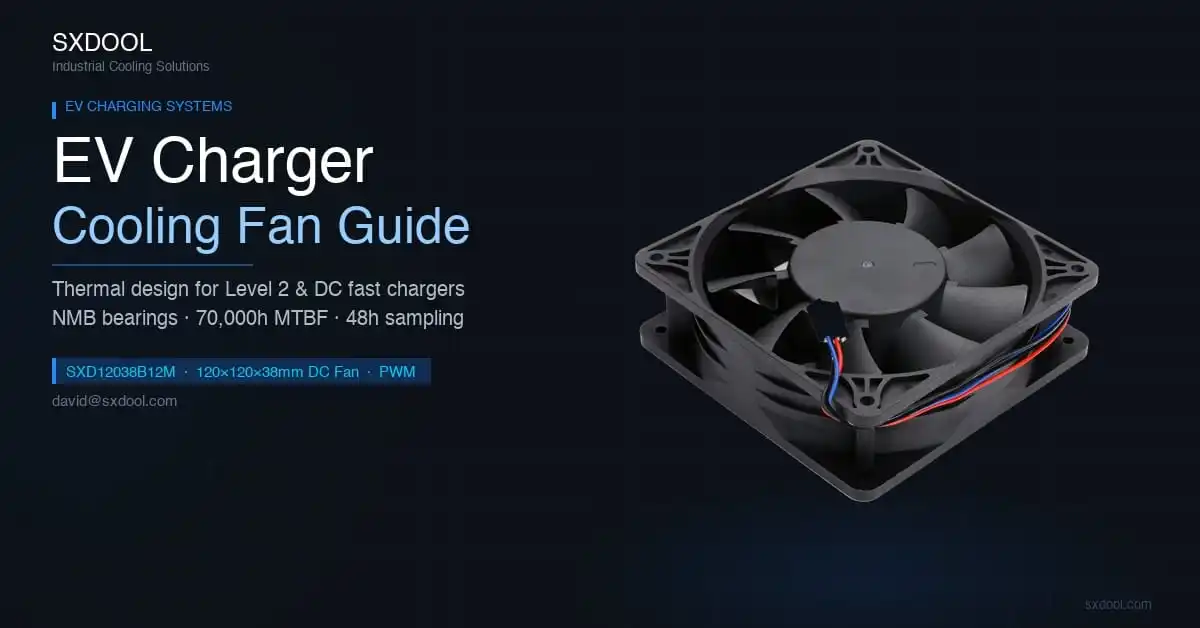
A static fan speed is rarely efficient for BESS applications. Thermal loads fluctuate based on the C-rate (charge/discharge rate) and ambient environmental conditions. PWM (Pulse Width Modulation) speed control allows the BESS management system to adjust fan speeds dynamically. This ensures that cooling intensity matches the real-time heat load, saving energy and reducing wear on the cooling components. SXDOOL's fans are engineered to respond linearly to PWM signals, providing the granularity needed for tight thermal control.
NMB Double Ball Bearings: Engineered for Longevity
Reliability is paramount in industrial energy storage. A cooling failure can lead to catastrophic thermal runaway. SXDOOL utilizes NMB double ball bearings in its high-performance fans. Unlike sleeve bearings, which can dry out and fail in high-temperature or continuous-duty cycles, NMB double ball bearings offer a much longer Mean Time To Failure (MTTF), often exceeding 70,000 hours at 40°C. This reliability is crucial for BESS installations designed for a 15- to 20-year lifespan.
Safety Implications: Preventing Thermal Runaway
Safety is the top priority for BESS developers. LiFePO4 chemistry is inherently safer than Nickel Manganese Cobalt (NMC), but it is not immune to thermal runaway if localized temperatures exceed critical thresholds (typically above 60°C for prolonged periods). Thermal non-uniformity creates "seed" locations for thermal runaway. If one cell enters a state of self-heating, it can propagate to neighboring cells. Effective BESS cooling ensures that heat is removed faster than it is generated, even during high-load periods, maintaining the system within a safe operating envelope.
Environmental Challenges and IP68 Protection
Containerized BESS units are often deployed in harsh environments—from coastal regions with high salt-mist to desert locations with fine dust and extreme humidity. The cooling system must be as resilient as the battery itself. Fans with an IP68 rating are essential. This rating ensures the fan is completely dust-tight and can withstand immersion in water. SXDOOL provides IP68-rated cooling solutions that utilize specialized vacuum-sealed motors and conformal coatings to prevent corrosion and electrical shorts, ensuring the cooling system doesn't become the point of failure in demanding field conditions.
Economic Impact: Long-Term TCO and Efficiency
For procurement professionals, the decision on thermal management components directly impacts the project's internal rate of return (IRR). While a cheaper fan might save a few dollars in CAPEX, the resulting thermal non-uniformity can lead to a 10-20% reduction in battery lifespan. In a multi-megawatt system, this translates to millions of dollars in lost revenue and premature replacement costs.
Comparison of Cooling Component Specifications
| Feature | Standard Industrial Fan | SXDOOL BESS-Optimized Fan |
|---|---|---|
| Bearing Type | Sleeve or Single Ball | NMB Double Ball Bearing |
| Ingress Protection | IP44 / IP54 | IP68 (Dust & Water Proof) |
| Speed Control | Fixed or Voltage Control | Advanced PWM Speed Control |
| Lifespan (MTTF) | 30,000 - 40,000 Hours | 70,000+ Hours |
| Static Pressure | Moderate | High-Static for Dense Racks |
Conclusion
Achieving thermal uniformity in containerized BESS is a multifaceted challenge that requires a deep understanding of thermodynamics, airflow dynamics, and component reliability. By focusing on precision airflow, leveraging technologies like PWM control and NMB bearings, and ensuring environmental resilience with IP68 ratings, engineers can significantly enhance battery lifespan and safety. As a specialist in BESS thermal management, SXDOOL (Sensda Electronics) continues to push the boundaries of cooling technology, providing the reliable hardware necessary for the next generation of energy storage.
For more information on how SXDOOL can optimize your BESS cooling strategy, contact our technical engineering team today.







0 Comentarios