CDU Control Cabinet Cooling Fans
Liquid-cooling equipment · Control electronics and auxiliary cabinets
Select a CDU control-cabinet fan from the heat generated by its electronics, the available air path and the actual fan supply—not from the CDU’s liquid-cooling capacity. A coolant distribution unit can transfer server heat through a liquid-to-liquid heat exchanger while a separate air path cools its power supplies, pump-drive electronics or controller compartment. Start by confirming which components in your design actually need forced air.
This guide is for OEM teams developing or qualifying the electronics compartment of a CDU. It does not establish an approved replacement for an installed equipment manufacturer’s fan.
Separate the control-cabinet air path from the liquid circuit
A liquid-to-liquid CDU transfers heat between the technology cooling loop and facility water through a heat exchanger. A liquid-to-air CDU instead rejects the liquid’s heat through an air-side coil. Vertiv’s CDU deployment guide explains these architectures. Neither architecture alone identifies the airflow needed inside an electrical compartment.
There is a documented reason to assess this separate air path: the nVent RackChiller CDU800 operation manual, 89217391 Rev. A, section 15.4, lists electrical-cabinet fans alongside a power supply, pump variable-speed drives and control electronics. This is an example of CDU construction, not evidence that a SXDOOL fan fits that equipment.
If your requirement is moving air through the main liquid-to-air coil, use the liquid-to-air radiator fan selection guide. For the electronics compartment, define the local heat sources and their allowed temperatures independently.
Locate the hot components before choosing an inlet or exhaust fan
Mark the power-supply exhaust, drive heat sinks, control boards and intake openings on a cabinet drawing. Identify which components already have their own cooling and which rely on enclosure ventilation. An auxiliary fan should move air through the intended hot zone; a nearby opening can let air bypass it.
| Zone | Information to collect | What to verify in the assembled cabinet |
|---|---|---|
| Control and communications bay | Board losses, permissible temperatures, nearby hot surfaces and existing ventilation. | Air reaches the warm components without carrying warmer exhaust from another bay into them. |
| Power-supply compartment | Losses at the intended load, its specified inlet conditions and any internal fan exhaust. | The cabinet inlet and outlet support the power supply’s required air path and service clearance. |
| Pump-drive electronics | Drive loss data, heat-sink orientation, duty profile and drive manufacturer’s installation instructions. | Drive cooling remains adequate during the specified operating modes; an enclosure fan does not replace the drive’s own requirements. |
The CDU’s rated heat-transfer capacity is not the heat generated by these electronics. Request loss data for the actual components and include heat entering from adjacent equipment in the thermal assessment. Do not divide the CDU’s kilowatt rating by a generic airflow rule to select a cabinet fan.
Compare airflow at the cabinet’s resistance
Filters, grilles, cable bundles and heat sinks restrict airflow. Assess the exact fan’s pressure–airflow curve against the intended cabinet path, then verify component temperatures with the doors and panels in their normal positions. SANYO DENKI’s airflow-resistance explanation describes the operating point where fan performance meets system resistance; maximum free-air flow alone does not establish installed cooling.
Compare clean and agreed service-condition filters, rather than assuming a new filter represents the full maintenance interval. If the fan needs an impractical speed or noise level to meet the temperature limit, revisit the openings, routing or fan arrangement. Record the acoustic measurement position and operating mode so the comparison can be repeated.
A SXDOOL sample to investigate for a separate electronics air path
SXD8038B24H-PWM is a candidate to discuss when an OEM is evaluating a compact axial fan for a constrained electronics air path. The photographed desktop sample is labeled 24 V DC, 1.40 A. This identifies the sample version; it does not establish the cabinet airflow, starting current or cooling result.
The linked product page describes a separate 24 V, 0.80 A reference. Keep the two versions distinct. Request the exact offered sample’s dimensional drawing, pressure–airflow data, noise test conditions, supply limits and electrical interface before deciding whether it belongs on the test shortlist. No CDU installation or performance test is established for the pictured sample.
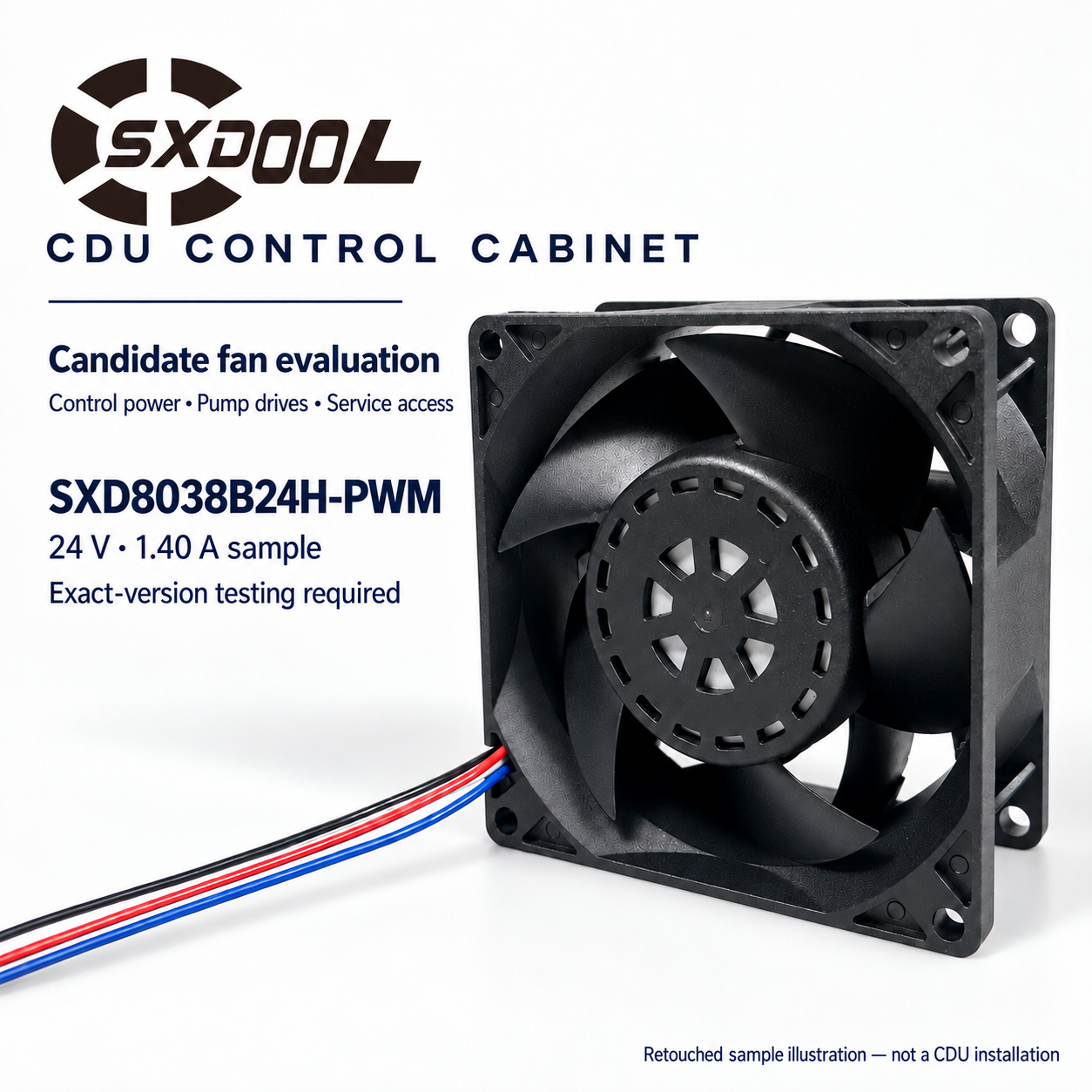
This candidate is worth investigating only if its confirmed mechanical envelope, electrical demand and measured operating point match the cabinet design. Reject it if the available supply, noise budget, airflow path or environmental requirements cannot be met. A model suffix or the colors of its leads are not a verified pinout, monitoring specification or communications interface.
Qualify moisture, alarms and maintenance together
Keep ventilation openings and electronics out of potential liquid-leak paths. Identify surfaces that could fall below the local dew point and follow the CDU manufacturer’s condensation-control design. Airflow alone does not establish protection against condensation, coolant exposure or leaks, and the pictured fan has no verified ingress-protection or coolant-compatibility claim in this guide.
Define the response to fan loss separately from pump redundancy. Test the agreed alarm and protective response under controlled conditions. If speed monitoring is required, confirm the fan’s exact output and the controller’s input specification; a rotating-fan signal does not prove unobstructed airflow or an acceptable component temperature.
Plan access to filters and fan fasteners, cable strain relief and the approved isolation procedure. Set inspection intervals from the equipment manufacturer’s requirements and the actual environment. A fan substitution in an existing CDU needs the equipment owner’s approved service process and exact electrical and mechanical matching.
CDU control-cabinet fan questions
Does a liquid-to-liquid CDU need an air-cooling fan?
Some designs use fans for electrical compartments even though the primary heat-transfer path is liquid-to-liquid. Check the actual cabinet and component cooling requirements. A fan is not automatically required in every CDU, and an electronics fan is not the main liquid-cooling heat exchanger.
Can I power a fan from any 24 V terminal in the CDU?
No. Confirm that the identified auxiliary circuit is intended to supply the fan and has the required capacity and protection. Check startup demand, supply tolerances and any control interface against the exact fan and CDU electrical drawings.
Does a redundant pump arrangement make the control cabinet thermally redundant?
No. Define the electronics cooling requirement separately. A shared fan, shared supply or restricted air path can affect the control compartment independently of pump availability. Verify the intended fault response in the assembled equipment.
Is SXD8038B24H-PWM a verified replacement for the nVent cabinet fan?
No. The nVent manual illustrates why a CDU can contain separate cabinet fans. It does not identify SXDOOL as its supplier or establish interchangeability. The SXDOOL 24 V, 1.40 A sample requires its own documentation and equipment-level qualification.
Request a CDU electronics fan evaluation
Send the CDU architecture and cabinet layout, local component losses, hottest fan-inlet condition, temperature limits, filter and air-path details, available mounting space, actual fan supply, noise limit, control and monitoring requirements, moisture conditions and maintenance access. Identify the required sample label and version, quantity, and the drawings or test records needed for approval.
For this candidate, specify “SXD8038B24H-PWM, 24 V 1.40 A sample” so that the separate 0.80 A reference is not substituted in the document review.
Discuss the CDU cabinet and exact sample
Explore industrial cooling-fan applications
Technical sources checked October 19, 2026. Equipment-maker examples explain design considerations and do not establish an SXDOOL installation or qualification.