BESS cooling fans: subsystem selection and control-cabinet airflow
Select a BESS fan for a defined compartment and airflow path. Battery-rack cooling, power-conversion cooling, a liquid-loop radiator and auxiliary control-electronics ventilation have different duties. Storage capacity alone cannot establish the required fan. Start with the compartment losses, permitted temperatures, available supply, airflow resistance and the response to loss of cooling.
This guide keeps those subsystem boundaries clear and gives a detailed selection path for the auxiliary electrical cabinet containing control, communication and supporting power equipment. A fan listed below is a candidate for engineering review; it has not been qualified here for a specific BESS.
Request a BESS control-cabinet fan reviewPrepare the engineering inputs
Identify the cooling circuit before choosing a fan
| Subsystem | Selection question | Evidence to use |
|---|---|---|
| Auxiliary and control-electronics cabinet | Can air reach the controller, communication devices and auxiliary power components without bypassing their hot zones? | Compartment losses, local inlet temperature, layout, supply and signal requirements, and component temperature tests. |
| PCS / power-conversion cabinet | Can the selected cooling circuit remove the converter losses at the specified duty? | Converter thermal design, heat-sink or cold-plate data, operating limits and fault response. See the inverter cooling selection guide. |
| Battery rack or module | What cooling method and temperature limits does the battery manufacturer require? | The exact battery-system design and qualification evidence. Auxiliary-cabinet fan results do not establish cell temperature uniformity. |
| Liquid-loop radiator or enclosure climate unit | Which side of the heat exchanger is the fan serving? | Coolant and air conditions, exchanger resistance and the unit manufacturer’s controls. See air-side radiator fan selection. |
A practical OEM example is Sungrow’s PowerStack system documentation, which identifies the PCS, power distribution cabinet, EMS, local controller and liquid-cooling system separately. That supports defining the compartment before selecting cooling equipment; it does not establish SXDOOL compatibility with that product. See Sungrow’s system description, section 1.1.
Define the auxiliary-cabinet heat sources and fan position
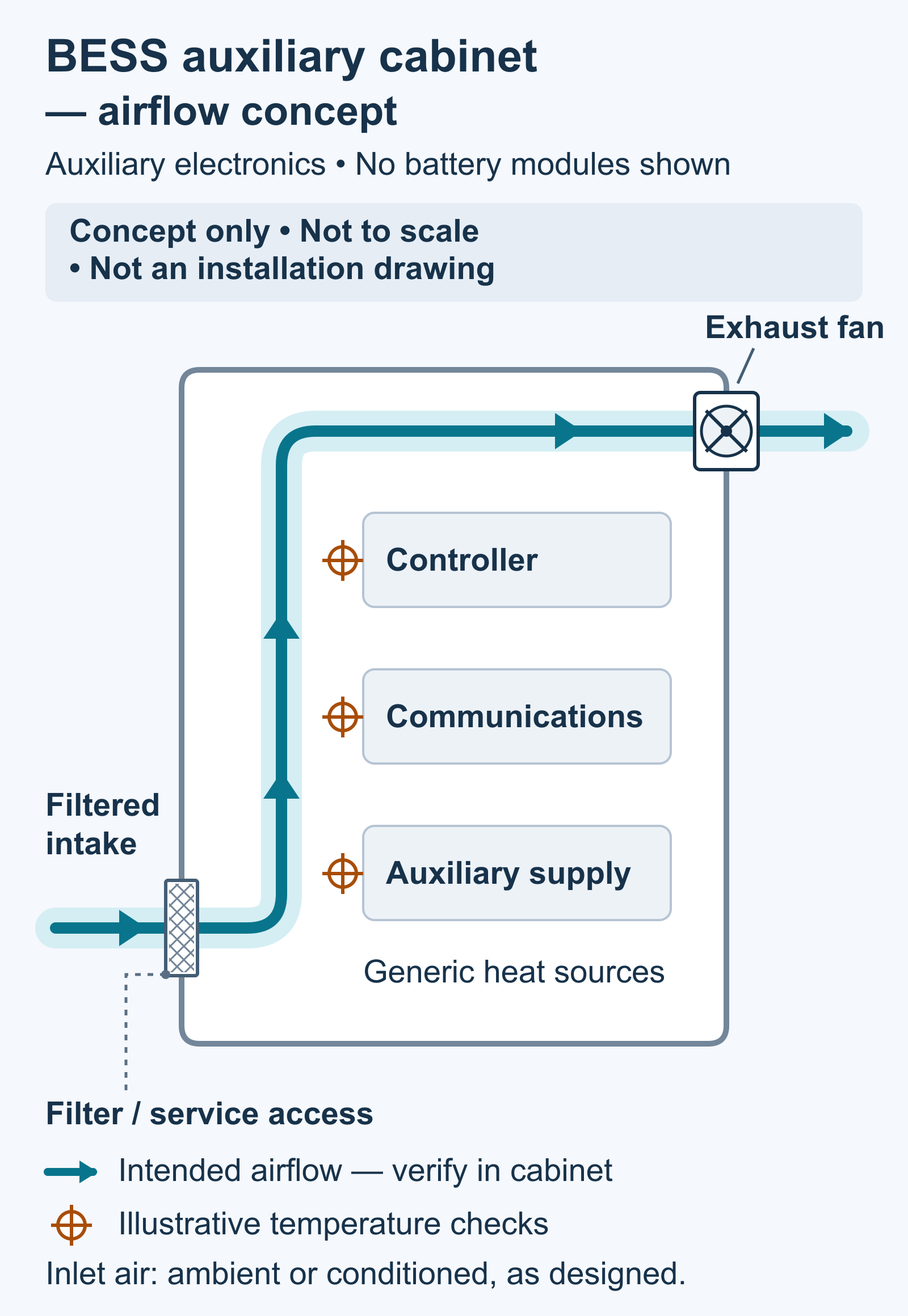
Make a loss and temperature list for the equipment actually installed. Depending on the design, this can include the EMS controller, communications gateway, local-control electronics, DC power supply and a UPS or transformer. Record normal operation, startup and the auxiliary-power mode that remains active when the main converter is stopped. Do not use the battery’s stored energy as the cabinet heat load.
Mark the intended intake, exhaust and fan mounting position on the enclosure drawing. Check the route past each component, cable trunking, partitions, guards and serviceable filters. A fan installed above a hot component may simply recirculate warm air if the inlet and outlet are poorly separated. Verify the route in the assembled cabinet with temperature and airflow measurements.
Also identify whether the compartment exchanges air with outdoors, with an already conditioned container, or only circulates air inside a sealed enclosure. Internal circulation can reduce a local stagnant zone, but the enclosure still needs a defined route to reject heat.
Check the conditions where ventilation can work
Ambient-air ventilation needs a usable temperature difference. Rittal specifies relatively clean inlet air cooler than the required enclosure interior for its ambient-air cooling approach. Apply that principle to the measured air at this compartment’s intake, not just a weather-station temperature. If the permitted cabinet temperature is below the available inlet temperature, review a separate cooling or heat-exchange system. Rittal: ambient-air enclosure cooling conditions.
Define dust, salt exposure, humidity and condensation conditions separately. A component IP label cannot qualify a cabinet opening or establish corrosion resistance. Rittal’s condensation guidance treats dew point, seals and climate control as enclosure-level issues; increasing fan speed does not by itself resolve them. Rittal: moisture in enclosures.
Choose service access and a filter condition that can be inspected in practice. The cabinet should remain within its temperature limits at the agreed maintenance condition, not only with an empty enclosure and new filter.
Select at the installed operating point
Filters, guards, restricted passages and the populated cabinet create resistance. Compare that system requirement with a curve for the exact fan configuration. Maximum free-air flow and maximum static pressure are different endpoints; neither describes the installed duty on its own. SANYO DENKI’s fan-selection tutorial explains the operating-point method.
For the auxiliary cabinet, compare temperature margin, input power and noise at that duty. A high-output fan may be unnecessary for a low-loss controller enclosure, while a restricted supply compartment may require a different pressure characteristic. Define noise at the installed measurement position, including grille and enclosure effects.
SXDOOL candidate: request the exact configuration first
SXD12038B24H is an existing SXDOOL product reference to investigate where the cabinet design calls for this type of axial-fan platform. Its product page is a starting point for a document request, not evidence that the fan meets a particular BESS duty. Compare the approved drawing, electrical requirements and curve with your cabinet before selecting a sample.
The current product page describes a fixed-speed base configuration and says PWM, FG or RD requirements need an approved suffix and interface drawing. Do not assume that this base model provides those functions. If the controller requires speed command or fault feedback, state the required function, connector, pinout, signal levels and failure behavior in the enquiry.
No installed BESS performance, service-life, ingress-protection or certification result is claimed for this candidate here. Request the released specification and test conditions for the complete model and revision. Use the document center to identify the documents needed for review.
Qualification checks for this cabinet
| Condition | What to record |
|---|---|
| Maximum declared auxiliary load | Local inlet and component temperatures after stabilization, supply conditions, airflow path and operating point. |
| Defined filter service condition | Filter identity and restriction, temperature margin and the maintenance trigger. |
| Restart or auxiliary-power transfer | Fan startup behavior and the cabinet controller’s response with the specified power architecture. |
| Loss of cooling | The OEM-approved test condition, detection method, alarm/derating response and component temperature limit. |
| Noise and maintenance | Installed acoustic conditions, access to the fan/filter, cable clearance and replacement identification. |
These are selection and verification inputs for normal electronics cooling. ESS safety assessment has a separate system scope: UL describes evaluation of protection, control, communication and other system functions, and distinguishes thermal-runaway propagation testing. An ordinary cabinet fan does not establish thermal-runaway protection or emergency-ventilation suitability. UL Solutions: ESS testing and certification scope.
BESS control-cabinet questions
Does a liquid-cooled battery system still need an auxiliary-cabinet fan?
Check the auxiliary compartment separately. A battery cold plate does not show how heat leaves the controller, communications hardware or supporting power equipment. A fan is only appropriate if the compartment’s thermal assessment, available air and enclosure requirements support it.
Can I replace the existing fan with a higher-CFM model?
Not from the free-air number alone. Compare the exact drawing, voltage, startup requirement, airflow direction, installed operating point, noise and interface. Confirm the OEM permits the substitution and verify the assembled cabinet.
Can fan feedback prove the filter is clear?
A rotation signal reports the behavior defined by its interface; it does not directly measure cabinet airflow or filter restriction. Establish a suitable inspection or monitoring method for the airflow condition and validate it with the equipment controller.
What should I send for an SXDOOL review?
Send the compartment drawing, component loss list and limits, inlet conditions, filter and airflow details, supply, mounting envelope, required control/feedback interface, service environment and acceptance test. Include the exact existing fan label and drawing if this is a replacement request.
Discuss the BESS auxiliary cabinetExplore cooling applications