Battery energy storage thermal management
BESS cooling fans for battery racks, PCS cabinets and container airflow
Engineering selection for air-cooled battery energy storage systems, including system resistance, redundancy, filtration, monitoring and service access. SXDOOL reviews exact fan configurations through project RFQ; application suitability is confirmed against the installed thermal design.
Start with the BESS cooling architecture
Battery racks, battery management electronics, power conversion systems and container auxiliaries may require different airflow paths. The fan must be selected at the intended operating point, not by frame size or free-air CFM alone. Inlet filters, dense rack geometry, ducts, louvers and heat exchangers can materially change required static pressure.
| BESS zone | Typical thermal task | Fan selection focus | Evidence required |
|---|---|---|---|
| Battery rack or module aisle | Limit cell-to-cell and rack-to-rack temperature spread. | Air distribution, low bypass leakage, service access and acoustic target. | Rack flow model or test, fan curve, temperature map and obstruction definition. |
| PCS / inverter cabinet | Remove concentrated power-electronics heat through heat sinks and restricted passages. | Static pressure, duct interface, PWM control, FG/RD monitoring and redundancy. | Pressure-flow curve, controller interface, one-fan-failure test and approved drawing. |
| Container intake / exhaust | Exchange or circulate larger air volume while managing dust and weather exposure. | Filter loss, louver resistance, corrosion environment, water path and maintenance. | Clean/loaded filter curve, installation boundary and environmental qualification plan. |
| Auxiliary electronics | Cool BMS, DC/DC, communication and control compartments. | Compact frame, voltage, connector, signal wire and local hot-spot control. | Exact electrical table, airflow path, cable/connector drawing and end-of-line test definition. |
Fan platform routing
DC axial platforms
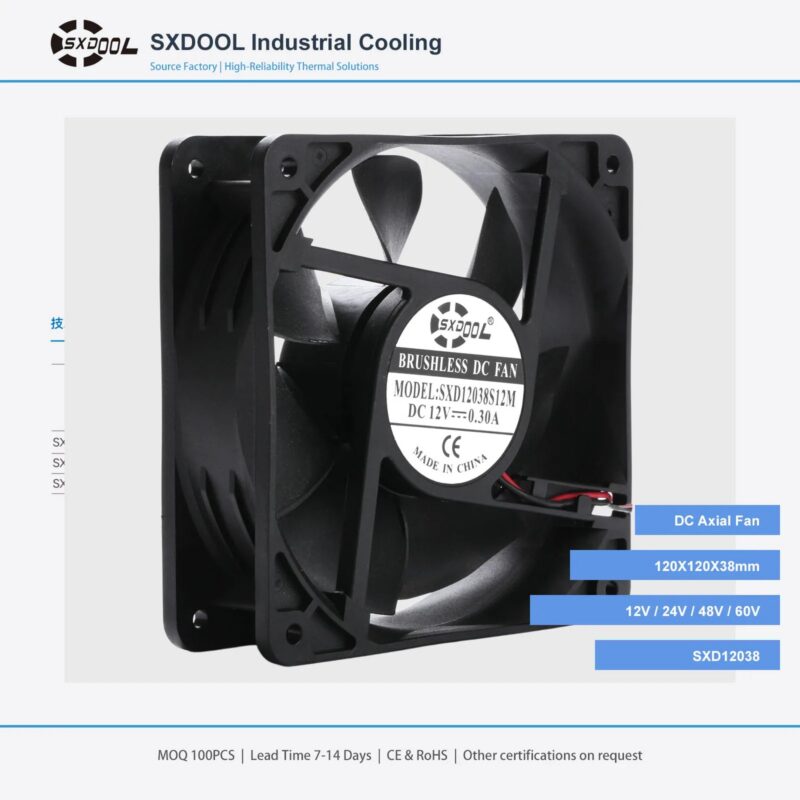
Suitable for low-voltage cabinet and rack airflow when the exact voltage, performance grade, cable, connector and optional PWM/FG/RD interface are defined.
EC axial platforms
Useful for AC-input cabinet or container airflow where project teams need energy-saving motor control. Confirm input range, frequency, speed behavior and wiring for the exact model.
Filter fan assemblies
Useful for filtered enclosure ventilation when panel cutout, filter media, clean and loaded pressure loss, airflow direction and ingress boundary are qualified together.
Qualification inputs for a BESS cooling RFQ
Thermal and mechanical
- Continuous and peak heat load by zone
- Ambient and target internal temperature
- Rack, duct and opening geometry
- Available fan envelope and mounting depth
Electrical and control
- Supply voltage and tolerance
- Startup current and power budget
- PWM command or speed-control method
- FG tachometer or RD alarm requirements
Environment and service
- Dust, moisture, salt, corrosion and altitude
- Filter media and service interval
- Acoustic and vibration limits
- Sample, pilot and batch documentation needs
Failure modes to test before release
| Failure mode | Why it matters | Recommended verification |
|---|---|---|
| Loaded or blocked filter | Airflow can fall while the fan remains electrically healthy. | Measure the operating point and temperature response at the defined loaded-filter condition. |
| Single-fan failure | Redundant layouts may still develop local hot spots or reverse flow. | Run one-fan-out thermal tests and confirm alarm, derating and shutdown response. |
| Controller or signal mismatch | Incorrect PWM level, pull-up or alarm polarity can hide a cooling fault. | Validate pinout, logic, pulse definition, startup and failure state with the intended controller. |
| Air recirculation or bypass | High total airflow may not reach the hot components. | Use smoke, pressure or temperature mapping to verify the actual route and seal bypass gaps. |
BESS cooling fan FAQ
How should engineers choose between an axial fan and a blower in a BESS cabinet?
Axial fans suit larger open flow paths, while blowers can be appropriate for ducts or localized high-resistance paths. Select from the required operating point on the pressure-flow curve and the physical inlet/outlet geometry, not from nominal CFM alone.
What information is needed to select a fan for a battery rack or PCS cabinet?
Provide heat load, temperature limits, airflow path, system resistance or geometry, fan envelope, voltage, monitoring signals, redundancy concept, environment, acoustic target and quantity. SXDOOL then reviews a suitable product family and the evidence needed for the exact released configuration.
Can an IP-rated fan make the complete BESS enclosure IP rated?
No. The enclosure rating depends on the complete installation, including openings, filters, louvers, cable exits, gaskets, drainage and mounting. A fan construction or component test cannot be extended to the entire BESS enclosure without assembly-level verification.
BESS airflow qualification paths
Evaluate fan platforms for battery racks, PCS cabinets and container ventilation
BESS airflow design must account for redundancy, filter loading, recirculation, monitoring and service conditions. These pages provide distinct starting points for AC-input EC and low-voltage DC architectures; the final configuration remains subject to the approved drawing and representative thermal tests.
12038 EC axial fan, AC input
For large AC-powered ventilation assemblies that can use a 120x120x38mm electronically commutated platform.
9238 EC axial fan, AC input
For 92mm BESS cabinet openings where the 38mm frame provides additional resistance margin.
SXD12038B24H 24V high-speed fan
For 24V PCS or rack ventilation paths that require a thicker high-output DC platform.
9238 24V high-speed DC fan
For compact 24V subsystems where a 92mm opening and 38mm depth are available.
SXD12025B24H-RBP 24V configuration
For 25mm-deep 24V installations that need a controlled -RBP cable or signal interface.
8038 high-pressure DC family
For dense compact power modules where an 80mm fan must work against significant restriction.