Blog
Industrial Electrical Cabinet Filter Fan Selection: A Procurement Guide for OEM Engineers


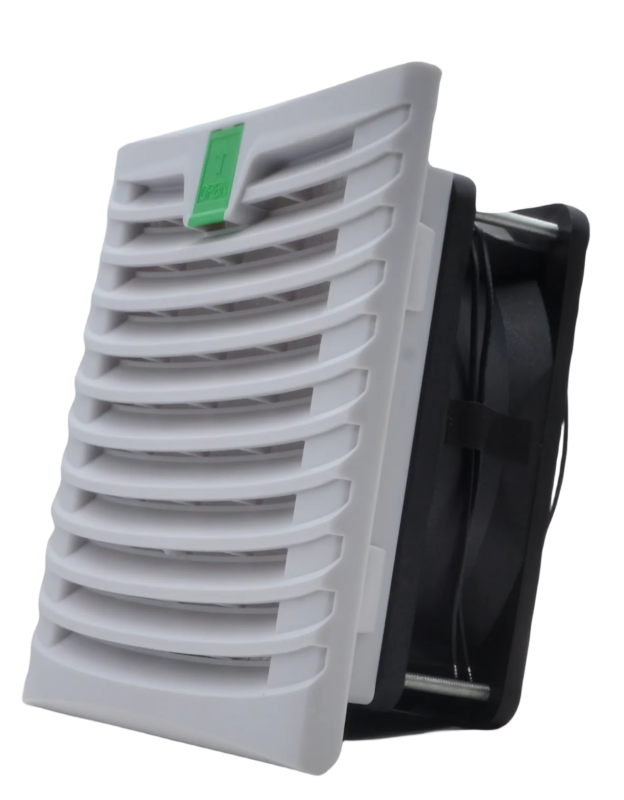
Select a cabinet filter fan against the heat load, allowable component temperatures, supply voltage and resistance of the complete intake and exhaust path. Frame size or a legacy part number alone does not establish that a replacement will cool the cabinet adequately.
This guide provides a qualification checklist for OEM engineers comparing complete fan-and-filter assemblies or evaluating an SXDOOL candidate. A candidate remains subject to configuration-specific documents and testing in the intended cabinet.
—
1. Define the Air Path and Maintenance Conditions
Identify the cabinet’s heat sources, including drives, power supplies, PLCs and other electronics. Record the intake and exhaust locations, clearances, filter medium and any internal barriers that could restrict airflow or leave a local hot spot.
In an intake installation, a filter fan draws ambient air into the cabinet. Check that the intake temperature and contamination conditions are suitable before choosing this cooling method; do not assume a fan can compensate for an unsuitable ambient environment.
Set an inspection and filter-replacement plan for the actual dust loading and duty cycle. Request the selected fan’s bearing specification and life data with the stated temperature, mounting orientation and test method. A bearing label alone does not establish a replacement interval or cabinet service life.
—
2. Thermal Calculation Fundamentals
Step 1: Establish heat dissipation. Use the equipment manufacturers’ loss data at the intended load, or measured losses. Do not infer the cabinet heat load from motor nameplate power or a generic wattage per component.
Step 2: Define the temperature limits. Record the highest relevant intake-air temperature and each component’s allowable operating temperature, including any derating requirements. Choose the cabinet target and validation margin from those limits.
Step 3: Estimate the airflow. The following steady-state air heat balance is a starting estimate, not a fan rating or proof of cabinet performance:
Q_air = Q_internal / (Cp × ρ × ΔT)
Here Q_air is airflow in m³/s, Q_internal is heat carried away by the air in W, Cp is air specific heat in J/(kg·K), ρ is air density in kg/m³, and ΔT is the permitted air-temperature rise. Use properties appropriate to the installation.
Illustrative example: Using 200 W, a 10 K rise, Cp = 1,006 J/(kg·K) and ρ = 1.2 kg/m³ gives approximately 0.0166 m³/s, or 35 CFM. These are assumed design inputs, not measured SXDOOL product data. This estimate does not resolve local hot spots, enclosure heat transfer, leakage, filter loading or altitude effects.
Confirm the available airflow at the installed operating point, then measure critical component temperatures under the intended worst-case load and ambient conditions. If cooling must continue after a fan fault, validate that fault condition separately.
—
3. Filter Pressure Drop and the Installed Operating Point
Request the pressure-airflow curve for the exact fan version, voltage and speed under review, together with resistance data for the chosen filter, grille and air path. Specify both the clean-filter condition and the maintenance threshold used for a loaded filter.
The intersection of the fan curve and the system resistance curve identifies the operating point. Free-air flow and maximum static pressure are endpoints, not the airflow and pressure available simultaneously in the cabinet. AMCA explains how fan and system curves determine the operating point.
Compare candidates at the required operating point and check noise, current and temperature in the installed assembly. Do not assign a universal pressure loss to every filter or select a higher-pressure fan without reviewing the complete system.
—
4. Compare Exact Configurations and Qualification Evidence
Compare suppliers using the same operating conditions and the exact quoted part numbers. Country of origin, brand name or frame size does not establish equivalent construction, protection, life or installed airflow.
Mechanical and electrical fit: Check the cutout, panel thickness, gasket, mounting depth, filter access, airflow direction, supply range, startup current, connector and requested control or alarm signals.
Performance and reliability: Request the applicable pressure-airflow curve, acoustic test conditions, life definition and environmental limits. Record the document revision and the tested configuration for each claim.
Commercial comparison: Obtain current written quotations for the same configuration, quantity, delivery terms and required documents. Confirm sample availability, production lead time and replacement-filter supply with each supplier; this guide does not promise a fixed price or delivery time.
—
5. Check Documentation for the Intended Panel and Market
Agree the applicable requirements with the panel builder and the organization responsible for the finished assembly’s assessment. Request documents identifying the exact fan or complete filter assembly and its approved construction.
- Protection: Check which item was tested, its mounting and gasket arrangement, test conditions and report scope. A fan-level protection claim does not by itself establish the finished cabinet’s rating.
- Declarations and material compliance: Request the documents applicable to the selected configuration and destination market. Do not extend one model’s declaration to every fan in a family.
- Panel component requirements: Where a UL 508A evaluation is relevant, review the applicable component requirements with the panel assessor. UL publishes specific component requirements for industrial control panels; a generic supplier statement is not a substitute for checking the selected component.
—
6. Make the Sourcing Decision After Validation
Retain the existing approved part when a proposed replacement has unresolved document gaps, incompatible mounting or electrical requirements, or has not met the cabinet’s thermal and qualification criteria.
Evaluate an SXDOOL candidate when its exact configuration can be documented and tested against the same acceptance criteria. Start with the cabinet ventilation and filter-unit range, then confirm the specific assembly and fan version before ordering a qualification sample.
Record the sample identification, test conditions, measured results and deviations. Release a replacement only through the customer’s normal approval process; a catalogue match is not an established drop-in replacement.
—
7. Prepare an OEM Configuration Request
Send the required cutout and mounting drawing, available depth, supply conditions, airflow or thermal target, noise limit, duty cycle, intake environment and filter-maintenance requirement.
If the application needs a particular connector, cable length, speed command or alarm output, specify its electrical interface and expected behavior. Ask SXDOOL to confirm feasibility and the exact orderable configuration in writing; available options differ by model.
Before release, agree the drawing revision, bill-of-material requirements, inspection criteria and the documents to be supplied. Request sample and production timing for that configuration instead of relying on a general delivery promise.
—
Conclusion
A useful cabinet filter-fan comparison connects the required operating point, environmental conditions, mechanical fit and maintenance plan to documents for the exact proposed configuration. Verify critical component temperatures in the finished cabinet before treating an SXDOOL candidate as an approved replacement.
For an initial review, share the cabinet heat load, intake temperature, drawings, supply and interface requirements, intended market and the evidence your qualification process requires.
Contact our engineering team: david@sxdool.com
Visit www.sxdool.com | WhatsApp: +86 134 3209 3474