Cooling Fans for Robot Controller Cabinets
A robot controller cabinet needs a fan that moves sufficient air through the actual controller and enclosure, with the correct electrical interface and a maintainable air path. Start with the controller’s heat-loss data, installation instructions and operating cycle. A fan that fits the opening or has a high free-air airflow rating is only a candidate until the assembled cabinet has been tested.
This guide is for integrators designing robot-cell cabinets and evaluating cooling components. For service replacements inside an existing robot controller, follow the robot manufacturer’s approved parts and procedures; the SXDOOL selection path below does not establish a drop-in replacement.
Locate the heat and follow both air paths
List the controller’s power electronics, power supply and processing hardware, then add any PLC, network switch or auxiliary supply installed in the same cabinet. Establish where the selected controller dissipates energy during the intended motion cycle. Use heat-loss information for the exact controller version rather than treating the robot’s full electrical input as heat released into the cabinet.
For example, Universal Robots publishes separate maximum heat-dissipation values for different robot types in its OEM Control Box specifications. This illustrates why the controller model is a required selection input; those values are not SXDOOL fan ratings.
When a controller is installed inside a larger enclosure, review two routes: air through the controller and air entering and leaving the outer cabinet. Keep the controller’s intake supplied with cooler air and route its exhaust away from that intake. An outer cabinet fan can be running while a cable bundle, nearby panel or recirculating exhaust leaves the controller poorly cooled.
The Universal Robots OEM installation guide specifically warns that insufficient airflow or recirculated warm air can cause overheating and shutdown. Use the clearance and environmental requirements in the manual for your own controller, including its revision and installation orientation.
Match the fan to the filter and cabinet resistance
Evaluate the fan with the filter, guard, grille, duct and internal hardware that the finished cabinet will use. These restrictions affect installed airflow. Select against the required operating point on a pressure–airflow curve, then confirm the result in the cabinet. Maximum airflow and maximum static pressure are different endpoints, not a simultaneous performance guarantee.
Plan for the filter condition expected before the next maintenance visit. If the proposed fan only meets the thermal target with a clean filter, the design needs more margin, less restriction or a revised maintenance plan. More speed may increase noise without fixing a blocked inlet or exhaust recirculation.
Place filter access where a technician can reach it without disturbing controller cables or opening unrelated compartments. Use the controller manufacturer’s cleaning and replacement instructions. Identify the actual contaminants in the robot cell: ordinary dry dust, metal particles, oil mist and washdown exposure require different enclosure decisions.
Check monitoring signals as carefully as the connector
A mechanically interchangeable fan may still have an incompatible supply, pinout or monitoring output. Confirm the required starting behavior, control input and speed or fault signal with the controller designer. PWM control, tachometer feedback and a fault output serve different functions; wire count or wire color does not identify them.
Universal Robots’ C274 documentation distinguishes a stopped fan from missing fan-speed monitoring data. This is a practical reason to validate feedback as well as airflow. It is not evidence that an SXDOOL fan supports that controller’s interface.
When a cabinet ventilation fan is not enough
| Installation condition | Design response to evaluate |
|---|---|
| Hot exhaust returns to the controller inlet | Correct the layout, separation and air path before specifying a faster fan. |
| Factory air contains oil mist, conductive debris or cleaning spray | Confirm whether direct ventilation is allowed. Evaluate suitable filtration or a separated-air cooling arrangement with the cabinet designer. |
| Ambient air cannot maintain the required component temperatures | Assess a different heat-removal method. A ventilation fan cannot supply air colder than its inlet air. |
| A controller requires an approved internal replacement fan | Use the manufacturer’s service route unless an alternative has been explicitly qualified. Do not defeat fan monitoring to accept a substitute. |
| Operators work beside the cell | Measure noise in the installed arrangement and confirm the thermal limit remains satisfied at any reduced-speed setting. |
Validate a candidate in the assembled robot cell cabinet
- Record the controller model, revision, permitted orientation and its thermal and ventilation requirements.
- Measure or obtain controller heat loss for the intended duty; include heat from the other equipment sharing the enclosure.
- Compare exact-model fan data with the required installed airflow and resistance. Check the mounting envelope, supply and electrical interface separately.
- Test the cabinet with production filters, guards, wiring and covers in place, at representative ambient conditions and robot duty.
- Check the temperature locations required by the equipment designer, fan monitoring, noise and maintenance access. Record the accepted configuration and limits before procurement.
An SXDOOL product path to evaluate
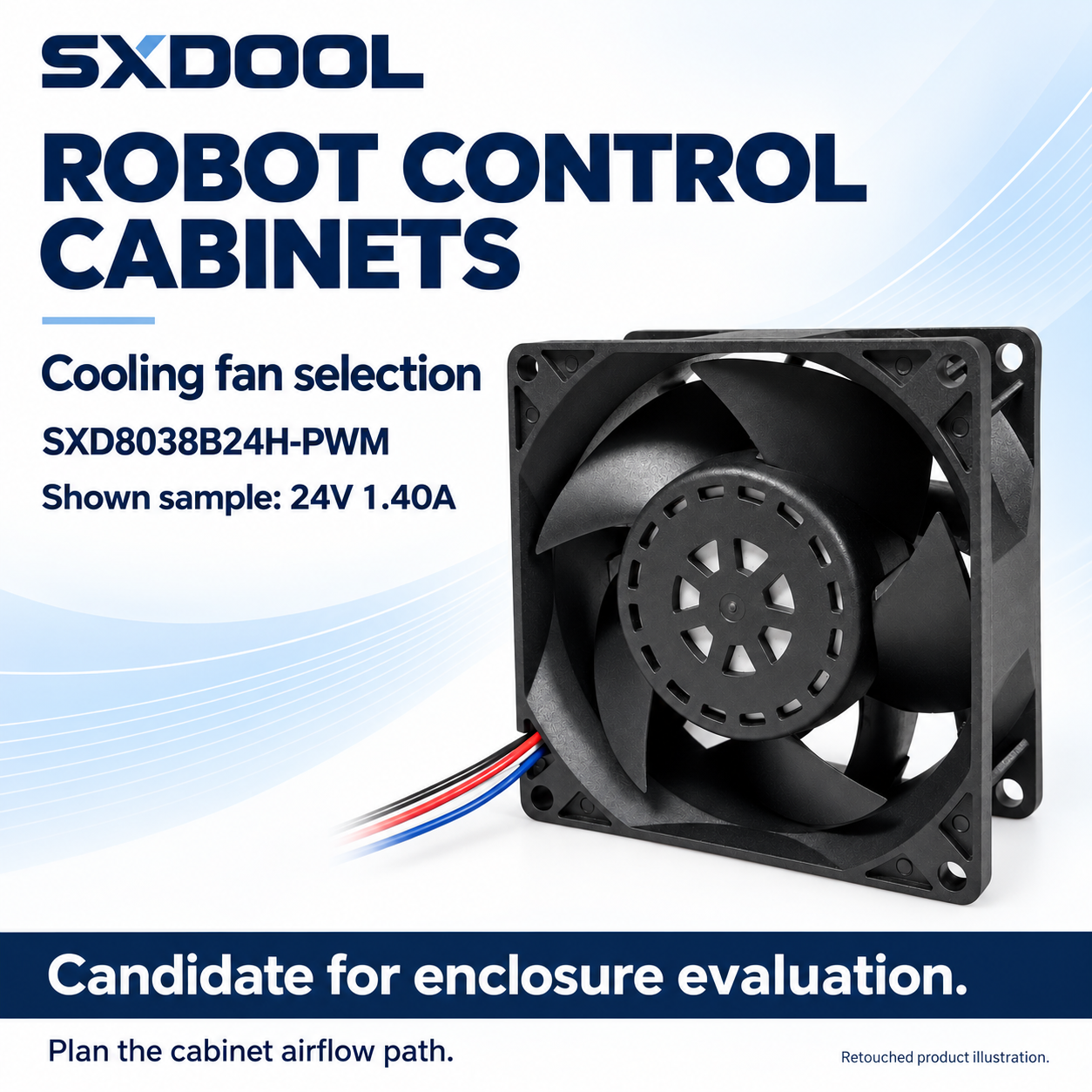
For an integrator-owned outer cabinet, the SXD8038B24H-PWM product reference is a starting point for a restricted-air-path review. It does not establish an approved replacement for a controller’s internal fan. Ask for the current mechanical drawing, pressure–airflow curve, electrical limits, control and feedback definitions, connector and starting behavior. Compare those with the equipment requirements before ordering a sample. No airflow, pressure, acoustic, service-life or environmental rating is assigned by this application guide.
Qualification boundary: Final selection requires the exact offered configuration and a test in the completed equipment. No named equipment-maker approval, universal fit, guaranteed cooling result or certification is claimed here.
Review the SXDOOL product reference · Technical document resources
What to include in a robot controller cooling inquiry
Send the controller make, model and revision; a cabinet layout showing inlet and exhaust positions; available fan space and power supply; heat-loss data or measured temperature problem; intended robot duty; filter and grille details; contamination and ambient conditions; noise limits; and the connector, pinout and monitoring requirements. For a replacement, include the existing fan label and the manufacturer’s replacement constraints.
These details allow a candidate to be compared against the application. They do not replace controller approval or installed testing. For enclosure design principles beyond robot controllers, see the industrial control cabinet cooling guide.
Robot controller fan selection questions
Why can a controller overheat while the cabinet fan is running?
The air moved by the cabinet fan may not pass through the controller’s required route. Check blocked openings, cabinet placement and exhaust recirculation, then compare actual temperatures with the manufacturer’s limits. Also check the controller’s own fan and monitoring status using its service procedure.
Can I replace a robot controller fan with one of the same size?
Size alone does not establish compatibility. Electrical supply, starting current, airflow under resistance, pinout, feedback behavior and the approved replacement scope must also match. This page does not identify an SXDOOL fan as an approved replacement for a named robot brand.
Should the outer cabinet fan replace the controller’s internal fan?
Do not assume so. The internal fan may serve a particular component path and be monitored by the controller. Design the outer enclosure around the manufacturer’s required cooling arrangement, or obtain an approved integration design.
Updated: .