

How PWM Speed Control Optimizes Energy Efficiency in BESS Cooling Units?
How PWM Speed Control Optimizes Energy Efficiency in BESS Cooling Units?
In the world of Grid-Scale Battery Energy Storage Systems (BESS), efficiency is the ultimate metric. While much attention is paid to the round-trip efficiency of the battery cells themselves, the "parasitic load"—the energy consumed by the system's own support infrastructure—plays a significant role in the overall profitability and performance of the installation. Cooling systems are often the largest contributor to this parasitic load. As BESS designers strive to squeeze every possible kilowatt-hour out of their systems, Pulse Width Modulation (PWM) speed control has emerged as a critical technology for optimizing energy efficiency, reducing noise, and extending component life.
The Efficiency Imperative in BESS
Energy storage systems are designed to bridge the gap between energy production and consumption. However, the thermal management systems required to keep batteries stable can consume a significant portion of the stored energy. If cooling fans run at 100% speed regardless of the actual thermal load, they waste energy, increase wear and tear, and generate unnecessary noise. This is particularly problematic during "standby" periods or low-power cycles when the battery temperature is well within safe limits.
To maximize the Levelized Cost of Storage (LCOS), operators must minimize these internal energy losses. This is where intelligent speed control, specifically PWM, becomes indispensable.
What is PWM Speed Control? A Technical Overview
Pulse Width Modulation (PWM) is a method used to control the speed of a DC or EC (Electronically Commutated) fan by rapidly switching the power on and off. Instead of reducing the voltage (which can be inefficient and lead to motor stalling at low speeds), PWM maintains a constant voltage but varies the "duty cycle"—the ratio of time the signal is "on" versus "off."
For example, a 50% duty cycle means the fan receives power for half the time and is off for half the time, resulting in a speed approximately half of its maximum RPM. Because the switching happens at a high frequency (typically 25kHz or higher), the motor experiences it as a smooth, continuous power level, allowing for precise speed adjustments from 0% to 100% of the fan's capability.
Energy Efficiency: Moving Beyond On/Off Control
Traditional cooling systems often relied on simple "on/off" thermostats or multi-tap AC motors. This approach is inherently inefficient. When the temperature hits a threshold, the fan kicks in at full speed, consumes maximum power, and then shuts off when the temperature drops. This leads to a "sawtooth" temperature profile and wasted energy during the high-speed bursts.
PWM allows for proportional cooling. By using the Affinity Laws of fans, we know that the power consumption of a fan is proportional to the cube of its speed. This is a crucial point for BESS designers:
- Reducing fan speed by just 20% can result in an energy saving of nearly 50%.
- Reducing fan speed by 50% can reduce power consumption by a staggering 87.5%.
By using PWM to match the fan speed exactly to the cooling demand, BESS units can significantly reduce their parasitic energy consumption, especially during evening hours or periods of lower ambient temperatures.
Intelligent Thermal Load Management: Dynamic Speed Adjustment
In a modern BESS enclosure, sensors are distributed throughout the battery modules to monitor temperature in real-time. This data is fed into a Battery Management System (BMS) or a dedicated Thermal Controller. The controller then outputs a PWM signal to the cooling fans.
This dynamic adjustment provides several benefits:
- Constant Temperature Maintenance: Instead of the "on/off" cycle, the fans maintain a steady, lower-speed airflow that keeps the battery temperature stable. Lithium-ion batteries perform best and last longest when kept at a consistent temperature.
- Rapid Response: If a sudden high-power discharge occurs (e.g., during a grid frequency response event), the BMS can instantaneously ramp up the fans to 100% speed to prevent a temperature spike.
- Compensation for Filter Clogging: Intelligent controllers can even use fan speed data to detect if air filters are becoming clogged, increasing the PWM duty cycle to compensate for the higher static pressure before alerting maintenance crews.
Noise Reduction and Mechanical Longevity
While energy saving is the primary driver, PWM control offers significant secondary benefits. Grid-scale BESS are increasingly being located near residential areas or commercial centers where noise ordinances are strict. A fan running at 100% speed is significantly louder than one running at 60%. Because noise (decibels) follows a logarithmic scale relative to fan speed, even a small reduction in RPM leads to a massive decrease in acoustic output.
Furthermore, mechanical wear is directly related to RPM. By utilizing PWM to keep fans running at the lowest necessary speed, the lifespan of the bearings—such as the high-quality NMB dual ball bearings used in SXDOOL fans—is extended even further. Lower speeds mean less friction, less heat generation within the motor, and less stress on the impeller blades.
EC vs. DC Fans: Advanced Control Capabilities
SXDOOL offers both DC and EC (Electronically Commutated) fans with advanced PWM control. While DC fans are the standard for low-to-medium voltage BESS components, EC fans are becoming the preferred choice for larger HVAC-style cooling units within the enclosure. Understanding these technologies is key for procurement professionals.
- DC Fans (12V, 24V, 48V): These are highly efficient and easy to control via standard PWM signals from microcontrollers or the BMS. They are ideal for module-level and rack-level cooling where space is at a premium and low-voltage power is readily available. SXDOOL's DC series features specialized ICs that ensure a linear response to PWM signals, making control logic simpler for the OEM engineer.
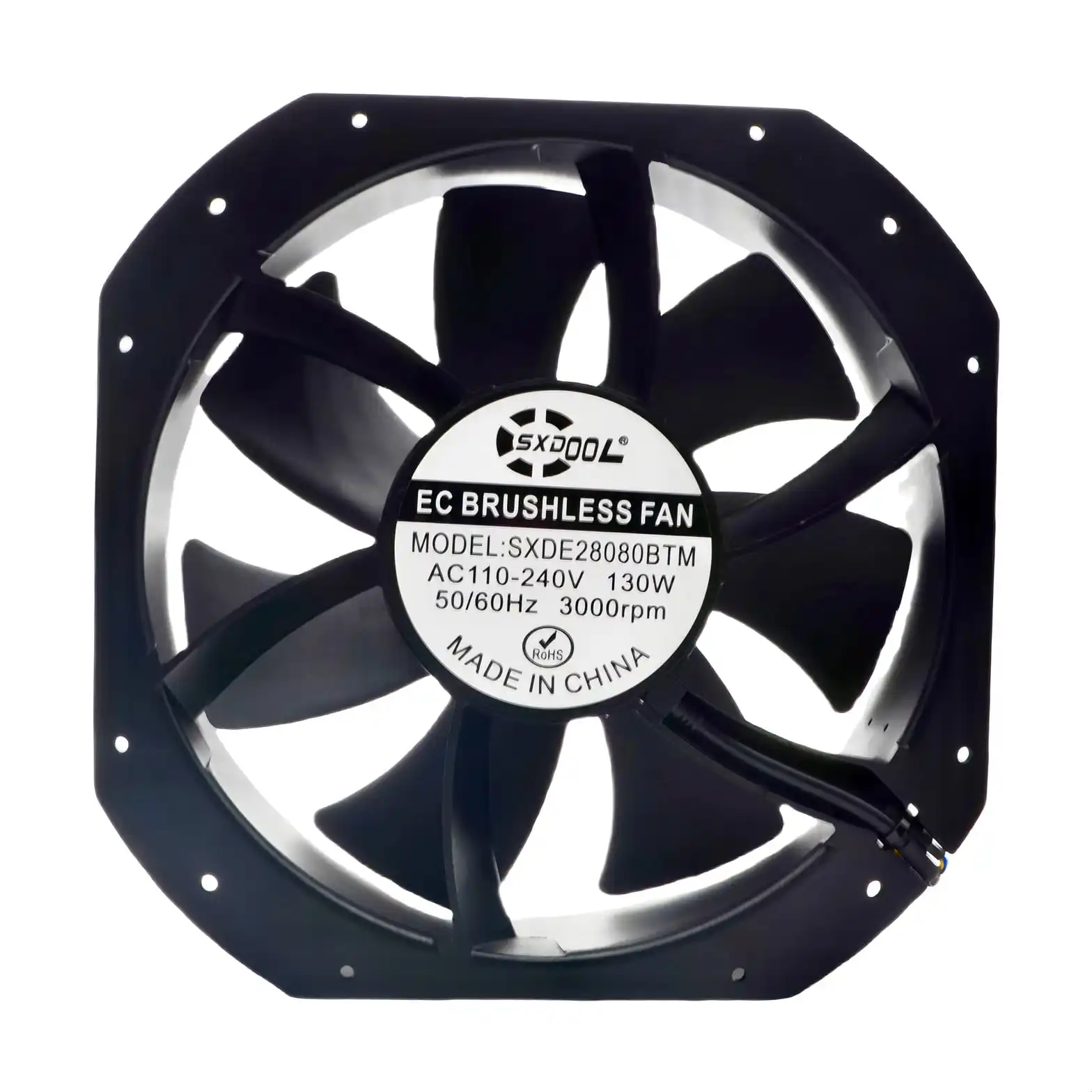
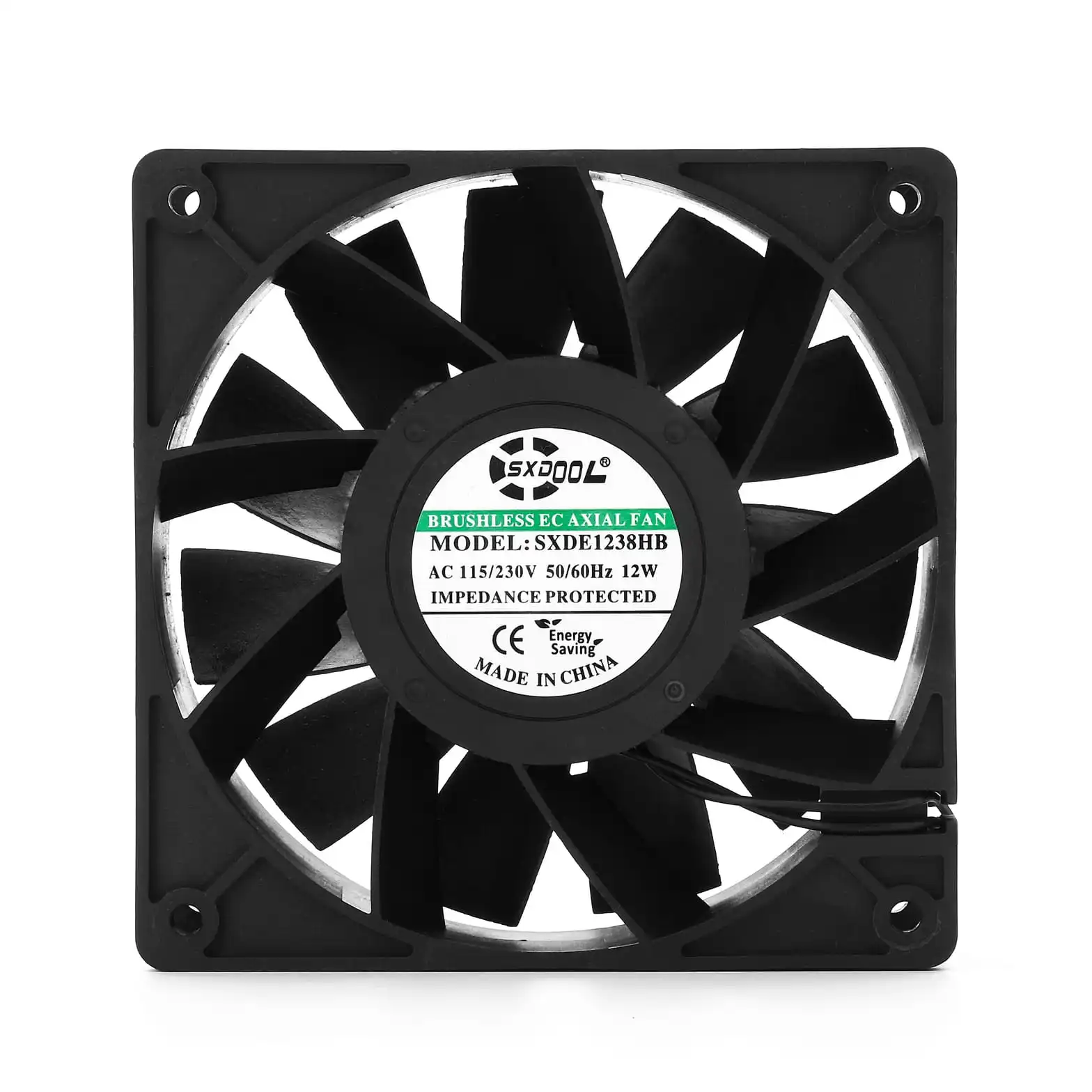
- EC Fans (115V, 230V, 380V): EC fans combine the best of AC and DC technology. They run on AC power but use an internal inverter and a brushless DC motor. This allows for the same precise PWM or 0-10V speed control as DC fans but with the power and simplicity of an AC connection. SXDOOL’s EC fans can save up to 60-80% energy compared to traditional AC fans. EC fans also offer higher torque and maintain programmed speed despite AC fluctuations, providing extra stability for the BESS.
Case Study: The Impact of PWM on Total Cost of Ownership (TCO)
To understand the strategic value of PWM, let’s consider a hypothetical 10MWh BESS installation using 200 high-power axial fans. In a traditional "fixed-speed" setup, these fans might consume a total of 20kW of power continuously. Over a year, this equates to 175,200 kWh of parasitic energy loss.
By implementing SXDOOL PWM-controlled fans and an intelligent BMS, the average fan speed can be reduced to 60% during off-peak hours and temperate weather. Given the cube-law relationship between speed and power, the average power consumption drops from 20kW to approximately 4.3kW.
- Annual Energy Savings: Approximately 137,000 kWh.
- Financial Impact: At an industrial electricity rate of $0.12/kWh, this results in an annual saving of $16,440.
- Extended ROI: Over a 10-year project lifespan, the cooling efficiency alone saves over $160,000, significantly impacting the project's bottom line.
This does not even account for the reduced maintenance costs. Fans running at lower speeds experience less bearing fatigue and accumulate less dust, extending the service interval from 24 months to potentially 48 months or more. For remote grid-scale sites, the cost of sending a technician for a "fan swap" can often exceed the cost of the fan itself, making the reliability of PWM-controlled systems a major financial win.
Integration and Best Practices
While the benefits are clear, integrating PWM fans into a BESS requires attention to detail. Engineers must ensure the PWM frequency matches the fan's specification (typically 25kHz) to avoid resonance or audible "whine." SXDOOL provides comprehensive technical support to ensure the PWM interface is robust against the Electromagnetic Interference (EMI) common in high-voltage battery environments.
SXDOOL's PWM Implementation: Precision and Reliability
Not all PWM implementations are created equal. SXDOOL engineers its fans with high-frequency PWM support to avoid audible "switching noise" or "humming" that can occur with lower-frequency controllers. Additionally, SXDOOL fans often include a Frequency Generator (FG) or Tachometer signal output. This allows the system to not only set the speed but also verify it. If a fan fails or is blocked, the BMS sees the zero-RPM signal and can trigger an immediate safety shutdown or redundancy switch, preventing a localized overheat.
Conclusion: The Strategic Value of PWM in Modern Cooling Systems
For industrial OEM engineers and BESS procurement professionals, the choice of cooling technology is a strategic decision that affects the lifetime ROI of the storage project. PWM speed control is no longer a "nice-to-have" feature; it is a fundamental requirement for modern energy storage thermal management.
By implementing SXDOOL fans with precise PWM control, BESS designers can achieve the "Triple Crown" of thermal management: Maximum Energy Efficiency, Minimum Noise, and Maximum Reliability. As the grid becomes increasingly dependent on stored energy, the intelligence within the cooling system ensures that the batteries remain cool, safe, and ready to perform when the world needs them most.











0 Comments