

Cost-Benefit Analysis of Using EC Fans in Multi-Gun EV Charging Stations
Cost-Benefit Analysis of Using EC Fans in Multi-Gun EV Charging Stations
The transition to electric mobility is accelerating, and with it, the demand for high-capacity charging infrastructure. Modern "Super-Fast" charging stations are increasingly designed with a multi-gun configuration, allowing a single power unit to serve two, four, or even eight vehicles simultaneously. However, as power density increases—often exceeding 350kW per unit—the thermal management requirements become exponentially more complex. This article provides a technical and economic analysis of Electronically Commutated (EC) fans versus traditional Alternating Current (AC) fans, highlighting why expert-engineered solutions from SXDOOL (Sensda Electronics) represent the most cost-effective path for long-term operations.
The Multi-Gun Thermal Challenge: Variable Load and High Density
In a multi-gun EV charging station, the heat load is rarely constant. The system must handle the extreme thermal output of multiple vehicles charging at peak rates, while also operating efficiently when only a single gun is in use or when the station is in standby. Traditional cooling systems using fixed-speed AC fans are inherently inefficient in these scenarios. They are either "all on," wasting energy during low-load periods, or "off," leading to heat spikes that can degrade sensitive power electronics.
Inference suggests that as charging stations move toward 800V and 1000V architectures, the cooling system's ability to respond dynamically to heat loads will become the primary determinant of station uptime. This is where EC technology comes into play.
Technical Deep Dive: What Makes an EC Fan Superior?
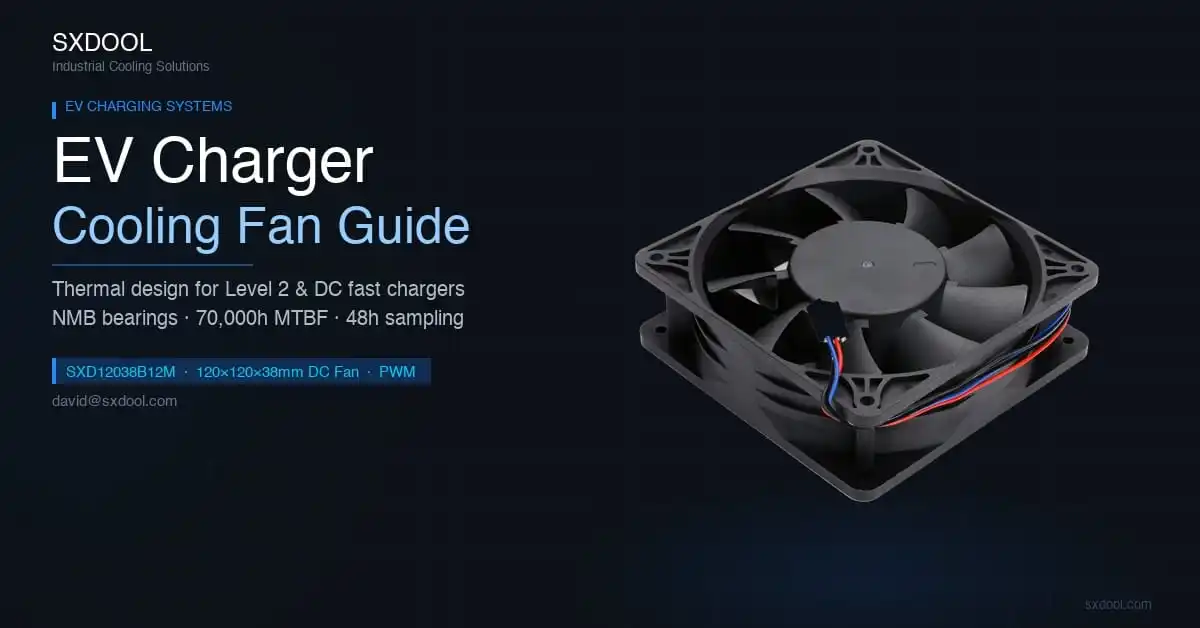
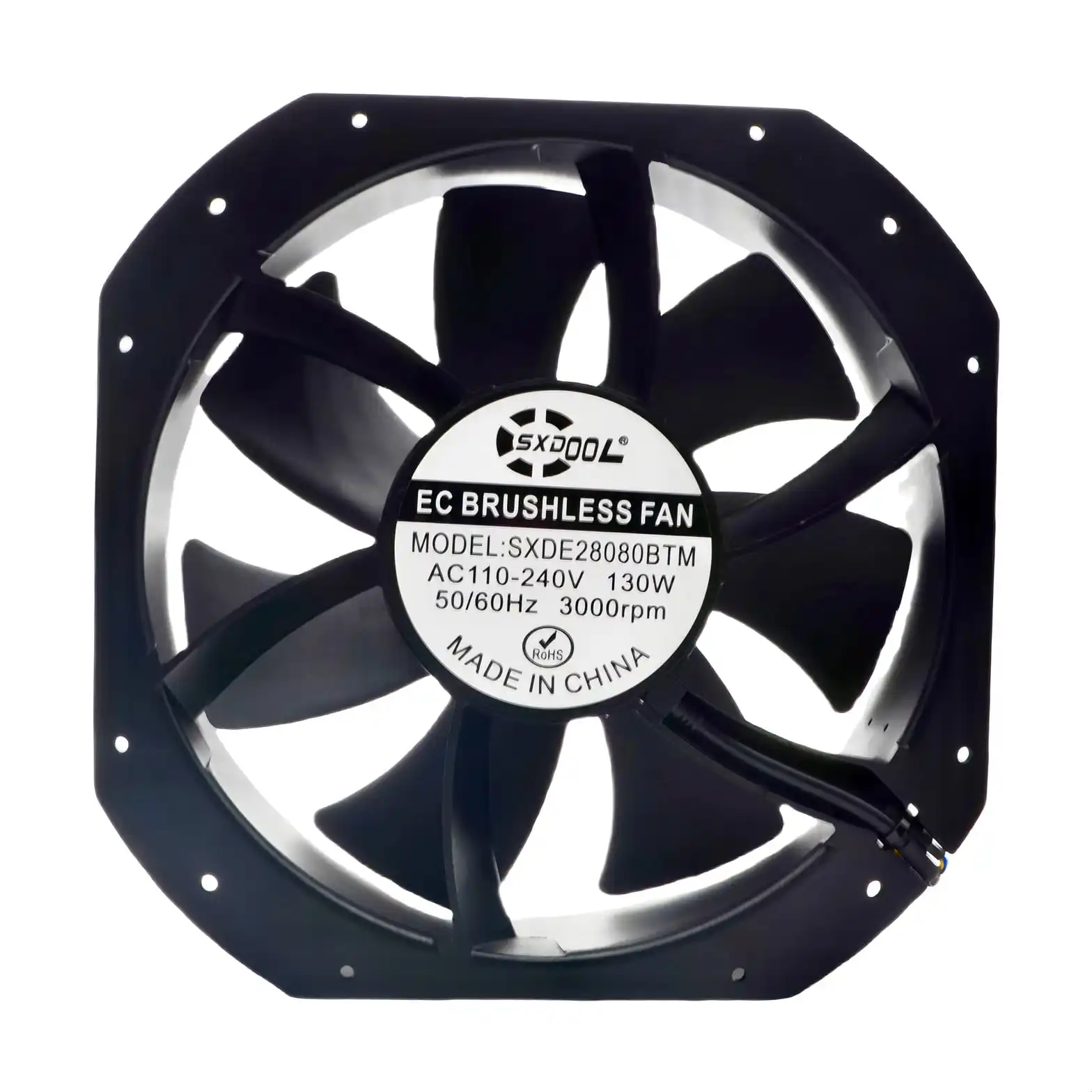
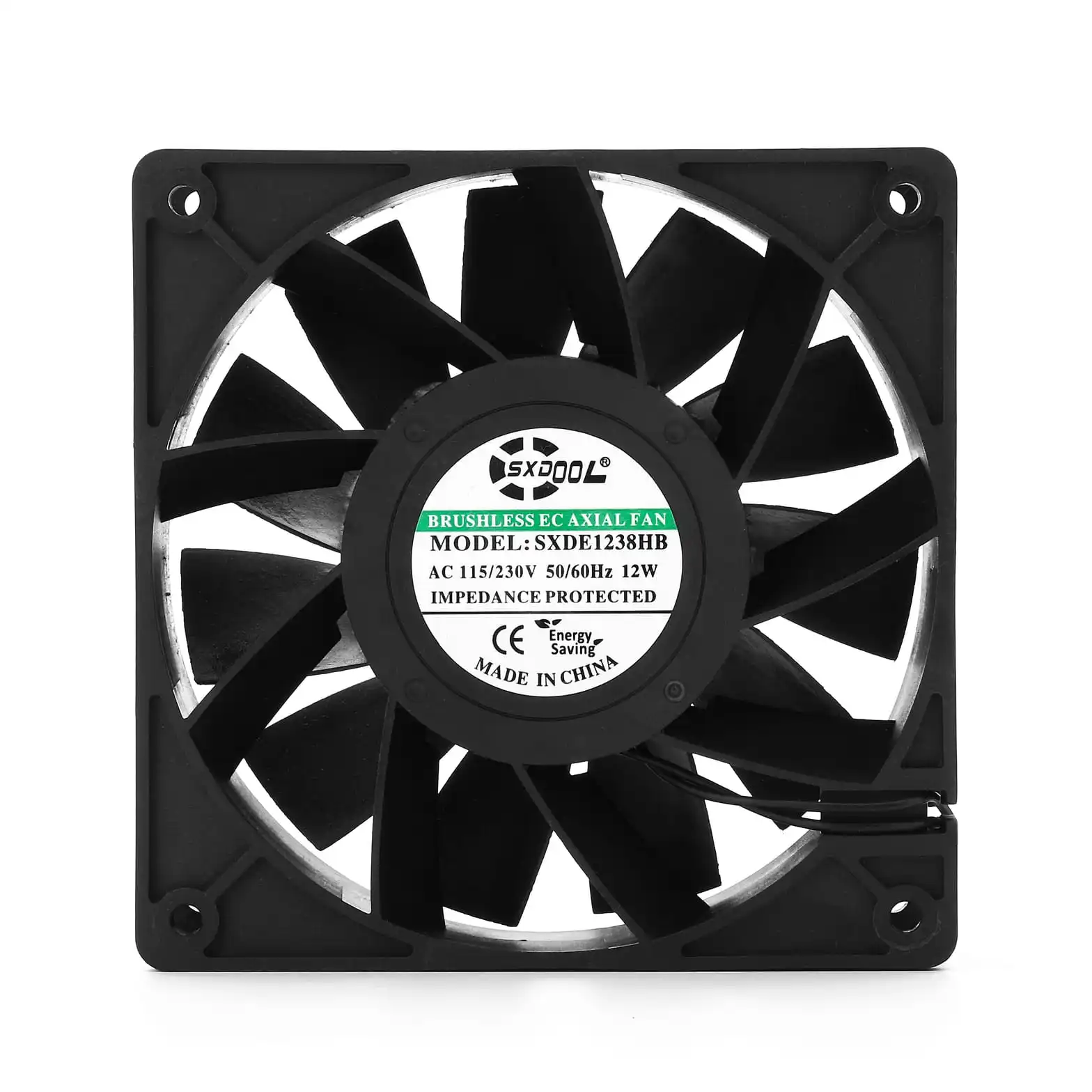
EC fans, or Electronically Commutated fans, combine the best features of AC and DC technology. They connect directly to an AC power source but utilize a brushless DC motor with integrated electronic control. This allows for seamless variable speed control, typically via Pulse Width Modulation (PWM) or a 0-10V signal.
Efficiency Benchmarks
Factually, traditional AC induction motors are notoriously inefficient, often converting 50% or more of their energy input into waste heat rather than mechanical work (airflow). In contrast, SXDOOL’s EC fans achieve efficiency levels of up to 90%. This reduction in energy loss occurs because EC motors use permanent magnets, eliminating the copper losses and slip losses inherent in AC motors. For a multi-gun station running 24/7, these small percentage gains in motor efficiency aggregate into massive annual energy savings.
Internal Components: NMB Bearings and UL94V-0 PBT
At Sensda Electronics (SXDOOL), we believe the motor is only as good as the components that support it. All our EC fans are equipped with precision NMB bearings. These Japanese-engineered bearings are critical for EC fans because they must handle the variable RPM ranges without vibrating or overheating. Furthermore, the housing and impellers are constructed from UL94V-0 rated PBT, ensuring that the fan assembly meets the highest fire safety standards required for high-voltage EVSE (Electric Vehicle Supply Equipment).
The Cost of Ownership: Capex vs. Opex Analysis
For procurement professionals, the initial purchase price (Capex) of an EC fan can be 20% to 40% higher than an equivalent AC fan. However, a narrow focus on Capex ignores the Total Cost of Ownership (TCO). Let’s break down the economics over a 5-year operational lifecycle.
1. Energy Consumption Savings
An average AC fan in a charging station might draw 150W. If it runs at 80% duty cycle, it consumes approximately 1,051 kWh per year. At an industrial rate of $0.12/kWh, that’s $126 per fan per year. An EC fan from SXDOOL, operating at variable speeds based on actual heat load, will typically consume 50% less energy on average. This results in an annual saving of $63 per fan. In a large charging hub with 100 fans, the energy savings alone amount to $6,300 per year.
2. Maintenance and Lifespan
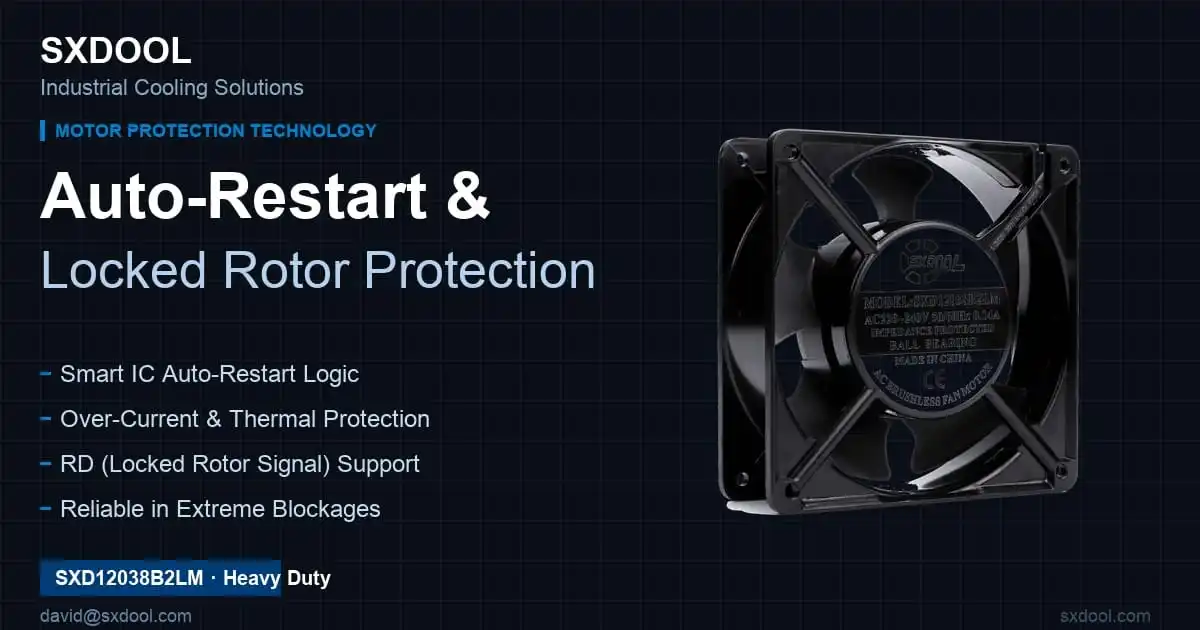
AC motors run hotter due to internal losses, which accelerates the degradation of bearing grease. By contrast, the "cool-running" nature of EC motors, paired with NMB bearings, significantly extends the service life. SXDOOL EC fans are rated for an L10 life of 70,000 to 100,000 hours. A traditional AC fan may require replacement after 30,000 to 40,000 hours in harsh outdoor environments. The cost of a single maintenance visit—truck roll, technician labor, and the replacement unit—often exceeds the initial cost of the fan by five times. By doubling the lifespan, EC fans effectively halve the long-term maintenance budget.
3. Noise Mitigation: The "Invisible" Benefit
Multi-gun charging stations are often located near residential areas, hotels, or shopping centers where noise ordinances are strict. AC fans running at full speed produce a constant high-decibel drone. SXDOOL’s EC fans use PWM control to ramp speed up and down smoothly. By operating at only the necessary speed, noise levels can be reduced by 10-15 dB during off-peak hours. This avoids potential fines and improves the user experience for EV owners.
IP68 Protection: Essential for Reliability
In multi-gun stations, the cooling system is often exposed to the elements. Dust, salt spray (in coastal regions), and heavy rain can easily penetrate a standard fan. SXDOOL’s EC fans feature IP68 rated potting. This vacuum-encapsulation process protects the integrated drive electronics from moisture and corrosive particulates. While an AC fan might survive a season, an IP68-protected EC fan is a "set-and-forget" component that ensures the station remains online during extreme weather events.
Return on Investment (ROI) Modeling
For a typical 4-gun 150kW charger using 4 high-flow cooling fans, the ROI on switching from AC to EC technology is usually realized within 14 to 18 months. Beyond this "breakeven" point, every dollar saved in energy and maintenance contributes directly to the operator’s bottom line. For OEM engineers, specifying SXDOOL EC fans is not just a technical upgrade; it is a financial strategy to increase the profitability of the charging network.
Why Partner with SXDOOL (Sensda Electronics)?
Choosing a fan supplier for EV infrastructure requires more than just looking at a datasheet. It requires an engineering partner who understands the nuances of thermal management in high-voltage environments. SXDOOL brings decades of experience to the table, offering:
- Custom PWM Curves: We can program our EC fans to match the specific thermal profile of your charging station.
- Rigorous Quality Control: Every fan is tested for airflow, static pressure, and electrical efficiency before leaving our facility.
- Global Certification: Our fans are UL, CE, and RoHS compliant, facilitating easier international deployment for our OEM partners.
Conclusion: Future-Proofing Your EV Infrastructure
As the EV market matures, the competition among charging network operators will shift from "who has the most plugs" to "who has the most reliable and efficient service." The thermal management system is the unsung hero of this reliability. By investing in EC fan technology—specifically high-performance models from SXDOOL featuring NMB bearings, IP68 protection, and UL94V-0 materials—engineers and procurement professionals can deliver a superior product that stands the test of time while maximizing operational ROI.
The numbers don't lie: the lower energy consumption, reduced maintenance costs, and superior performance of EC fans make them the only logical choice for the modern multi-gun EV charging station.








0 Comments