

EC Motor Fans vs AC and DC Fans: Energy Savings, Control, and OEM Design Advantages
Electronically commutated (EC) motor fans have been available for over a decade, yet AC axial fans remain the default choice in a surprising number of industrial OEM designs. The reasons are understandable—AC fans are familiar, readily available, and require no additional control circuitry. But for designs that run continuously, ship to multiple markets, or carry EU ErP efficiency mandates, EC fans deliver measurable engineering and financial advantages that AC fans cannot match.
This article provides a technical comparison of EC, AC, and DC fan architectures, with specific focus on OEM applications in EV charging, industrial control, and energy storage.
---
Motor Architecture: How EC Differs from AC and DC
AC induction motors (standard AC fans): Synchronous speed is locked to line frequency (50 or 60 Hz). Speed control requires either thyristor phase cutting (which generates EMI and damages windings) or a separate variable frequency drive. Efficiency peaks at full load; part-load efficiency drops sharply.
DC brushless motors (standard DC fans): Permanent magnet rotor, electronically commutated internally. Efficient and controllable, but require regulated DC power supply. Single-voltage input (5V, 12V, 24V, or 48V). Not suitable for applications powered directly from AC mains without an intermediate PSU.
EC motors: An EC fan combines a permanent magnet brushless DC motor with an integrated AC/DC power conversion and commutation circuit. The result: a motor that accepts AC mains input (any voltage, any frequency) and operates with the efficiency and controllability of a DC brushless motor. No external power supply required. No VFD required.
---
Efficiency Comparison: The Numbers That Drive EU ErP Compliance
The EU's Energy-Related Products (ErP) Directive, extended in 2023 for fans and air-moving equipment, sets minimum motor efficiency requirements that AC induction motors below 2 kW struggle to meet.
Typical efficiency comparison at full load:
| Fan Type | Motor Efficiency (Full Load) | Motor Efficiency (50% Load) | Power Factor | | AC induction | 60–72% | 35–45% | 0.65–0.80 | | DC brushless | 85–92% | 80–88% | N/A (DC input) | | EC motor | 88–94% | 82–90% | >0.95 |
The part-load efficiency advantage is critical for systems that spend significant operating time below full thermal load. A cabinet cooling fan running at 70% duty (nights, low ambient, partial load) consumes 40% less energy over its service life with an EC motor compared to an equivalent AC motor.
Annualized energy savings for a single fan (120mm, 80W AC vs. 55W EC at full load): - 8,760 hours/year × (80W − 55W) = 219 kWh/year/fan - At \$0.15/kWh industrial rate: \$33/year/fan - For a 500-unit EVSE deployment: \$16,500/year in energy savings
---
Single-SKU Global Coverage: The Supply Chain Advantage
Standard AC fans are voltage-specific. A 115 VAC fan for North America is a different part from a 230 VAC fan for Europe. For OEMs shipping hardware globally, this creates: - Doubled SKU count for the same fan function - Separate inventory pools in different regional warehouses - Version control complexity in service parts management - BOM errors when the wrong variant ships
SXDOOL's EC fans operate across 100–264 VAC / 47–63 Hz continuously. A single part number covers: - North America: 120 VAC / 60 Hz ✓ - Europe: 230 VAC / 50 Hz ✓ - Japan: 100 VAC / 50 or 60 Hz ✓ - Middle East/India: 220–240 VAC / 50 Hz ✓ - Industrial 200 VAC delta systems ✓
This eliminates the dual-SKU problem entirely. One procurement BOM line. One qualification. One spare part to stock.
---
Speed Control and System Integration
EC fans accept industry-standard control signals:
0–10V analog speed control: Most common interface for building management systems and industrial PLCs. Fan speed varies linearly with input voltage—0V = minimum, 10V = maximum. Simple to wire, no additional components.
PWM speed control: Compatible with microcontroller and FPGA outputs. Duty cycle commands from 0–100% map to fan speed range. Latency from command to speed change: typically <500 ms.
Tachometer (RPM) output: Frequency signal (2 pulses per revolution) for closed-loop speed monitoring. Essential for applications with fan redundancy alarming.
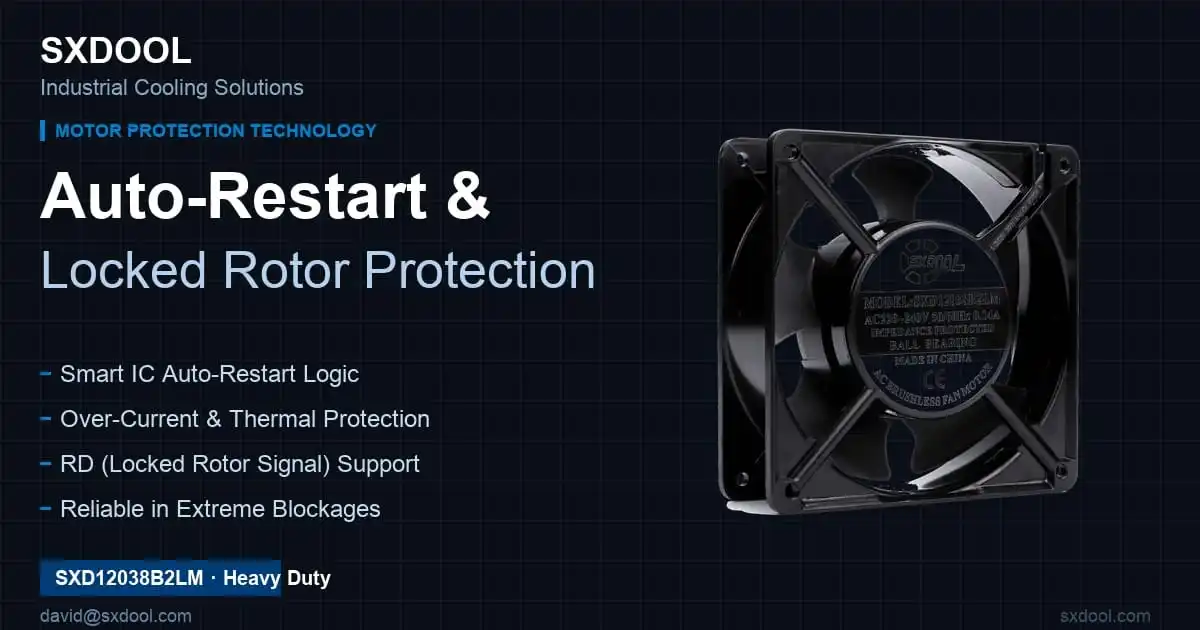
Fan fault (RD) signal: Open-collector output goes low on fan stall or locked rotor. Enables automatic alarm and redundant fan activation in critical cooling applications.
For EV charger and energy storage BMS designs, these control interfaces enable thermally-proportional fan speed control: fans run slowly during low-load conditions (quiet, energy-efficient) and ramp to full speed only when thermal sensors detect elevated temperatures.
Impact on system acoustics: At 70% speed, a fan produces approximately 9 dB(A) less noise than at 100%—a 3x reduction in perceived loudness. For Level 2 EV chargers in residential neighborhoods, this is often a compliance requirement, not just a preference.
---
Reliability Comparison in Continuous-Duty Applications
EC fans typically demonstrate superior field reliability compared to AC fans in continuous-duty industrial applications for two reasons:
1. Reduced thermal stress on windings: EC motor efficiency means less heat dissipated in the motor itself. Lower winding temperature = slower insulation degradation = longer motor life.
2. Smooth commutation: Unlike thyristor-controlled AC fans (which produce current spikes on commutation), EC commutation is electronically managed with current limiting. This reduces mechanical stress on bearings and extends lubricant life.
SXDOOL's SXDE1238MB EC fan achieves an L10 bearing life of 70,000 hours at 40°C—equivalent to 8 years of continuous operation. Comparable AC fans with single ball bearings typically achieve 30,000–50,000 hours under the same conditions.
---
When to Choose AC Instead of EC
EC fans carry a 15–30% unit cost premium over equivalent AC fans. For certain applications, AC remains the correct choice:
- Low duty cycle applications (< 20% runtime): Energy savings do not justify the premium
- Single-market products (no global voltage compatibility needed): AC fans are simpler
- Very low power budgets (sub-30W fans): EC efficiency advantage is less significant at small power levels
- Ultra-high temperature environments (>80°C continuous): Some AC induction motors handle extreme heat better than EC power electronics
For all other industrial, EVSE, medical, and energy storage applications with >4,000 hours/year expected runtime, EC fans deliver superior TCO.
---
SXDOOL EC Fan Portfolio
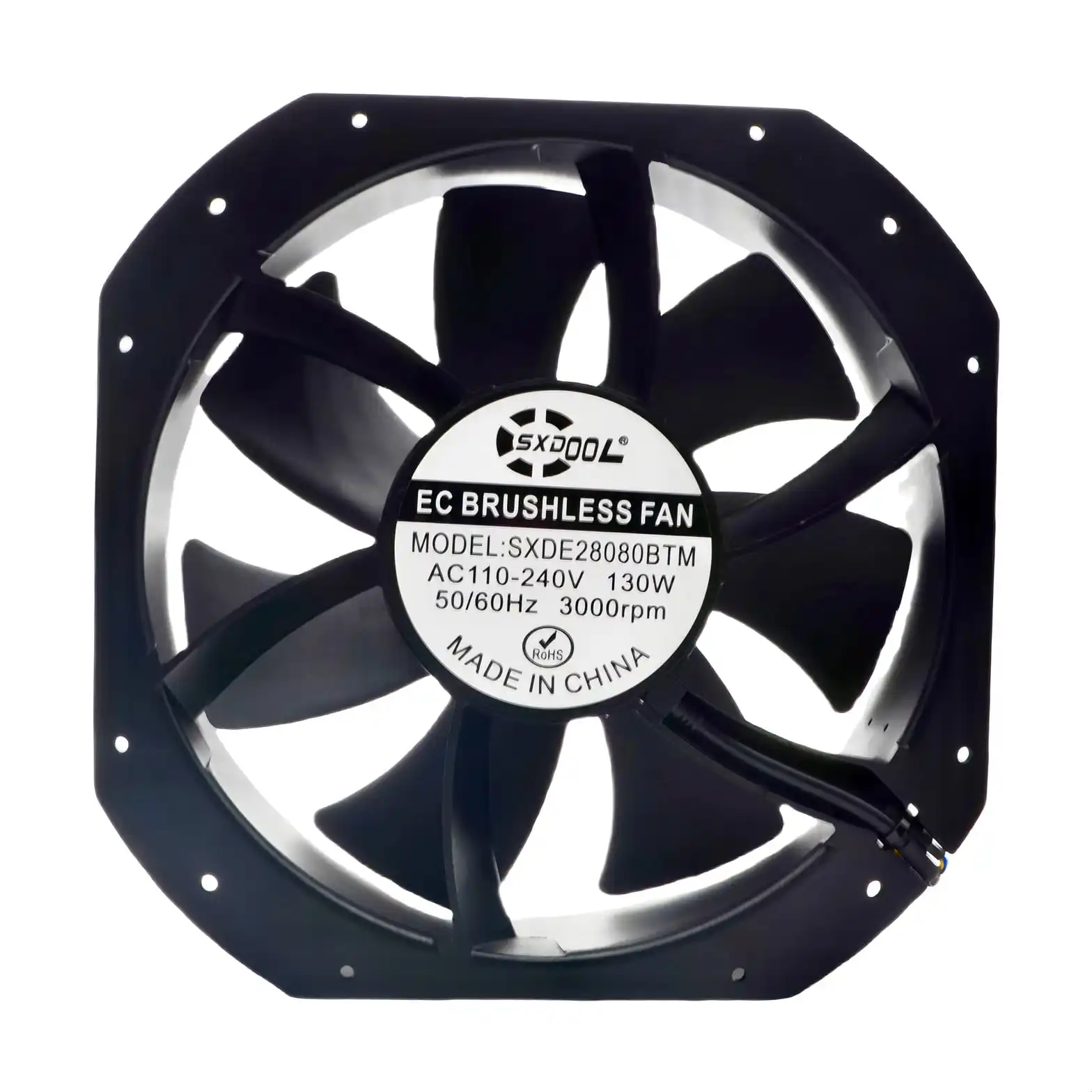
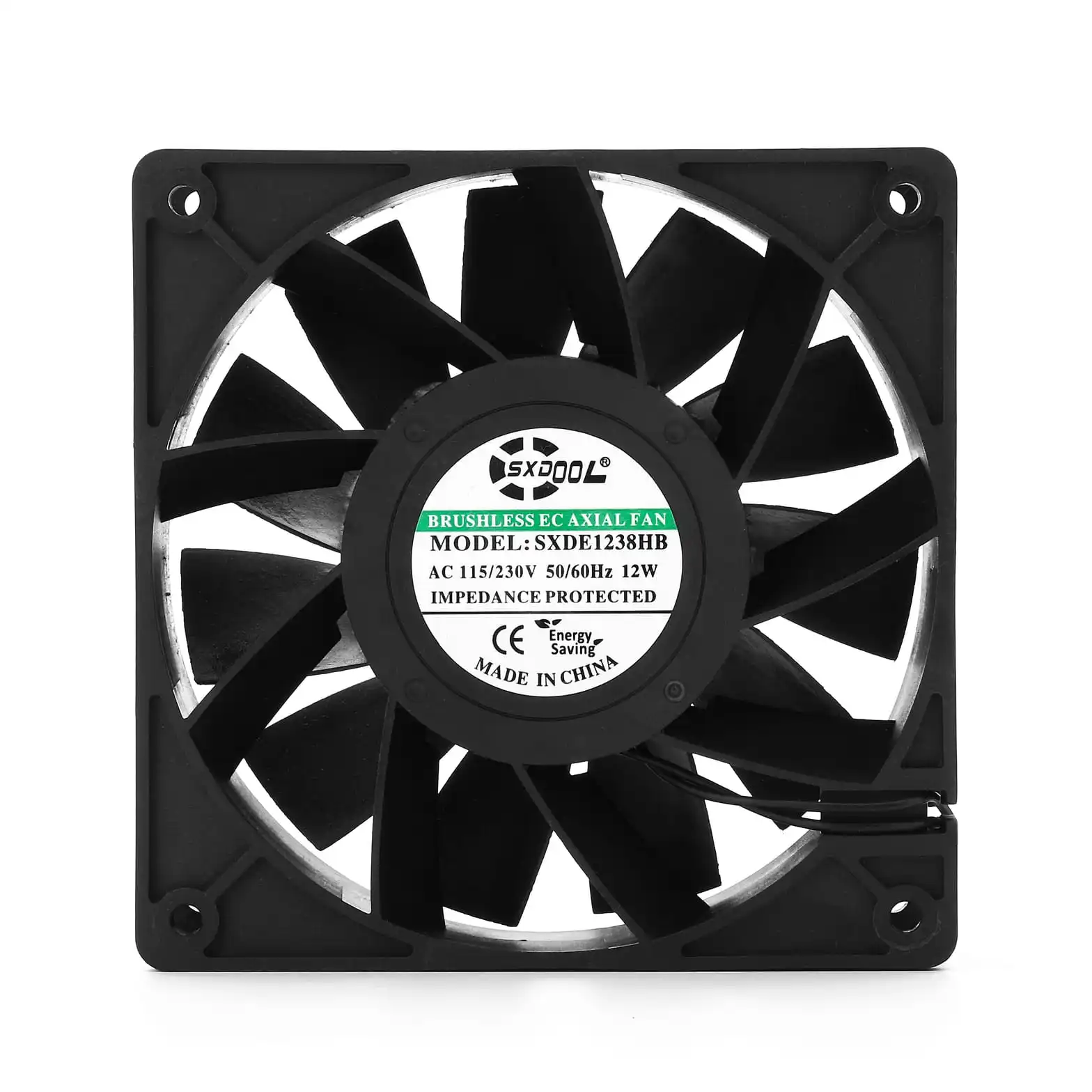
| Model | Size | Input Voltage | Max Airflow | Max Static Pressure | Bearing Life | | SXDE1238MB | 120×120×38mm | 100–264 VAC | 285 CFM | 0.62 inH₂O | 70,000 h | | SXDE28080BTM | 280×280×80mm | 100–264 VAC | 850 CFM | 1.20 inH₂O | 70,000 h |
All models include: - 0–10V / PWM speed control input - Tachometer and RD alarm output - IP68 motor sealing (vacuum-potted windings) - NMB dual ball bearings (Japan) - CE, RoHS 2.0 certification
48-hour engineering sample fast-track available for all standard models.
Contact our engineering team: david@sxdool.com Visit www.sxdool.com | WhatsApp: +86 134 3209 3474








0 Comments